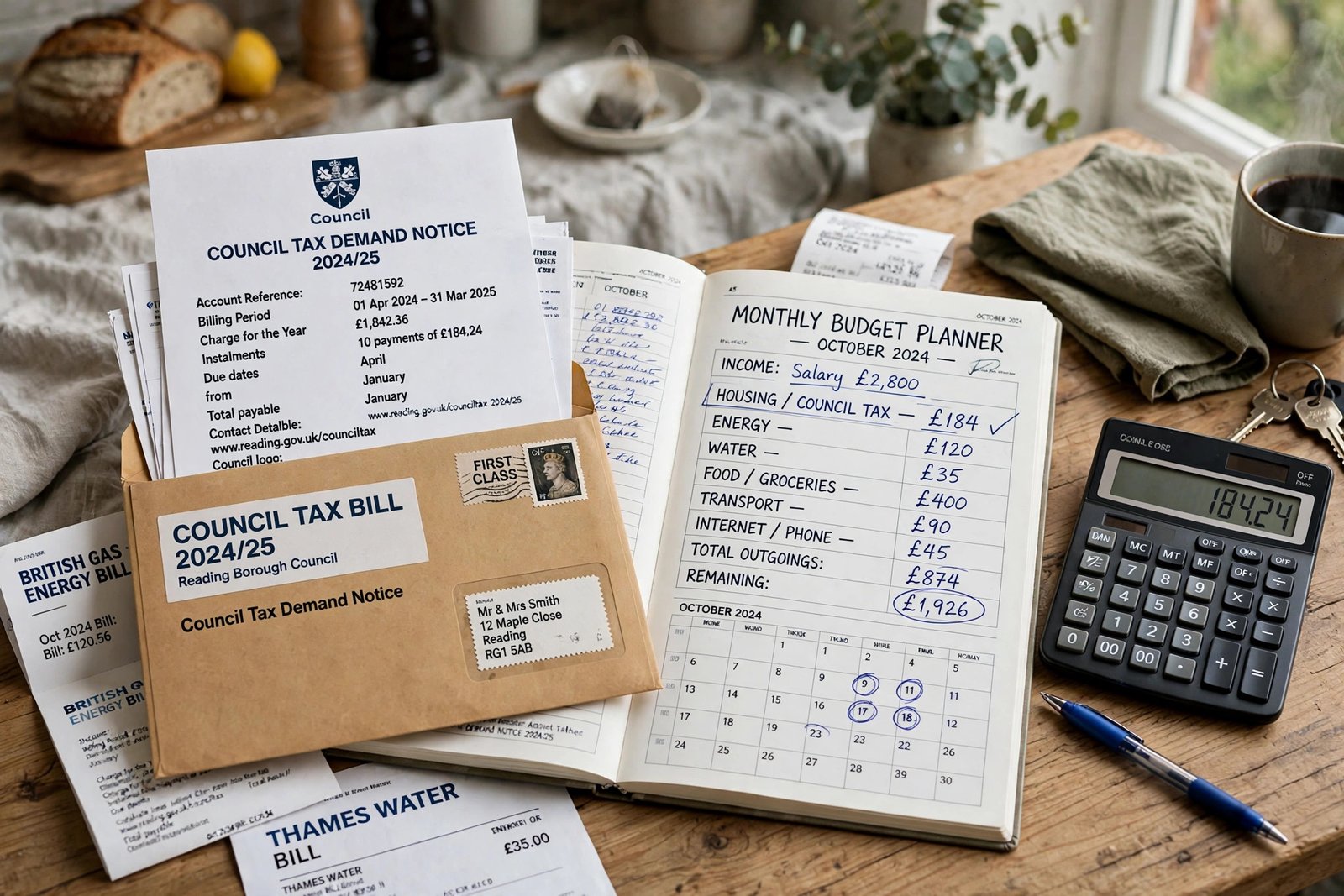
It’s the bill nobody loves and everybody underestimates: council tax. For most UK households it’s the third or fourth biggest monthly outgoing — often £150–£250 a month in England — yet it rarely gets the budgeting attention of the mortgage or the food shop. That’s a mistake, because council tax has quirks that can ambush the unprepared: it isn’t paid in twelve equal monthly instalments by default, bills arrive with increases you didn’t vote for, and getting behind carries some of the sharpest enforcement powers of any household debt. Here’s how council tax actually works and how to build it into your monthly budget without surprises.
How council tax billing really works
Council tax is charged by your local authority based on your property’s valuation band (A–H in England and Scotland, A–I in Wales), set by the Valuation Office Agency. The average Band D bill in England is now around £2,280 a year — but your actual bill depends on your band and your council, with London boroughs often cheapest and some rural/unitary authorities most expensive. Crucially, the default payment schedule is ten monthly instalments (April to January), not twelve — meaning February and March are “free” months, but the other ten are ~20% higher than a twelfth would be. You can request twelve instalments from your council, which smooths budgeting enormously — do it if your cash flow is tight.
Bills also rise most years: councils can increase tax by up to 5% annually (including the adult social care precept) without a referendum. A 5% rise on £2,000 is £100 a year you didn’t plan for. Build a small annual uplift assumption into your budget rather than being surprised every April. The official details are on GOV.UK’s council tax pages.
Discounts and reductions you’re probably missing
Before budgeting the headline figure, check what you don’t have to pay. Single-person discount: 25% off if you’re the only adult in the property — the most commonly claimed and still frequently missed. Student exemptions: full-time students are exempt; a household of only students pays nothing. Disability reductions, empty-property rules, and second-home premiums all affect bills. Council Tax Reduction (formerly Council Tax Benefit): if you’re on a low income or certain benefits, you may get substantial reductions — each council runs its own scheme, so check yours directly; our low-income budgeting guide covers how this interacts with the wider safety net.
Also check your band: an estimated hundreds of thousands of UK homes are in the wrong band, some overpaying for years. If your neighbours in identical properties pay less, challenge your band via the Valuation Office Agency — successful challenges can mean backdated refunds. It’s free to check and free to challenge.
Building it into your monthly budget
Treat council tax as a fixed, non-negotiable outgoing — same category as rent and utilities, not as flexible spending. MoneyHelper’s budget planner tool handles this kind of fixed-bill planning well. Three practical approaches: Monthly accrual: divide the annual bill by 12 and set aside that amount monthly in a bills pot, even in the “free” months — this smooths the ten-instalment lumpiness and builds a buffer for April increases. Twelve-instalment request: ask your council to spread payments across twelve months for perfectly even budgeting. Annual review: every March, when the new bill lands, update the budget line immediately — don’t let the increase silently eat your savings rate.
Where does it sit in priority? Very high. Council tax arrears are “priority debt” — councils can ultimately send bailiffs, deduct from wages or benefits, and in extreme cases seek imprisonment. If you’re choosing between paying council tax and paying a credit card, the council tax wins every time. Anyone juggling priorities should read our weekly food shop cost breakdown to find the flexible spending that can give instead.
Council tax and renters: who’s liable?
Renters are often confused about council tax liability — and confusion here is expensive. The general rule in England: the tenant is liable if the property is their main home under a tenancy of six months or more. For shorter lets, holiday lets or houses in multiple occupation (HMOs), liability often stays with the landlord. In Scotland, similar principles apply with local variations. If you’re moving into a shared house, check the tenancy agreement: joint tenants are usually jointly and severally liable, meaning the council can pursue any one of you for the whole bill if housemates don’t pay — choose housemates’ reliability accordingly. When moving, tell the old council the exact leaving date and register with the new one immediately; gaps and overlaps are the most common source of billing disputes. Students in shared houses with non-students: the students are exempt but the non-students pay the full bill minus any applicable single-person discount — a frequent surprise, so clarify before signing. And renters can claim the same discounts as owners (single-person 25%, Council Tax Reduction) — tenure doesn’t affect eligibility, only liability does.
What happens if you fall behind
This is the part that makes council tax different from other bills. Miss payments and the council can demand the entire year’s balance immediately after two missed instalments. Continued non-payment leads to court summons (adding £80+ in costs), liability orders, then enforcement: bailiffs, attachment of earnings (deductions straight from your wages), deductions from benefits, and ultimately — rarely but really — imprisonment for wilful refusal. No other household bill escalates this fast. The lesson: if you’re struggling, contact the council before you miss payments. They must consider affordable repayment plans, and early contact keeps you out of the enforcement machinery. Citizens Advice and StepChange can negotiate on your behalf for free.
The bottom line
Council tax isn’t just another bill — it’s a large, rising, ten-instalment outgoing with the sharpest enforcement teeth in household finance. Budget for it deliberately: claim every discount, consider twelve instalments, accrue monthly for April increases, and treat it as priority debt above all unsecured borrowing. Do that, and the brown envelope every March becomes a routine line item instead of a nasty surprise. In monthly budget planning, boring predictability is the goal — and council tax, handled properly, is one of the most predictable bills you have.
Frequently Asked Questions
How much is council tax per month in the UK?
It varies by band and council — the average Band D bill in England is around £2,280 a year. Paid over the default ten instalments, that’s about £228 a month; over twelve, about £190.
Can I pay council tax over 12 months instead of 10?
Yes — you have the legal right to request twelve monthly instalments from your council. It smooths budgeting and is worth doing if cash flow is tight.
What discount can I get on council tax?
25% single-person discount is the main one. Full-time students are exempt, and low-income households may qualify for Council Tax Reduction — check your council’s scheme.
What happens if I don’t pay council tax?
After two missed payments the council can demand the full year’s balance, then pursue court action, bailiffs, wage deductions, and in extreme cases imprisonment. Contact the council early if you’re struggling.
How do I check my council tax band?
Search your address on the Valuation Office Agency website (linked from GOV.UK). If similar neighbouring properties are in lower bands, you can challenge yours for free.