You leave for work at eight, return at six, and the maths is unavoidable: your dog is alone for ten hours door to door. So is it safe to leave your dog alone for 8 hours a day? It is the question almost every full-time working dog owner in Britain quietly asks, usually while feeling guilty about the answer. The honest response is nuanced — it depends on the dog, the setup, and what those eight hours actually look like — but there are clear welfare lines that should not be crossed, and plenty of practical ways to make a working day work for your dog.
This guide lays out what animal welfare organisations actually recommend, the risks of long daily absences, how to assess whether your dog is coping, and the realistic alternatives — from dog walkers to daycare — that fit British working life.
What the welfare guidance says
No UK law specifies a maximum number of hours a dog may be left alone, but welfare guidance is consistent: dogs should not regularly be left for more than four hours at a stretch. The RSPCA and other major charities frame it around the dog’s needs — dogs are social animals that need companionship, toilet opportunities, food, water and mental stimulation at appropriate intervals. Eight hours exceeds every major charity’s comfort zone for a daily routine.
The RSPCA’s guidance on leaving dogs alone emphasises that duration is only part of the picture: an eight-hour stretch with a midday break is a different proposition from eight unbroken hours. Puppies, elderly dogs, dogs with separation anxiety, and dogs with medical conditions such as diabetes or urinary issues cope far worse with long absences than healthy, well-adjusted adults.
The real risks of the 8-hour day
Toileting is the most immediate issue. Most healthy adult dogs can physically hold on for eight hours, but “can” is not “should” — regularly pushing bladder limits risks urinary tract infections and genuine distress. Dogs with smaller bladders, older dogs, and those on medications may simply not manage, leading to accidents that are your scheduling failure, not the dog’s.
Beyond the bladder, long daily isolation risks chronic boredom, under-stimulation and loneliness. Dogs that spend every weekday alone commonly develop separation anxiety, destructive chewing, excessive barking (hello, neighbour complaints), and depression-like lethargy. Blue Cross advice on separation anxiety describes how these behaviours often start subtly — pacing, drooling, loss of appetite — months before owners connect them to the alone-time routine.
How to tell if your dog is coping
Dogs rarely file complaints; they show you. Signs your dog is not coping include destruction focused on doors and windows, toileting despite being housetrained, howling or barking that neighbours report, frantic over-greeting when you return, refusal to eat while alone (check with a camera), and injuries to paws or mouth from escape attempts. A pet camera for a week gives you the unvarnished truth — many owners discover their “fine” dog paces for hours.
Conversely, a dog that naps, plays with left-out enrichment, toilets appropriately on a midday break, and greets you calmly is likely coping well. Coping is not binary; it exists on a spectrum, and your job is to keep pushing your setup toward the comfortable end of it.
Making it work: the midday break and enrichment
The single most impactful change is breaking the day in half. A dog walker, a neighbour, a family member, or a lunch-break dash home transforms eight unbroken hours into two manageable four-hour stretches. Professional dog walkers are plentiful across the UK — expect to pay roughly £10 to £18 for a 30 to 60-minute group or solo walk depending on your area. Look for insured walkers with canine first-aid training, and ask for references.
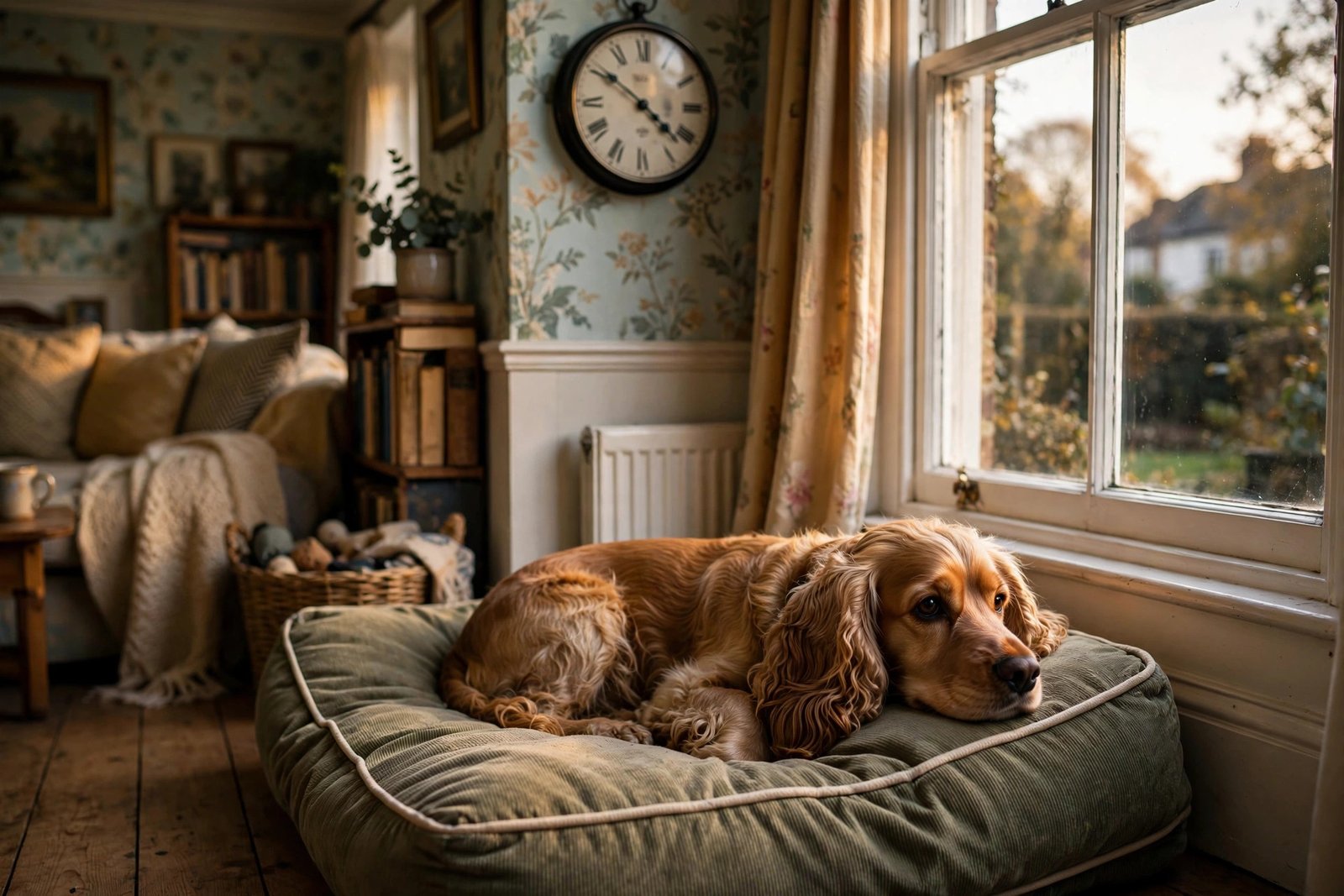
Enrichment fills the remaining hours: frozen Kongs, snuffle mats, lick mats, and puzzle feeders make alone time mentally engaging rather than empty. Rotate them so they stay novel. Leave a radio or television on for background company, ensure fresh water in a spill-proof bowl, and create a comfortable confined area rather than the whole house — many dogs settle better in a smaller, den-like space. Our guide to keeping your house clean when you live with pets includes confinement setups that protect both your dog and your skirting boards.
Bigger alternatives: daycare, work-from-home days, and holidays
For dogs that genuinely struggle, doggy daycare — typically £20 to £40 per day in the UK — provides company, play and supervision. Visit first, check staff ratios and rest provisions, and be wary of chaotic free-for-alls with no downtime. Negotiating even one or two work-from-home days a week with your employer dramatically changes the weekly picture; the pandemic proved most office jobs tolerate it.
And do not forget recovery time: weekends and holidays should be dog-rich. Long walks, training, and adventures together rebalance the weekly ledger. When planning time off, pet-friendly holidays in the UK let your dog share the break rather than enduring another lonely stretch in kennels — the antidote to a year of long weekdays.
Puppies, seniors and special-needs dogs
The eight-hour question has different answers at different life stages. Puppies under six months cannot be left for a working day at all — they need toileting every two to four hours, frequent meals, and near-constant supervision for safe socialisation. If you work full time, a puppy means committing to a sitter, staggered family schedules, or daycare from the start. Senior dogs often need more frequent toilet breaks, medication at set times, and the comfort of company as hearing, sight and confidence fade; long absences hit them hardest emotionally.
Dogs with separation anxiety, recent rescues still settling in, and dogs with conditions like diabetes or epilepsy need tailored plans — sometimes involving adjusted work hours or professional daycare rather than a standard walker visit. The right setup is the one matched to your actual dog, not to an idealised average.
Conclusion
Is it safe to leave your dog alone for 8 hours a day? As a daily, unbroken routine with no midday break — no, not really, and every major welfare organisation would agree. But “working full time” and “good dog owner” are not mutually exclusive. Break the day with a walker, enrich the alone hours, watch honestly for stress signals with a camera, and consider daycare or home-working days if your dog struggles. Dogs are adaptable, forgiving creatures — meet them halfway on the hours, and the guilt you feel at the office can stay where it belongs: unnecessary.
Frequently Asked Questions
Is it illegal to leave a dog alone for 8 hours in the UK?
There is no specific hourly limit in law, but the Animal Welfare Act 2006 requires owners to meet their dogs’ needs, and prolonged isolation causing suffering could breach it. Charities recommend no more than four hours regularly.
Can puppies be left for 8 hours?
No. Young puppies need toileting every couple of hours and cannot be left for a full working day. If you work full time, a puppy requires a sitter, family help or daycare until it is old enough for longer stretches.
How much does a dog walker cost in the UK?
Typically £10 to £18 for a 30 to 60-minute walk, varying by region and whether it is solo or group. Many walkers offer discounted weekly packages for regular midday visits.
Will getting a second dog fix loneliness?
Not reliably — and it can double the problem if the first dog has separation anxiety, which is about attachment to you specifically. Fix the alone-time setup first; consider a second dog only for the right reasons.