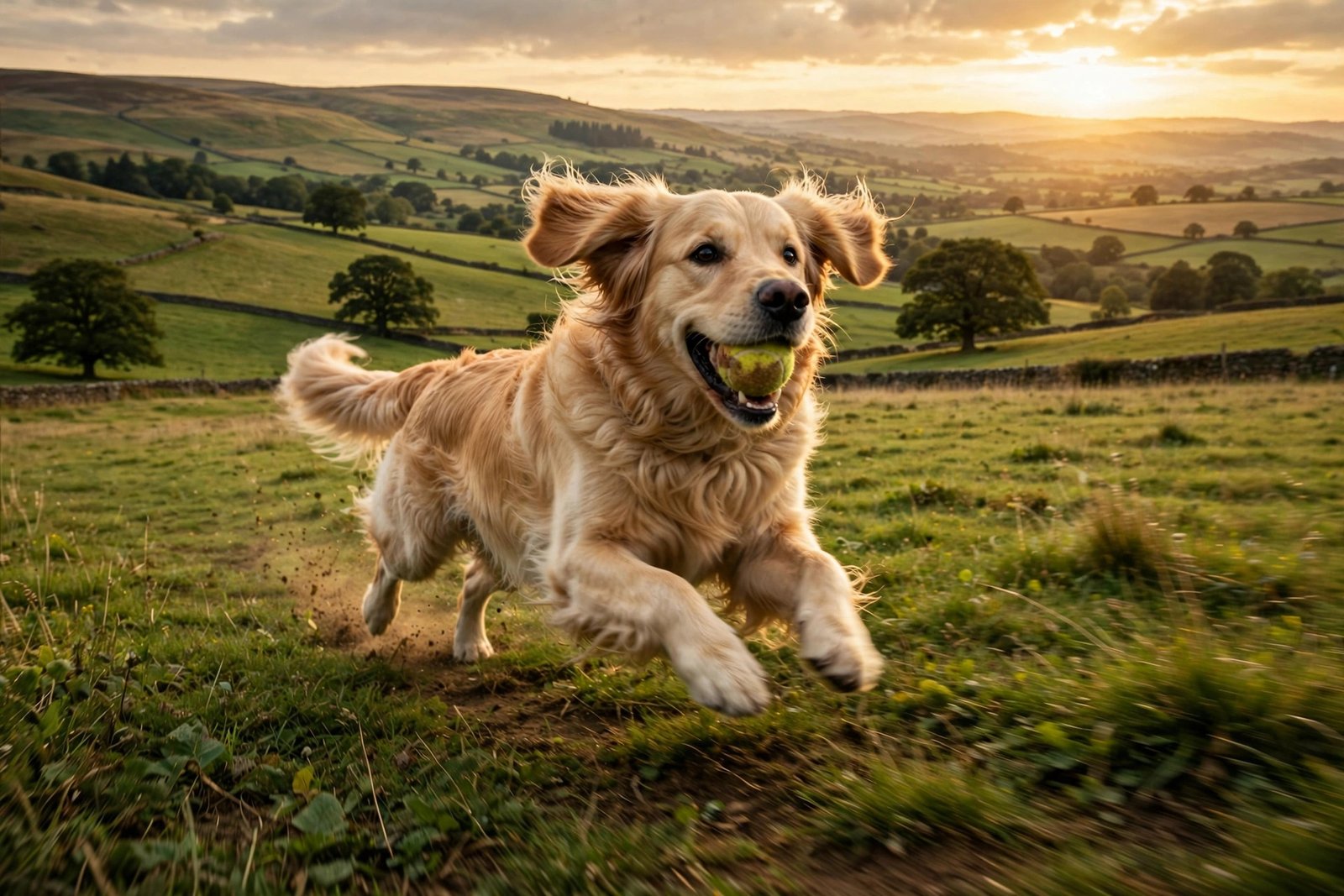
The golden retriever is Britain’s beloved family dog — gentle, goofy, and seemingly powered by an endless battery. But how much exercise does a golden retriever actually need daily? New owners often swing between two extremes: marathon sessions that exhaust a growing puppy, or a quick lap around the block that leaves an adult golden bouncing off the walls. Getting it right matters, because this breed’s sunny temperament depends on having its considerable physical and mental energy properly spent.
This guide gives you honest, age-by-age exercise guidelines for golden retrievers in the UK, explains why mental stimulation counts as much as miles, and shows how to adapt the routine for British weather, puppies, seniors, and everything in between.
The headline number: what adult goldens need
A healthy adult golden retriever typically needs one and a half to two hours of exercise a day, split across two sessions. That is the figure The Kennel Club’s breed guidance for golden retrievers broadly supports for this active gundog breed — they were developed to work all day retrieving game, and that engine does not switch off because they now live in suburbia. One daily walk, however long, rarely cuts it; goldens do far better with a morning outing and an evening one.
But “exercise” does not mean two hours of pavement pounding. Goldens thrive on variety: brisk walks, off-lead running where safe and legal, swimming (most goldens are water-obsessed), retrieving games, and scent work. A 45-minute walk with twenty minutes of fetch and training mixed in tires a golden more thoroughly than a monotonous two-hour march.
Puppies: the five-minute rule and why it matters
Growing golden puppies need protection from their own enthusiasm. The widely used guideline is five minutes of structured exercise per month of age, twice a day — so a four-month-old gets roughly 20 minutes per session. This is not about being precious; rapid growth plus repetitive impact on hard surfaces is linked to joint problems in large breeds, and goldens are already prone to hip and elbow dysplasia.
Free play in the garden does not count toward the limit — self-directed pottering, sniffing and gentle play are fine and healthy. What you are restricting is forced, repetitive exercise: long on-lead marches, extended fetch sessions, stairs, and jumping. PDSA’s puppy exercise advice stresses that mental enrichment — puzzle feeders, short training games, novel safe objects to explore — builds a tired, content puppy without stressing growing joints.
Mental exercise: the forgotten half of the equation
A golden that has walked for two hours but used its brain for none of them will still be restless. These are intelligent working dogs; ten minutes of training, a snuffle mat, a frozen Kong, or a simple “find it” scent game can settle a dog more effectively than an extra mile. Many behaviour problems blamed on “hyperactivity” — counter-surfing, mouthing, destructive chewing — are really under-stimulation problems wearing a different hat.
Build brain work into daily life rather than treating it as extra: ask for a sit before meals, practise recalls on walks, hide treats around the garden, rotate toys weekly so old ones feel new. Gundog-style training clubs, which are plentiful across the UK, are golden-retriever heaven — they channel the breed’s retrieving and scenting instincts into structured fun.
Adapting to British weather and seasons
Goldens are gloriously weatherproof, but UK conditions still need managing. In summer heatwaves, walk early or late, carry water, and watch for overheating — heavy-coated, enthusiastic dogs can overheat faster than owners expect. Wet winter months are fine for goldens (they were bred for Scottish weather, after all) but muddy paws and damp coats need a drying routine to avoid hotspots.
Dark winter evenings call for reflective gear and well-lit routes. This is also the season to discover Britain’s walking riches: from local country parks to the long-distance trails covered in our guide to the UK’s best national parks for first-time hikers, many of which welcome dogs on leads. And if you fancy combining exercise with a break, pet-friendly holidays in the UK with coastal or fell walking on the doorstep are ideal for an active golden.
Seniors and dogs with health conditions
From around eight years old, start adjusting: shorter, more frequent walks rather than long epics; softer surfaces over hard pavements; swimming as a superb low-impact option for arthritic joints. Watch for the signs that exercise needs dialling back — lagging behind, stiffness after rest, reluctance to start — and discuss joint supplements or pain management with your vet rather than simply accepting the slowdown.
Goldens are stoic and eager to please, which means they will overdo it to stay with you. It is your job to be the sensible one: build in rest days after big adventures, keep weight lean (excess weight is brutal on golden joints), and remember that a sniffy twenty-minute potter can be the highlight of a senior dog’s day.
Feeding and weight: the other half of the exercise equation
Exercise and diet are inseparable in goldens, a breed genetically inclined to overweight. An overweight golden needs more exercise to burn the same energy yet can tolerate less of it — the cruel paradox of the chubby retriever. Keep your dog lean enough that you can feel (but not see) the ribs, and adjust food to exercise: bigger adventure days earn slightly bigger dinners, while quiet weeks mean trimming portions. Treats count — training treats, dental chews and the odd bit of toast add up fast in a food-obsessed breed, so measure the daily ration and subtract treat calories from it.
Feed after exercise, not before: vigorous activity on a full stomach increases the risk of gastric dilatation-volvulus (bloat), a life-threatening emergency that deep-chested breeds like goldens are prone to. Wait at least an hour after a big walk before the dinner bowl goes down, and avoid elevated feeding rituals that encourage gulping. A slow-feeder bowl is a cheap, effective investment for the classic golden inhaler.
Conclusion
So, how much exercise does a golden retriever actually need daily? For a healthy adult, think 90 minutes to two hours split across two sessions, generously seasoned with swimming, retrieving, training and sniffing. Scale it right back for puppies, scale it gently down for seniors, and never forget the mental half of the equation. Get the balance right and you unlock the golden retriever’s famous best self: calm in the house, joyful outdoors, and ready for anything — including, let us be honest, eating anything. That part no amount of exercise fixes.
Frequently Asked Questions
Is one long walk a day enough for a golden retriever?
Usually not. Most adult goldens do better with two sessions totalling 90 minutes to two hours. A single walk, however long, leaves them under-stimulated for the rest of the day.
Can I run with my golden retriever?
Yes, once fully grown (around 12 to 18 months). Build distance gradually on soft surfaces, avoid running in heat, and check with your vet first if your dog has any joint history.
How do I tire out my golden without long walks?
Swimming, fetch and retrieving games, scent work, puzzle feeders and short training sessions all exhaust a golden’s brain and body efficiently — ideal for bad weather or busy days.
Do golden retrievers calm down with age?
Most settle noticeably between two and three years old, provided their exercise and mental needs are met. An under-exercised five-year-old golden can still behave like an adolescent.