You bought the beautiful velvet armchair. Your cat looked at the £90 scratching post beside it, stretched, and chose the armchair. If you are asking why your cat keeps scratching the furniture, the answer is refreshingly simple: scratching is not misbehaviour, spite, or a verdict on your interior design. It is one of the most deeply wired feline behaviours there is — as natural as purring. The trick is not to stop your cat scratching, but to make the right surfaces irresistible and the wrong ones unappealing.
This guide unpacks the biology behind scratching, why cats prefer certain furniture, how to choose and position a scratching post your cat will actually use, and the deterrents that work without stressing your cat. No punishment, no declawing (illegal in the UK, as we will explain), just feline psychology applied to your living room.
Why cats scratch: it is not about your sofa
Cats scratch for three overlapping reasons. First, claw maintenance: scratching strips away the dead outer sheath of the claw, keeping the sharp new claw underneath functional. Second, stretching: a good scratch lets a cat extend its back, shoulders and paws after a nap. Third — and most overlooked — communication. Cats have scent glands in their paw pads, so every scratch leaves both a visual mark and a chemical signature saying “I live here.” That is why cats often scratch prominent, socially significant spots: the arm of the chair you sit in, the doorframe everyone walks through.
Understanding this changes the strategy completely. You cannot train out a behaviour that maintains your cat’s body and marks its territory. Cats Protection’s advice on scratching frames it perfectly: the goal is redirection, giving the cat a better outlet for a normal need.
Why your furniture wins over the scratching post
Look at it from the cat’s perspective. Your sofa arm is tall enough for a full stretch, heavy enough not to wobble, positioned in the social heart of the home, and covered in a satisfyingly shreddable weave. The typical cheap scratching post is short, wobbly, tucked in a corner the cat never visits, and wrapped in carpet — a texture many cats dislike. No contest.
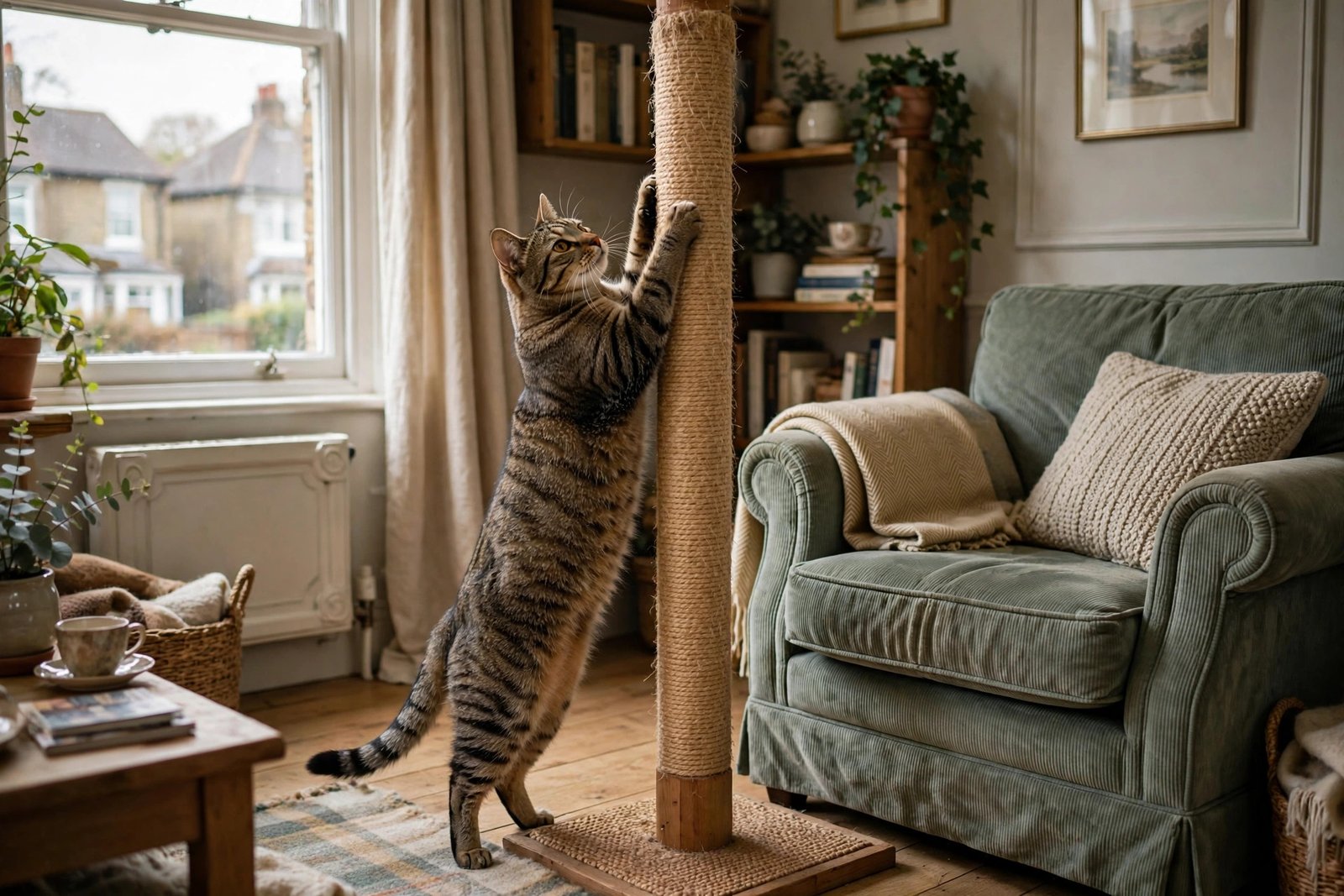
Texture matters enormously. Most cats prefer sisal rope or corrugated cardboard over carpet, because carpet teaches them that carpet-like textures (including your rugs) are acceptable. Stability is non-negotiable: if the post wobbles when the cat leans in, they will never trust it again. And height counts — the post must allow a full vertical stretch, which for an average cat means at least 70 to 80 centimetres of scratchable surface.
Choosing a scratching post your cat will actually use
Invest in one excellent post rather than three flimsy ones. Look for a heavy, wide base, a tall sisal-wrapped column, and ideally a horizontal cardboard scratcher as well, since some cats are dedicated horizontal scratchers. Place the new post directly beside the furniture currently under attack — right beside it, not across the room. You are competing for the same territory, so the alternative must be in the same territory.
Make the post rewarding: rub it with catnip or silvervine, dangle a toy from the top, and praise or treat any interaction with it. Many owners see results within days once the post is correctly chosen and positioned. Covering the targeted furniture arm temporarily with a throw or double-sided sticky tape during the transition removes the reward of the old spot while the new habit forms. For broader strategies on protecting your soft furnishings, our guide to keeping your house clean when you live with pets covers washable throws and pet-friendly fabrics.
Deterrents that work without frightening your cat
The best deterrents make the furniture boring, not scary. Double-sided sticky tape (sold as “sticky paws” strips) on scratched areas works because cats dislike the tacky sensation. Aluminium foil has a similar effect, though it is unsightly — use it as a short-term training aid. A throw or blanket draped over the favoured corner removes the satisfying texture entirely.
What about sprays? Citrus-scented deterrent sprays work for some cats and not others, and they need frequent reapplication. Never use anything that startles or punishes the cat — spray bottles, shouting, or clapping create a cat that scratches when you are not looking and trusts you less. Blue Cross guidance on cat behaviour emphasises that fear-based methods suppress the symptom while the underlying need festers, usually resurfacing elsewhere.
Declawing is illegal in the UK — and here is why that matters
It is worth stating plainly: declawing cats is illegal in England, Scotland and Wales under the Animal Welfare Act 2006, except on narrow veterinary medical grounds. The procedure is not a nail trim — it amputates the last bone of each toe — and it causes chronic pain, behavioural problems and difficulty walking. If a vet, breeder or internet forum ever suggests it, walk away. The legal and ethical position in Britain is unambiguous, and the behavioural solutions in this article work better anyway.
Claw trims and flooring: the supporting cast
Regular claw trims — every two to three weeks, taking just the sharp tip — reduce the damage potential of any scratching dramatically. If you are nervous, ask your vet nurse to demonstrate; most practices offer quick, inexpensive trim appointments. In multi-cat or enthusiastic-scratcher households, flooring choice helps too: our roundup of low-maintenance flooring for busy households includes options that stand up to claws far better than delicate weaves.
Indoor versus outdoor cats: does access change scratching?
Outdoor cats scratch trees, fences and garden furniture, which satisfies the urge naturally — but they still scratch indoors, because indoor scratching is about marking home territory specifically. Do not assume garden access solves furniture scratching; the sofa is prime social real estate no tree can replace. Indoor-only cats, meanwhile, need more scratching outlets, not fewer: provide at least two posts in different rooms, plus a horizontal cardboard scratcher, since the entire territory is indoors. Flat-dwelling cats in particular benefit from a tall floor-to-ceiling scratcher that doubles as a climbing frame, satisfying stretching, claw care and exercise in one.
Conclusion
Your cat is not destroying your furniture to annoy you; they are maintaining their claws, stretching their body and signing their name on their home. Once you see scratching as a need rather than naughtiness, the solution becomes obvious: provide a tall, stable, well-placed sisal post, make the sofa temporarily unappealing, and reward every good choice. Most cats redirect within a fortnight when the alternative is genuinely better. Your armchair survives, your cat stays happy and unstressed, and the only scratching you hear is the satisfying rasp of sisal — exactly as nature intended.
Frequently Asked Questions
Why does my cat scratch furniture even though it has a post?
Usually the post is too short, wobbly, badly positioned, or wrapped in an unappealing texture. Upgrade to a tall, stable sisal post placed right next to the scratched furniture, and most cats switch voluntarily.
Will my cat stop scratching if I punish it?
No — punishment teaches the cat to scratch when you are not watching and damages your relationship. Redirection to an appealing post plus making furniture temporarily unattractive works far better.
Is it cruel to trim my cat’s claws?
Not at all, provided you only trim the sharp tip and avoid the pink quick inside the nail. Regular trims are painless and reduce scratch damage; your vet nurse can show you the technique.
Does neutering stop scratching?
Neutering reduces territorial urine-marking but has little effect on scratching, which serves claw maintenance and stretching as well as marking. Even neutered cats need a good scratching outlet.