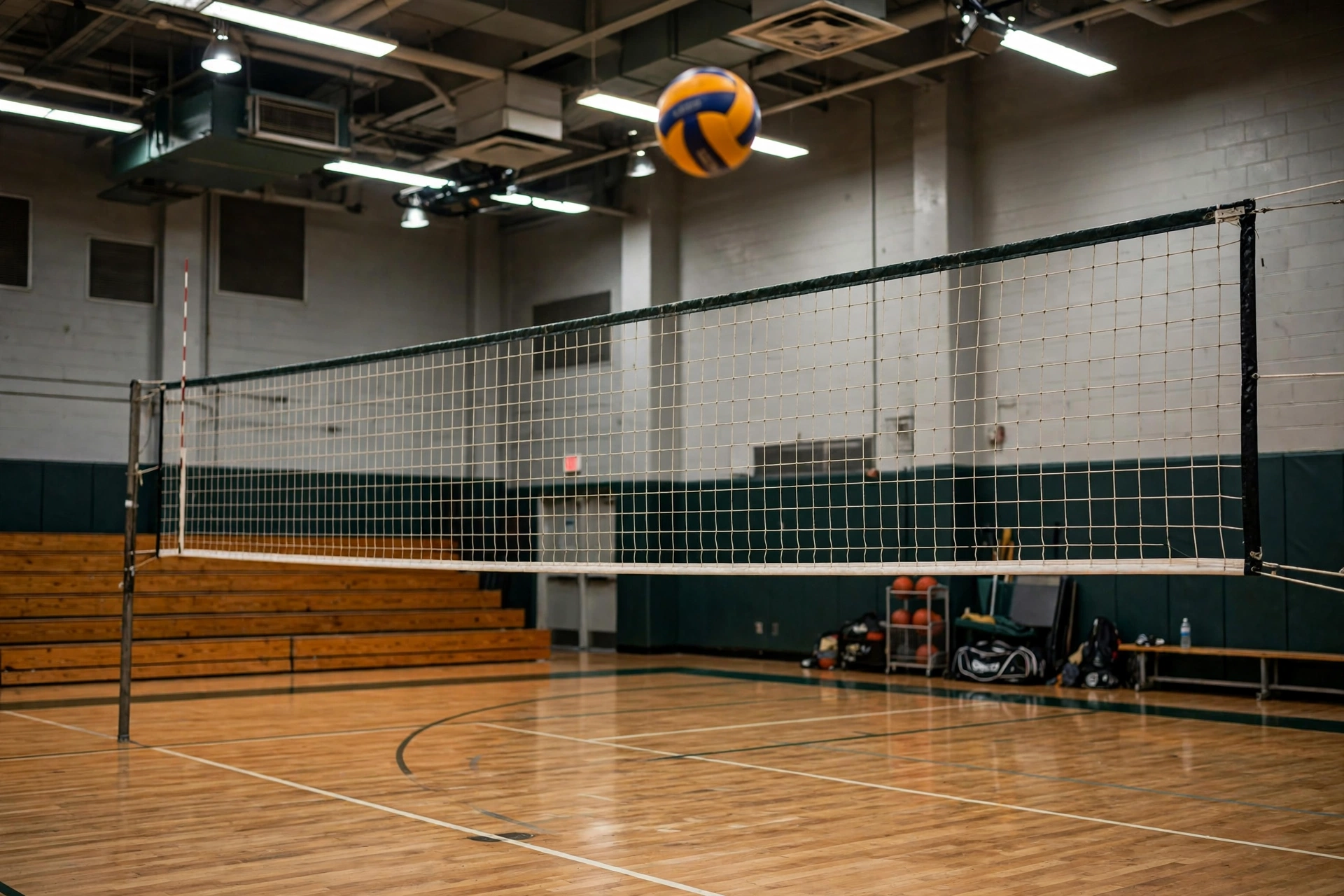
How tall is a men’s volleyball net? The official answer is 2.43 metres (about 7 feet 11⅝ inches), measured at the centre of the net. That single number governs everything from Olympic finals to your local league night — but it is only part of the story. Women’s, junior, sitting and beach volleyball all use different heights, and even a few centimetres of sag or mis-measurement can change how the game plays.
This guide gives you every official net height, explains how the measurement is actually taken, shows you how to set a net up correctly, and covers what UK players and clubs need to know.
The Official Men’s Net Height: 2.43 Metres
The Fédération Internationale de Volleyball (FIVB) — the sport’s world governing body — sets the men’s indoor net height at 2.43 metres, measured from the playing surface to the top of the net at its centre. The measurement is taken at the centre because nets naturally sag slightly; the rules allow the net to be up to 2 cm higher at the sidelines than at the centre, which keeps the playing surface fair across its full width.
For reference, 2.43 metres converts to 7 feet, 11 and ⅝ inches. If your net system uses imperial markings, that is the number to look for. The FIVB official volleyball rules are the ultimate authority on this and every other dimension of the court.
Full Net Height Table: Men, Women, Juniors and More
Here are the standard heights you are most likely to come across:
Men’s indoor (senior): 2.43 m. Women’s indoor (senior): 2.24 m. Boys’ under-19: 2.43 m (same as senior men). Boys’ under-17: 2.24 m. Girls’ under-18: 2.24 m (same as senior women). Girls’ under-16: 2.20 m. Mixed recreational / co-ed: often 2.35–2.38 m as a compromise, though this is a convention rather than an official standard. Sitting volleyball (men): 1.15 m. Sitting volleyball (women): 1.05 m. Beach volleyball: 2.43 m for men and 2.24 m for women — identical to the indoor game.
Junior heights vary slightly between national federations, so if you coach a youth team, check your competition’s specific regulations rather than assuming.
How the Height Is Measured
Getting the measurement right matters more than most casual players realise. The correct procedure is:
Measure from the floor (or sand) to the top of the net tape at the centre of the court. The net itself is 1 metre deep, made of 10 cm square mesh, with a white canvas band 5–7 cm wide along the top. Two antennae — flexible rods 1.8 m long — are fastened to the outer edges of the side bands, marking the crossing space over the sidelines.
A proper net gauge or a rigid tape measure is better than a soft tailor’s tape, which can stretch. Measure after tensioning the net, not before, because tightening the side straps and top cable pulls the centre down slightly. Many experienced referees measure twice: once during setup and once just before the first serve.
Setting Up a Net at the Correct Height
Step 1 – Position the posts
Posts sit 0.5 to 1 metre outside the sidelines (the exact distance depends on your system). Make sure they are vertical — a leaning post throws the whole geometry off and makes accurate height measurement impossible.
Step 2 – Attach and roughly tension the net
Hang the net on the top cable or strap, centre it over the court, and attach the side straps. Pull the top reasonably taut but leave the fine adjustment for the next step.
Step 3 – Set the centre height first
Adjust the winch or strap mechanism until the top of the net at the centre reads exactly 2.43 m for a men’s game. Only then check the height at the sidelines, which should be no more than 2 cm higher.
Step 4 – Tension the bottom and sides
Tighten the bottom rope so the net hangs flat and does not billow. A loose net absorbs the ball’s energy and makes judging touches harder. Re-check the centre height after tensioning, since pulling the net tight often changes it.
Step 5 – Fit the antennae and padding
Slide the antennae into their pockets on the side bands so they extend 80 cm above the net, and fit post padding for player safety — this is mandatory in most organised competitions.
Why the Height Matters So Much
Net height shapes the entire character of the game. At 2.43 m, the average male club player can attack effectively but must work for it — the height rewards good approach footwork, timing and vertical jump rather than raw size alone. Lower the net by even 10 cm and the balance tips dramatically: hitting becomes far easier, blocking becomes far harder, and rallies get shorter.
That is also why the women’s height of 2.24 m is not simply “lower because players are shorter” — it is calibrated so the women’s game has the same attacking-blocking balance as the men’s game. The same logic sits behind every junior and sitting-volleyball height: each is tuned to the athletes playing at it.
For players, knowing the exact height helps set realistic training goals. If you want to spike effectively in the men’s game, you need a touch height comfortably above 2.43 m — which means working on your jump, your approach and your timing. Ball tracking matters too, and the same visual skills that help in volleyball transfer to other court sports — see our tips on improving your vision and ball tracking in basketball for drills you can adapt.
Common Net Setup Mistakes
Measuring at the sideline instead of the centre. The official height is a centre measurement. A net that reads 2.43 m at the post will sag below the legal height in the middle.
Forgetting re-checks. Nets stretch during a match, especially new ones. In tournaments, referees re-check height between sets — a good habit for league play too.
Uneven tension. A net that is tight on one side and loose on the other plays inconsistently and looks unprofessional. Tension both sides evenly.
Wrong height for the competition. Turning up with the net at men’s height for a women’s fixture (or vice versa) is an embarrassing and easily avoided error. Confirm the required height before you leave for the venue.
Buying a Volleyball Net in the UK
If you are equipping a club, school or garden setup, look for a net system with adjustable height settings marked in both metric and imperial. A good club system lets you switch between 2.43 m, 2.24 m and junior heights in minutes, which is essential if the same hall hosts men’s, women’s and youth sessions.
Key things to check: a proper winch or ratchet tensioning system (cheap strap-only systems sag), sturdy posts with floor sockets or weighted bases, and included antennae and post padding. For outdoor or beach use, choose weather-resistant materials — salt air and UV light destroy cheap nets quickly.
Clubs affiliated to Volleyball England can get guidance on approved equipment and competition regulations, which is worth checking before spending club funds.
Volleyball in the UK: Where to Play
Volleyball has a growing footprint in Britain, with national leagues, university competitions and a lively beach volleyball scene each summer. Most clubs welcome beginners and run sessions at multiple levels, so you do not need to be clearing 2.43 m on day one — many newcomers start in mixed recreational sessions before trying structured league play.
If you are picking up new sports more broadly, technique-focused practice pays off everywhere. Players who enjoy refining their skills often branch out — our guide to improving your disc golf accuracy covers the same kind of deliberate, mechanics-first practice that sharpens a volleyball spike.
FAQs
How tall is a men’s volleyball net in feet? 2.43 metres is 7 feet 11⅝ inches — often rounded to “just under 8 feet”.
Is the beach volleyball net the same height? Yes — 2.43 m for men and 2.24 m for women, identical to indoor.
How tall is a youth volleyball net? It depends on the age group: boys’ under-17 and girls’ under-18 play at 2.24 m, while younger groups play lower. Always check your competition’s rules.
Can the net be slightly higher at the sides? Yes — the rules permit the net to sit up to 2 cm higher at the sidelines than at the centre.
Final Thoughts
A men’s volleyball net stands 2.43 metres at the centre — a number set by the FIVB and used from the Olympics down to local league halls. Measure at the centre, tension the net properly, re-check it during play, and make sure you are using the right height for your competition. Get those basics right and the net becomes one less thing to think about, leaving you free to focus on the game itself.