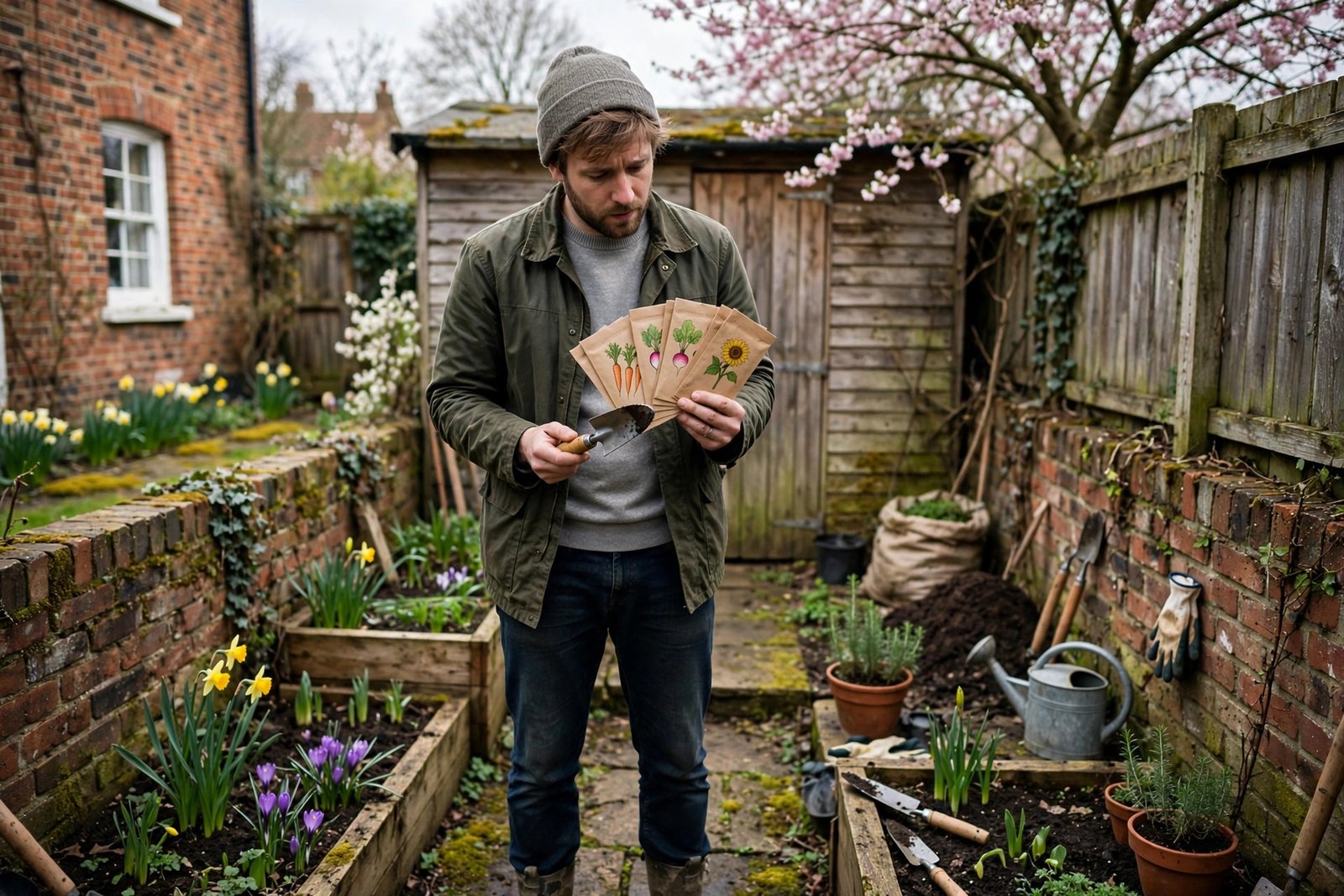
You have never grown anything. Not a cactus, not a windowsill basil — nothing. The gardening world seems to speak a foreign language of “chitting” and “earthing up” and “last frost dates”, and every guide assumes knowledge you do not have. This guide assumes nothing. If you are a total beginner in Britain wondering how do I start a vegetable garden as a total beginner in britain, here is your first 30 days: the absolute minimum you need to buy, the foolproof first planting, and a week-by-week plan that takes you from zero to your first harvest without overwhelm, jargon or failure.
Day 1: the £30 starter kit (nothing more)
Beginner gardening fails at the garden centre, where enthusiasm buys £200 of kit for a hobby that does not exist yet. You need five things. A bag of peat-free multipurpose compost (£7) — the growing medium for everything. A packet of mixed salad leaves (£2.50) — the fastest, most forgiving crop in existence. A packet of radish seeds (£2) — ready in a month, the instant gratification that hooks beginners. A hand trowel (£5) — the only tool that matters at this stage. Containers — and here is the secret: you do not need to buy them. Washing-up bowls, buckets, old storage boxes with drainage holes drilled in: anything 20cm+ deep works. Total: under £30, and the only “garden” you need is a sunny windowsill, balcony or doorstep.
Do not buy: a greenhouse, raised beds, a rotavator, fertilisers, or twenty seed packets. Every experienced gardener’s shed is full of beginner over-purchases. Start with the £30 kit; let the hobby earn its upgrades. The RHS beginner growing guides confirm this minimalism — their advice to new gardeners starts with containers and salads, not allotments.
Week 1: sow your first seeds (15 minutes)
Fill your containers with compost to 3cm below the rim, water it, and sow salad leaves: sprinkle seeds thinly on the surface, cover with 1cm of compost, water gently, and put the container in the sunniest spot you have. Do the same with radishes in a second container, sowing them 2cm deep and 3cm apart. Label both with the date (a marker on masking tape — future you will thank present you). Then walk away. That is the whole job: 15 minutes, two containers, done.
Now learn the only daily habit: the finger test. Push your finger 2cm into the compost each morning — dry means water, damp means leave it. Overwatering kills more beginner plants than underwatering, and the finger test prevents both. Seedlings appear in 5–10 days; the moment of the first green shoots is the moment most beginners become gardeners for life. If you want company on the journey, our indoor plant guide covers the houseplant side of the same beginner skills.
What “germination” actually looks like
Seeds do not need light to germinate — they need moisture and warmth (15–20°C, i.e. a normal British home). The compost should be damp like a wrung sponge, never soggy. If nothing appears after two weeks, the seeds were probably too cold or drowned — sow again; seeds are cheap and every gardener re-sows. Failure at this stage is data, not defeat.
Week 2–3: thin, water, watch
Your seedlings are up — crowded, leggy, competing. Now the hardest beginner lesson: thinning. Pull out the weakest seedlings so the strongest have space (salads: 5cm apart; radishes: 3cm apart). It feels like murder. It is mercy — crowded seedlings grow into nothing, spaced seedlings grow into salads. Keep up the finger test, water in the morning, and rotate containers occasionally so growth is even.
This is also the week to start a second sowing of salad leaves — the “little and often” principle that gives continuous harvests instead of one glut. And observe: which container dries fastest? Which gets the most sun? You are learning your microclimate without studying — the knowledge accumulates through attention, not textbooks. The Garden Organic beginner resources reinforce this learn-by-doing approach.
Week 4: your first harvest (and what is next)
Radishes are ready about a month after sowing — pull the biggest, twist off the tops, wash and eat. They will be peppery, crisp and unreasonably satisfying. Salad leaves are cut-and-come-again: snip the outer leaves with scissors, leaving the centre to regrow, and the same plants produce for weeks. You have now completed the full cycle — sow, grow, harvest, eat — in 30 days, for £30, with zero prior knowledge. Everything else in gardening is a variation on this loop.
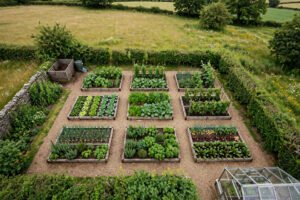
What is next depends on what hooked you. Loved the speed? Sow more salads, try spring onions and beetroot. Want bigger things? A 30-litre pot grows a tomato plant or three potato tubers. Caught the bug properly? Now — and only now — is the time for raised beds, and our small garden plant guide maps the expansion. The 30-day container start was never the destination; it was the proof that you can do this. The allotment, the greenhouse, the prize marrows — they all start with a washing-up bowl of radishes.
Your free mentors: learning from other beginners
You do not have to learn alone. Britain has a huge, welcoming beginner-gardening community: local allotment open days (plot-holders love showing beginners around), community gardens in most towns (volunteer for a morning and learn more than any book teaches), and enormous online communities where no question is too basic. Garden centres run free workshops in spring. But the best mentor is the neighbour with the vegetable patch — gardeners are famously generous with advice, spare seedlings and strong opinions about compost. Ask.
The beginner’s mindset: permission to fail
Some seeds will not germinate. Some seedlings will damp off. A slug will eat something you loved. This is not failure — it is the tuition fee, and every gardener pays it. The gardeners with the best plots are not the ones who never failed; they are the ones who kept sowing. Keep notes (what, when, what happened), celebrate every harvest however small, and remember the fundamental truth: plants want to grow. Your job is mostly to provide the conditions and get out of the way. Thirty days ago you had never grown anything. Now you are eating your own radishes. That is not a small thing — that is the whole thing.
Frequently Asked Questions
I have never grown anything — where do I start?
Two containers, compost, salad leaves and radish seeds — under £30 total. Sow, water with the finger test, harvest in 30 days. The full cycle teaches everything; expansion comes later.
What is the easiest vegetable for a total beginner?
Radishes (ready in a month, nearly foolproof) and cut-and-come-again salad leaves (continuous harvests from one sowing). Both grow in any 20cm-deep container.
Do I need a garden to grow vegetables?
No — a sunny windowsill, balcony or doorstep grows salads, radishes, herbs and more in containers. Start where you are; the garden can come later.
How often should I water seedlings?
Use the finger test: push 2cm into the compost each morning — water if dry, leave if damp. Overwatering kills more beginner plants than underwatering.
What if my seeds do not germinate?
Sow again — seeds are cheap and every gardener re-sows. Common causes: too cold, too wet, or sown too deep. Failure is data, not defeat.