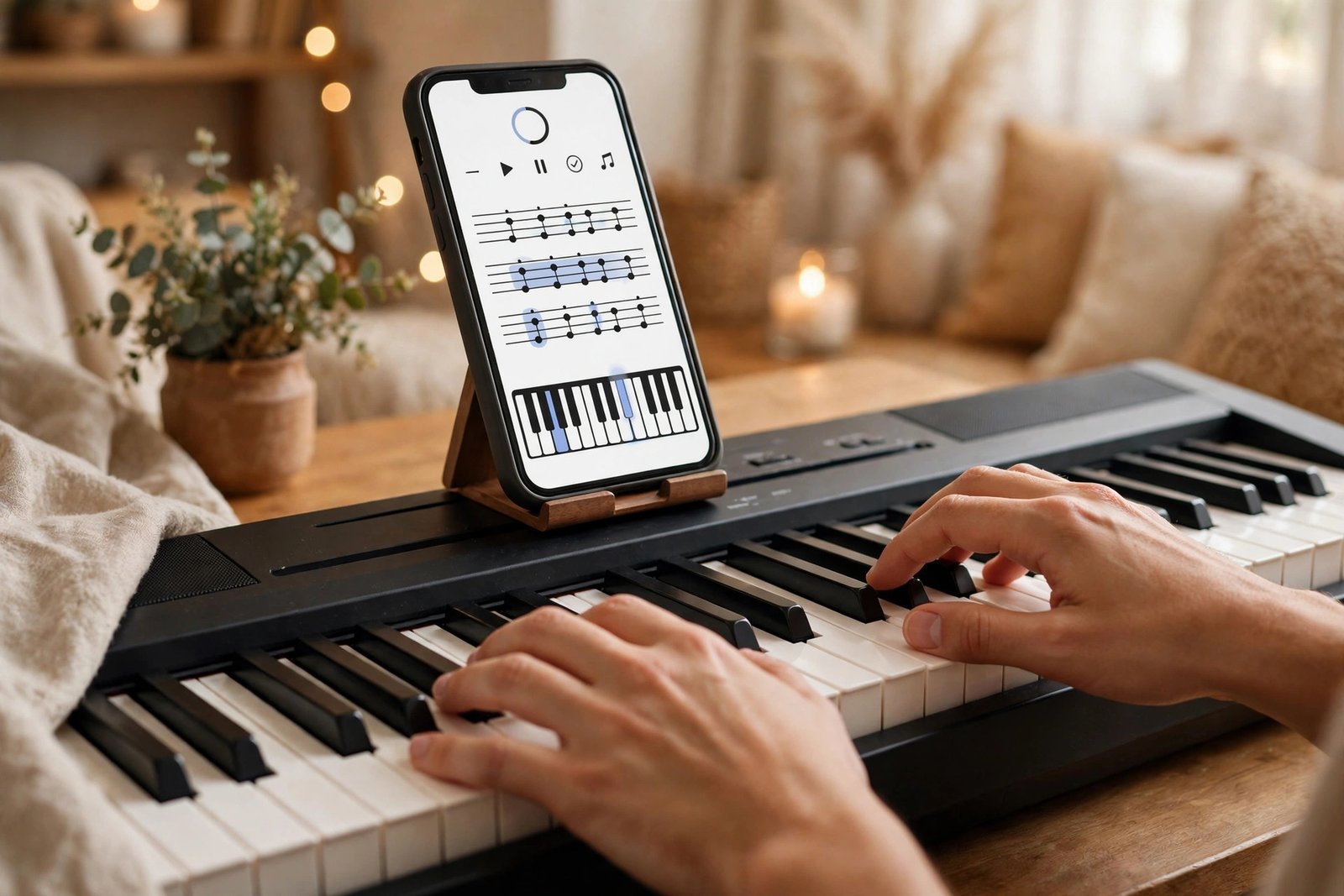
Learning piano as an adult in Britain used to mean one route: find a teacher, pay £30–£40 an hour, practise scales alone all week. In 2026, your phone is a surprisingly capable piano tutor — listening to your playing through the microphone, correcting your timing in real time, and gamifying the grind of practice into something you’ll actually do daily. Free piano apps won’t replace a good teacher entirely, but they’re the best £0 starting point the instrument has ever had. Here’s which free apps are actually worth your time, what they can and can’t teach, and how to combine them into a practice routine that works.
What free piano apps do well (and where they fall short)
The honest framing first. Apps excel at the mechanical foundations: note reading, rhythm, finger coordination, and the sheer repetition that builds muscle memory. Their real-time feedback — hearing you played the wrong note instantly — is something books and YouTube can’t offer. Where they fall short: technique (no app can see your wrist tension or hand position), musicality (phrasing, dynamics, interpretation), and accountability (it’s easy to skip a day when the teacher isn’t coming on Thursday). The winning formula for most adult learners: a free app for daily practice and fundamentals, plus occasional lessons — even monthly — for technique correction. Think of the app as your practice partner, not your professor. And if piano is part of a broader “finally learn that thing” project, our guide to learning a new hobby cheaply in the UK covers the mindset that keeps adult learners going.
The best free piano apps in 2026
Simply Piano: the best free starting point
The most popular piano app in Britain for good reason: its free tier offers genuinely useful beginner courses with excellent real-time note recognition, and the interface is the most polished in the category. The free content covers the fundamentals — hand position basics, simple songs, note reading — enough for 4–6 weeks of real progress. The catch is the aggressive upsell to premium (£90+ a year); the free tier is a taster, not a full course. Use it to confirm you enjoy playing, then decide whether to pay or switch.
Flowkey: best for learning real songs
Flowkey’s standout feature is its song library — hundreds of recognisable pieces from classical to pop, with a “wait mode” that pauses until you play the right note. The free tier includes a rotating selection of songs and beginner courses. It’s the most motivating option for learners who find exercises boring: you can be playing a simplified version of a song you love within days. The note recognition is solid, and the video tutorials with hand close-ups are genuinely helpful for fingering.
Piano Academy: best gamified practice
If you (or your kids) need practice to feel like a game, Piano Academy’s free tier leans hardest into gamification — streaks, scores, challenges. The pedagogy is lighter than Simply Piano’s, but for building the daily habit that matters more than anything in month one, fun wins. Particularly good for children and for adults who bounced off more serious apps.
Perfect Piano / Walk Band: best totally-free options
These are free virtual pianos — on-screen keyboards you play by touch, with no subscription tiers at all. They’re not tutors (no structured lessons, no feedback on a real keyboard), but they’re perfect for learning note names, testing whether you enjoy the instrument, or practising when travelling. Pair one with free YouTube lessons and you have a £0 learning stack.
Note Rush and Tenuto: best for music theory
Reading music is where most adult beginners stall. These focused, cheap-or-free apps drill note recognition and rhythm through rapid-fire games — ten minutes a day for a month, and sight-reading stops being scary. Unsexy, wildly effective, and the single best supplement to any of the main apps above.
Do you need a real piano? The keyboard question
Apps work with any keyboard, but what you practise on shapes what you learn. A full-size 88-key weighted keyboard (£200–£400 used) is the real thing and what teachers recommend. A 61-key unweighted keyboard (£70–£120) is fine for the first 3–6 months — you’ll outgrow the range and the light action eventually, but it’s a perfectly good way to start free. What doesn’t work well: tiny 25-key MIDI controllers (you’ll run out of keys immediately) and phone touchscreens (fine for note learning, useless for technique). Buy second-hand from Facebook Marketplace or Gumtree — digital pianos are durable and depreciate fast, so £150 buys what cost £400 new. Check all keys, all pedals and the power supply before paying.
A realistic free practice routine for beginners
Fifteen to twenty minutes a day beats two hours on Sunday — consistency builds the neural pathways; marathons build frustration. A solid free routine: 5 minutes of note-reading drills (Tenuto or similar), 10 minutes in your main app working through the current lesson, 5 minutes playing a song you actually like (Flowkey’s free songs or a YouTube tutorial). That’s it. After a month, add a second song; after three months, most learners can play simple pieces hands-together and read basic notation. The apps’ streak features exist for a reason — protect the streak like it matters, because the habit is the skill at this stage. Organise your practice like anything else worth doing: our roundup of the best organising apps of 2026 includes habit trackers several musicians swear by.
When to get a teacher (and how to find a cheap one)
Get a teacher when: your wrists or forearms hurt (technique problem an app can’t see), you’ve plateaued for a month, or you want to play with real musicality rather than just correct notes. You don’t need weekly £35 lessons — a monthly check-in (£25–£40) to fix technique while the app handles daily practice is the cost-effective hybrid most adult learners thrive on. Find teachers through the Musicians’ Union directory, local music services (many councils run adult learner programmes), or community noticeboards; university music students often teach beginners for £15–£20 an hour and are excellent for fundamentals. The BBC’s arts pages regularly cover community music initiatives worth joining, and Arts Council England lists funded local music education programmes — playing with others, even badly at first, accelerates learning enormously.
The bottom line
The best free piano apps in Britain in 2026 — Simply Piano, Flowkey, Piano Academy and the theory drillers — can take a complete beginner to playing real songs within weeks, for nothing. Start with a free tier, practise 20 minutes daily, buy a second-hand keyboard when you’re committed, and add occasional lessons for technique. The instrument that defeated generations of reluctant children with scales and stern teachers has never been more accessible. Your move.
Frequently Asked Questions
Can you really learn piano with just a free app?
You can learn the fundamentals — note reading, rhythm, coordination, simple songs — very effectively. Apps can’t correct your physical technique or teach musicality, so combine app practice with occasional lessons for the best results.
What is the best free piano app for adults?
Simply Piano has the best free beginner experience; Flowkey is best for learning real songs quickly; Piano Academy suits learners who need gamification. All have generous free tiers — try each for a week and keep the one you actually open daily.
Do I need a piano to use piano learning apps?
You need some kind of keyboard — the apps listen via microphone as you play a real instrument. A second-hand 61-key keyboard (£70–£120) is fine to start; upgrade to 88 weighted keys when you’re committed.
How long does it take to learn piano as an adult beginner?
With 20 minutes of daily practice, most adults play simple songs hands-together within 2–3 months and read basic notation within 6 months. Reaching confident intermediate level typically takes 2–3 years — the same as any serious skill.
Are piano apps good for children?
Yes, with supervision — Piano Academy’s gamification works particularly well for kids. But children benefit even more from a teacher’s technique correction, since bad habits formed young are hard to undo. Consider apps as practice support between lessons.