
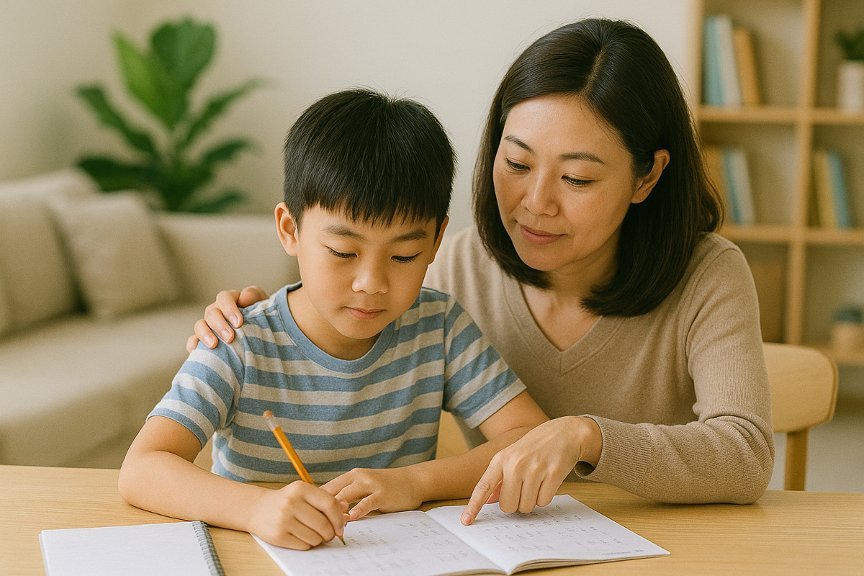
Homework battles are stressful enough without adding AI to the mix. But whether we like it or not, kids are already using it — so the useful question isn’t whether AI will touch homework, but how AI can help with homework for kids in ways that actually build learning instead of bypassing it.
Used well, AI is like a patient tutor who’s available at 8pm on a school night. Used badly, it’s a cheating machine that hollows out learning. Here’s how to steer your family toward the first.
How Can AI Help With Homework? The Good Uses
1. Explaining things differently
Sometimes a concept just doesn’t click the way the teacher explained it. “Explain fractions like I’m 9, using pizza examples” or “explain photosynthesis in simple steps” gives your child a second angle. Different explanations open up understanding — this is AI at its most tutor-like.
2. Socratic practice, not answers
The golden prompt: “Don’t give me the answer. Ask me questions one at a time to help me work it out myself.” This turns the chatbot into a proper tutor. Teach your kids this prompt early — it’s the difference between learning and copying.
3. Generating practice questions
“Make me 10 times-table questions, starting easy and getting harder” or “quiz me on French vocabulary for animals.” Instant, personalised practice material on any topic.
4. Checking and improving work
After your child has written something: “Check this paragraph for spelling and suggest two ways to improve it.” Feedback on completed work builds skills; generating the work from scratch doesn’t.
5. Help with projects and research
Brainstorming ideas, structuring a project, finding child-friendly explanations of topics — all legitimate uses, as long as your child does the actual thinking and writing.
The Cheating Problem: Be Realistic
Let’s be honest: kids will be tempted to get AI to just do the work. Schools know this too — many now design homework to be AI-resistant and teach AI detection awareness. As a parent, the constructive approach is:
- Talk about it openly rather than banning it outright (bans just drive it underground).
- Explain the point of homework — it’s practice for the exam, where AI won’t be there. Copying homework is like skipping training then expecting to win the match.
- Set the rule clearly: AI for understanding and checking, never for producing work to submit as your own.
- Stay involved. Ask your child to explain what they learned. If they can’t explain it, they didn’t learn it — whatever the homework says.
Age-Appropriate Guidance
- Under 10: use AI together, never solo. You drive; they watch and participate. Keep sessions short.
- 10–13: supervised independent use. Teach the “tutor, not answer machine” prompts. Check outputs together — AI makes mistakes, and spotting them is itself a learning exercise.
- 14+: more independence, but keep the conversation going about academic integrity and your school’s specific AI policy.
Also worth reading: the risks of AI for children and what parents should know about AI chatbots for teens.
Watch Out: AI Gets Things Wrong
AI chatbots confidently produce wrong answers — wrong maths, made-up historical “facts”, plausible-sounding nonsense. Teach your kids to verify important facts against textbooks or trusted sources like BBC Bitesize, which remains one of the best free learning resources for UK curricula. “The AI said so” is never a citation.
Subject-by-Subject: AI Homework Help That Works
- Maths: “Explain how to solve [problem type] step by step, then give me 3 similar problems to try.” AI is excellent at maths tutoring when used for method, not answers. Ask it to check working, not just final answers — the working is where learning happens.
- English: feedback on drafts (“suggest 3 ways to improve this paragraph’s opening”), vocabulary building, and comprehension practice. Never for writing the essay itself.
- Science: explaining concepts with analogies, virtual experiment walkthroughs, and quiz questions. “Explain photosynthesis using a factory analogy” sticks better than textbook paragraphs for many kids.
- Languages: conversation practice, vocabulary quizzes, and pronunciation help (with voice mode). See AI language learning.
- History/Geography: timelines, cause-and-effect explanations, and “explain like I’m 10” summaries of complex topics. Always verify dates and facts — AI invents these confidently.
Building Good AI Habits Early
The habits kids form now will shape how they use AI for life. Worth deliberately teaching:
- Verify everything important. Make fact-checking a game: “The AI said X — let’s check the textbook.” Kids who learn AI makes mistakes become critical thinkers; kids who don’t become passive consumers.
- Show your working — to the AI too. “Here’s my attempt: [working]. Where did I go wrong?” teaches the meta-skill of seeking feedback rather than answers.
- Use AI to go deeper, not just finish faster. “I finished the homework — now ask me hard questions about the topic.” Curiosity is the habit that compounds.
- Talk about when NOT to use it. Creative writing, personal reflections, opinions — some work should come from inside, not from a chatbot. Help kids feel the difference.
- Model it yourself. Let them see you using AI well: “I’m going to ask the AI to explain this news story, then we’ll check if it’s right.” Normalise critical, curious use.
Setting Up Your Child’s AI Safely
- Use mainstream tools with age-appropriate settings rather than obscure apps with unknown data practices.
- Turn off training-data sharing in the chatbot’s settings where the option exists.
- Keep it in shared spaces for younger children — the kitchen table, not the bedroom.
- Agree the rules together: AI for understanding and checking, never for producing work to submit; no personal information shared; tell a parent about anything weird.
- Check in regularly — “what’s the most useful thing the AI helped you with this week?” keeps the conversation normal and open.
Practical Takeaway
AI can be a brilliant homework helper for kids when it acts as a tutor — explaining, questioning, and giving feedback — rather than an answer machine. Set the ground rules early, teach the “help me work it out” prompts, stay involved especially with younger children, and always verify. Used this way, AI doesn’t replace learning; it gives your child a patient study buddy who’s available whenever homework hour gets tough.






2 thoughts on “How Can AI Help With Homework for Kids? A Parent’s Guide”