
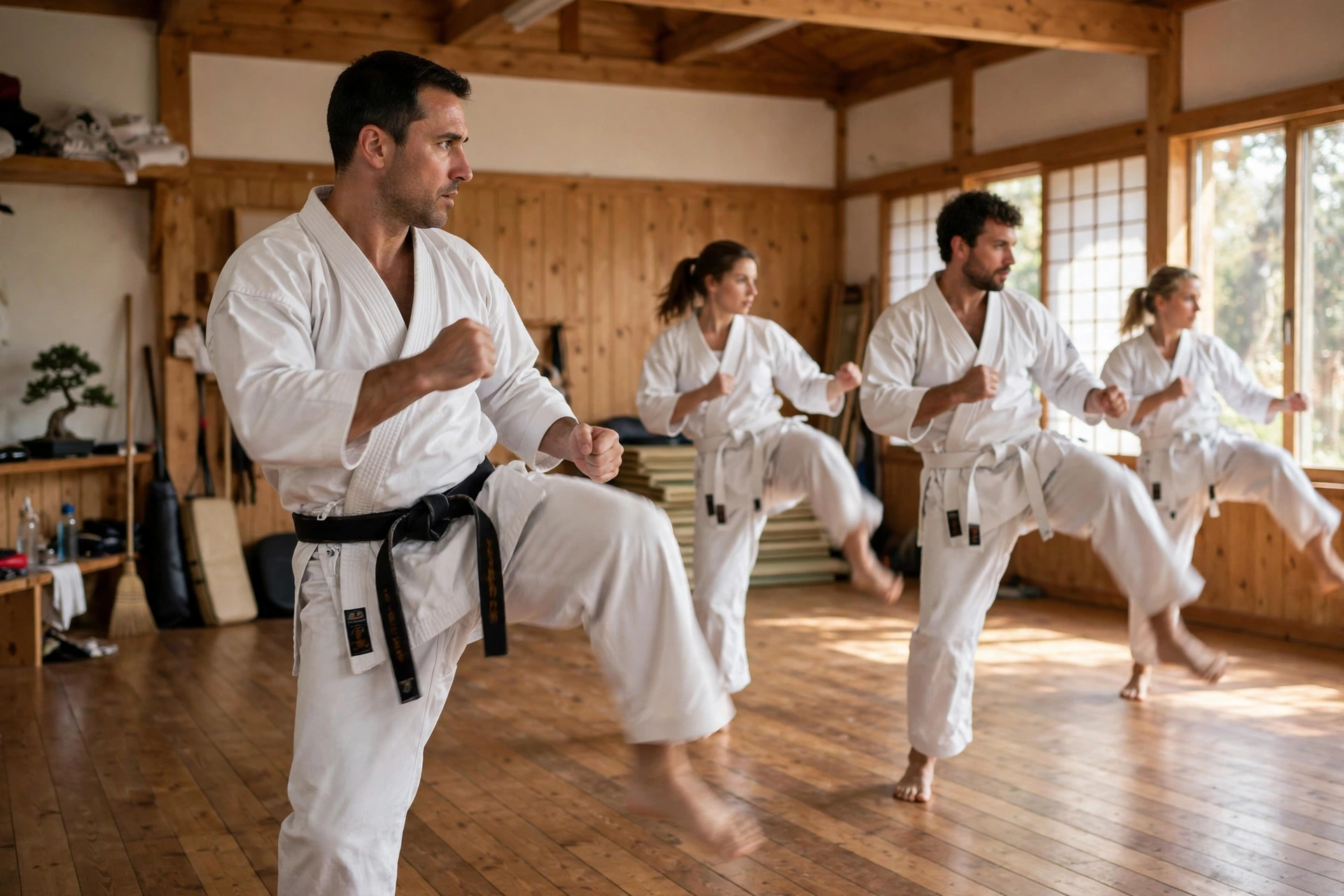
How long does it take to get a black belt? For most students, the honest answer is between three and five years of consistent training. In fast-moving styles with frequent gradings it can be closer to two years, while in arts like Brazilian jiu-jitsu the journey often stretches past a decade. The belt itself is never bought with time alone — it is earned through regular practice, assessed gradings, and a genuine understanding of your chosen art. If you are thinking about starting at a local club in the UK, here is exactly what to expect, style by style.
The Short Answer: Typical Black Belt Timelines
If you train two to three times a week and attend gradings when your instructor says you are ready, these are the realistic ranges:
- Taekwondo: 3 to 4 years
- Karate: 3 to 5 years
- Judo: 4 to 6 years (sometimes longer in the UK)
- Kickboxing: 4 to 5 years
- Kung fu: 5 to 7 years
- Brazilian jiu-jitsu: 8 to 12 years
These figures assume a fairly dedicated amateur — not a professional athlete, but someone who shows up most weeks, practises at home now and then, and takes gradings seriously. Train once a week and you can roughly double these timelines. Train five or six times a week, as juniors in competitive squads sometimes do, and you may move faster — but no reputable instructor will rush you through grades you have not earned.
How Long Does It Take to Get a Black Belt in Each Style?
Karate: 3 to 5 years
Karate is one of the most popular routes to a black belt in Britain. Most UK clubs follow a kyu grading system running from 10th or 9th kyu (white belt) up to 1st kyu (brown belt), with gradings every three to four months for beginners. Each step asks for more: basic punches and blocks, then kata (set forms), then controlled sparring and self-defence applications. A committed adult training twice a week usually reaches 1st dan (the first level of black belt) in around four years. Children often take a little longer, because many associations add junior grades or age requirements before a full black belt can be awarded.
Taekwondo: 3 to 4 years
Taekwondo, famous for its spectacular kicks, tends to have one of the quicker paths. The Korean system uses coloured belts called gup grades, typically ten of them, leading to 1st dan. Because the syllabus is well standardised and gradings are frequent, motivated students in the UK frequently reach black belt in about three years. Competition-focused students may even grade slightly faster, since tournament experience sharpens technique. Choosing the right sports gear early on — a well-fitted dobok, gum shield and foot pads — makes those first years of kicking drills far more comfortable.
Judo: 4 to 6 years
Judo is stricter than many arts about its black belt standard. In the UK, judo gradings are governed by the British Judo Association, which sets national syllabus requirements. You must demonstrate a wide range of throws, holds and groundwork, and for senior grades you generally need competitive experience — points earned in contests count towards your promotion. This competitive element is why judo often takes a little longer: you cannot simply learn the techniques in a quiet dojo, you have to prove them against resisting opponents. For many judoka this makes the black belt feel especially meaningful when it arrives.
Brazilian Jiu-Jitsu: 8 to 12 years
Brazilian jiu-jitsu (BJJ) is famously the slowest path to a black belt, and its practitioners wear that as a badge of honour. There are only five belt colours — white, blue, purple, brown and black — and each promotion can take two to three years. There is no skipping through quick gradings; your instructor promotes you only when your live grappling genuinely reflects the next level. Anyone promising a BJJ black belt in two years should be treated with deep suspicion. The upside is that a BJJ black belt carries enormous credibility, because everyone in the sport knows exactly how hard it was to earn.
Kung Fu and Other Traditional Arts: 5 to 7 years
Many kung fu schools do not use belts at all, but those that do — or that award sashes — usually follow a long, layered syllabus of forms, weapons and partner drills. Expect five years at minimum. Kickboxing and MMA-adjacent gyms fall somewhere in the middle: many UK kickboxing clubs award a black belt after four to five years of steady work, including pad rounds, sparring and fitness benchmarks.
The UK Picture: Clubs, Associations and Schedules
Martial arts in Britain are organised through national governing bodies, and this shapes your journey. Karate clubs typically affiliate to bodies such as the English Karate Federation, taekwondo clubs to British Taekwondo, and judo clubs to the British Judo Association. Affiliation matters: it means your grades are recognised anywhere in the country, your instructor holds verified qualifications and insurance, and gradings follow a published syllabus rather than one person’s whim. Sport England lists recognised national governing bodies if you want to check a club’s credentials before joining.
A typical UK training schedule looks like this:
- Beginners’ class: 1 to 2 sessions per week, 60 to 90 minutes each
- Intermediate students: 2 to 3 sessions per week, often adding a sparring or fitness session
- Advanced (brown belt and above): 3 to 4 sessions per week, plus competitions and seminars
Monthly club fees in the UK usually sit between £30 and £60 for adults, with juniors a little cheaper. Grading fees are separate — typically £20 to £40 per grading including your new belt and certificate. Licence or membership fees for the national association (often £25 to £45 a year) cover your insurance. None of this is prohibitive, but it is worth budgeting honestly: the black belt journey is a marathon, and you want a club you can afford to stay at for years.
What a Black Belt Actually Is: Dan Grades Explained
One of the biggest surprises for beginners is that a black belt is not the end. In most arts, 1st dan black belt simply means you have mastered the fundamentals — you are considered a serious student rather than a beginner. The dan system continues upward: 2nd dan, 3rd dan and beyond, each requiring years of further training, teaching and contribution to the art. Higher dans are often awarded partly on what you give back — coaching juniors, refereeing, helping run your club.
This is why experienced martial artists say the black belt is the beginning, not the destination. The coloured belts teach you technique; the black belt years teach you depth, teaching skill and character. Going in with that mindset takes the pressure off the timeline and lets you enjoy the training itself.
What Determines How Fast You Progress
Two students can start on the same day and reach black belt two years apart. These are the factors that make the difference:
Training frequency
This is the single biggest factor. Two sessions a week is the realistic minimum for steady progress; three is the sweet spot for most adults. Each extra weekly session compounds — not just in mat hours, but in how well your body remembers technique between classes.
Starting age
Children learn quickly but many associations will not award a full adult black belt before the mid-teens, so juniors may collect junior black belts first. Adults in their twenties and thirties often progress fastest of all, combining physical capability with the discipline to practise deliberately. Starting in your forties or fifties is absolutely fine — expect the same timeline, just be a little more patient with recovery.
Your association’s rules
Some bodies set minimum time-in-grade requirements (for example, six months at brown belt before you may attempt 1st dan). Others require competition points, first-aid certification, or a minimum age. These rules protect the standard, so respect them rather than resenting them.
Your instructor’s judgement
In every legitimate club, the instructor decides when you are ready to grade — not you. A good instructor holds you back when your technique is sloppy and pushes you forward when you are genuinely ready. Trust that judgement; it is the quality control that keeps the belt meaningful.
Common Mistakes That Slow Students Down
- Chasing belts instead of skill. Students who obsess over the next grading often cram, pass narrowly, and then struggle at the level above. Focus on the training and the grades take care of themselves.
- Skipping the boring basics. Stances, footwork and basic strikes feel tedious, but every advanced technique is built from them. The students who drill basics diligently are the ones who sail through higher gradings.
- Training inconsistently. Six sessions one month and none the next builds far less than two sessions every week. Martial arts skill is perishable — regularity beats intensity.
- Ignoring fitness and flexibility. You do not need to be an athlete, but poor cardio and stiff hips will cap your progress, especially in kicking arts. A little running and stretching alongside classes pays off enormously.
- Choosing a club for speed, not quality. Clubs that promise unusually fast black belts — sometimes called McDojos — tend to produce students who cannot perform under pressure. Visit several clubs, watch a class, and choose the one with the best teaching, not the quickest timeline.
Tips From Instructors: How to Make the Journey Smoother
Ask any senior instructor how to reach black belt efficiently and you will hear the same advice. First, be consistent above all else — turn up, especially on the days you do not feel like it. Second, ask questions; instructors love students who want to understand the why behind a technique, and understanding accelerates learning. Third, practise a little at home: ten minutes of shadow boxing, kata or stretching most days adds up to hundreds of extra hours over a few years. Fourth, compete if your art allows it — nothing sharpens technique like testing it. Finally, help the beginners once you are able; teaching a white belt a basic throw will expose the gaps in your own understanding faster than anything else.
Frequently Asked Questions
Can I get a black belt in one year?
In a legitimate art, no. Any club offering a black belt in twelve months is selling you a product, not teaching you a martial art. The physical skills, timing and understanding simply cannot be developed that quickly, and other practitioners will recognise the difference immediately.
Does a black belt mean I can defend myself?
A black belt means you have solid fundamentals and the composure that comes from years of training. Arts with live sparring or competition — judo, BJJ, kickboxing — translate most directly to self-defence. But no belt is a guarantee, and awareness and avoidance matter more than any technique.
Am I too old to start?
Almost certainly not. Clubs across the UK have thriving adult beginner groups, and many black belts earned their first dan in their forties, fifties or beyond. Choose an art that suits your body — judo’s hard falls are tougher on older joints than taekwondo’s kicking, for example — and progress at your own pace.
How much does it cost to reach black belt?
Roughly speaking, four years of club fees at £40 a month is about £1,920, plus grading fees (£20 to £40 each, perhaps eight to twelve gradings), annual licences, and kit. A realistic total for the journey in the UK is £2,500 to £4,000 — the price of a decent hobby, spread over several years.
What happens after black belt?
You keep training. Most black belts describe 1st dan as the point where real learning begins — refining technique, starting to teach, competing at a higher level, and working towards 2nd dan over the next two to three years. Many say the years after black belt are the most enjoyable of all, because the pressure of chasing grades is gone.
The Bottom Line
So, how long does it take to get a black belt? Plan for three to five years of training two or three times a week in most striking arts, a little longer in judo, and the better part of a decade in Brazilian jiu-jitsu. Pick a properly affiliated UK club, turn up consistently, respect the process, and the belt will arrive — along with fitness, confidence, friendships and skills that last far longer than the colour of the belt around your waist. Whether you go on to explore getting better at soccer in the off-season or commit to martial arts for life, the discipline you build on the mats will serve you everywhere.


