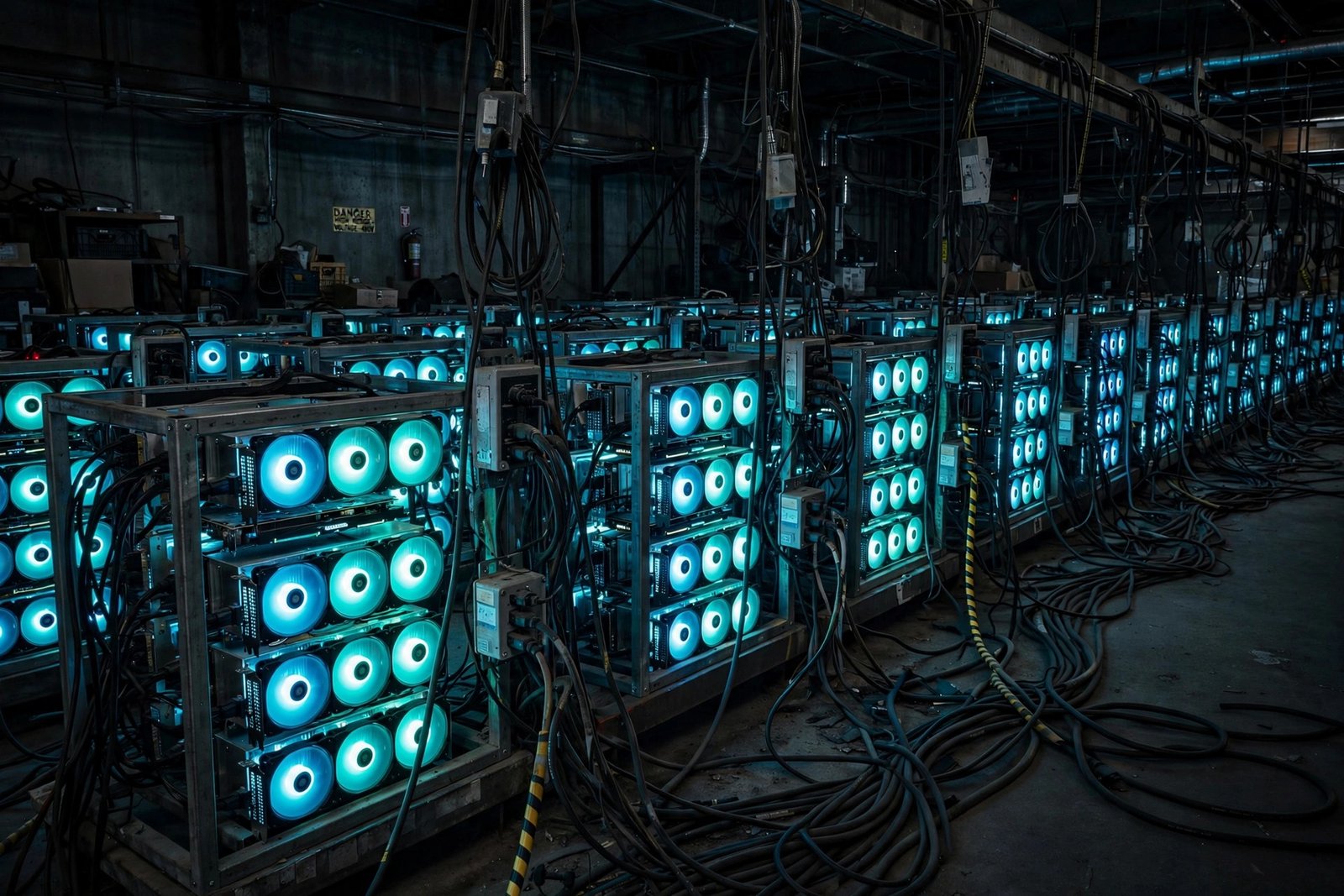
Picture it: a humming rig in your spare room, quietly minting digital money while you sleep. Crypto mining’s romantic image dies hard — but in Britain in 2026, with electricity among the most expensive in Europe and industrial-scale operations dominating every major network, the maths for individuals looks very different from the YouTube thumbnails. So let’s do what the thumbnails won’t: the actual arithmetic of mining in Britain today, and the honest answer about whether it’s still profitable for ordinary people.
How mining works (the 90-second version)
Mining secures proof-of-work blockchains like Bitcoin: computers race to solve cryptographic puzzles, and the winner adds the next block of transactions and earns newly issued coins plus fees. In Bitcoin’s early days, a laptop could win. Today, the network is secured by vast warehouses of specialised machines (ASICs) in regions with cheap power — the difficulty adjusts automatically so that blocks arrive every ten minutes regardless of how much computing power joins. Your spare-room rig isn’t competing against other hobbyists; it’s competing against industrial operations with electricity at a third of your price.
Ethereum — once mineable with gaming GPUs — abandoned mining entirely in 2022, switching to staking. That killed the most accessible form of home mining overnight and flooded the market with second-hand graphics cards. What’s left for individuals: Bitcoin (ASIC-dominated), a handful of smaller GPU-mineable coins, and cloud mining contracts (mostly best avoided — more below).
The British electricity problem: doing the maths
Here’s where British dreams meet British bills. Mining profitability is overwhelmingly about electricity cost — typically 70–90% of ongoing expenses. Under Ofgem’s price cap, a standard UK household pays roughly 24–27p per kWh (check the current Ofgem price cap for the exact figure — it changes quarterly). A single modern Bitcoin ASIC miner draws around 3,000–3,500W continuously: that’s roughly 80 kWh per day, or about £20 a day in electricity at 25p/kWh — over £600 a month, before you’ve earned a single satoshi.
Now the revenue side. That machine might earn on the order of £5–£10 a day in Bitcoin at typical 2026 difficulty and prices — figures that swing with both. £20+ in costs versus under £10 in revenue: you’re losing money every hour it runs. Industrial miners survive because they pay 5–10p per kWh (or less) via direct power deals, run thousands of machines to dilute overheads, and upgrade hardware relentlessly. A British hobbyist at 25p/kWh isn’t competing; they’re donating to their energy supplier. Our guide to how much electricity a gaming PC uses gives a sense of scale — now imagine that running at full tilt, 24/7, forever.
What about GPU mining or smaller coins?
The GPU-mining landscape is a shadow of its former self. With Ethereum gone, remaining GPU-mineable coins have far smaller rewards, and their profitability at UK electricity prices is marginal at best — often negative once you account for hardware wear. Some enthusiasts mine speculatively (betting a small coin rises later) or for heat reuse (a miner warming a garage in winter offsets heating costs conceptually), but as a profit strategy in Britain, the numbers rarely work. Niche exceptions exist — free or subsidised electricity (some businesses, some renewable setups with genuine surplus), but “free” electricity usually isn’t, once you account for equipment and opportunity cost.
The hidden costs beyond electricity
Even if the electricity maths worked, the full picture includes: hardware costs — a competitive ASIC costs £2,000–£5,000+ and becomes obsolete within a few years as difficulty rises; noise and heat — ASICs sound like industrial vacuum cleaners and pump out serious heat, making domestic settings miserable and potentially breaching tenancy or noise rules; maintenance — fans fail, firmware needs updates, downtime earns nothing; tax — HMRC generally treats mined coins as income when received (valued in pounds), with CGT on later growth, per HMRC’s crypto guidance; and your time — monitoring, troubleshooting and optimising a rig is a hobby, not passive income.
Add it up honestly and the “profit” most British home miners report usually evaporates once all costs are counted. If money is tight, our UK budgeting guide will find you more reliable pounds than a mining rig will.
Cloud mining: the trap to avoid
Unable to mine at home, some Britons buy “cloud mining” contracts — paying a company to mine on their behalf. Treat this space with extreme scepticism: it has been one of crypto’s most scam-ridden sectors for a decade, with countless operations that were simply Ponzi schemes wearing hard hats. The legitimate ones struggle with the same economics as home mining (they pay for power too) and pass thin margins to you after their cut. The FCA has repeatedly warned about unregistered investment schemes dressed as mining. If someone guarantees mining returns, it’s not mining — it’s fraud.
When mining CAN make sense in Britain
Fairness requires the exceptions. Mining can work if you have genuinely cheap power — your own solar with real surplus, for instance (though even then, selling the electricity back or using it yourself usually beats mining). It can make sense as a hobby where the education and enjoyment justify small losses — plenty of enthusiasts mine at a slight loss for the fun of participating in the network. And it can make sense at tiny scale for learning: a small, quiet device that teaches you how blockchains work is cheap tuition. What’s not sensible in 2026 Britain: buying expensive hardware expecting profit at 25p/kWh. The industrial era of mining has no room for spare-room romantics expecting returns.
The bottom line
Is crypto mining still profitable for individuals in Britain in 2026? For Bitcoin at UK electricity prices: no — the maths is decisively negative, and industrial competition makes it worse every year. For GPU mining of smaller coins: marginal at best, usually a hobby rather than a business. The profitable paths — ultra-cheap power, genuine scale, or technical edge — aren’t available to ordinary households. If you want crypto exposure, buying small amounts on an FCA-registered exchange beats mining on cost, hassle and returns. Keep the romance; skip the rig.
If you’re still tempted, run a one-month paper trial first: track what a rig would have earned versus its electricity cost using a mining calculator, without buying anything. The numbers on paper are usually sobering enough to save you thousands in hardware.
Frequently Asked Questions
How much electricity does Bitcoin mining use?
A single modern ASIC miner uses roughly 3,000–3,500W continuously — about 80 kWh daily. At UK prices (~25p/kWh), that’s around £20 a day in electricity alone.
Can I mine Bitcoin with my gaming PC?
Effectively no. Bitcoin mining is dominated by specialised ASIC machines; a gaming PC’s hash rate is negligible against the network and would lose money on electricity.
Is cloud mining legitimate?
The sector is rife with scams, including outright Ponzi schemes. Even legitimate operations face thin margins. Treat guaranteed-return offers as fraud.
Do I pay tax on mined crypto in the UK?
Generally yes — mined coins are usually treated as income when received (valued in pounds), with Capital Gains Tax on any subsequent growth when sold.
What’s the cheapest way to get crypto instead of mining?
Buying small amounts regularly on an FCA-registered exchange via bank transfer — lower cost, zero noise, zero maintenance, and honest tax treatment.