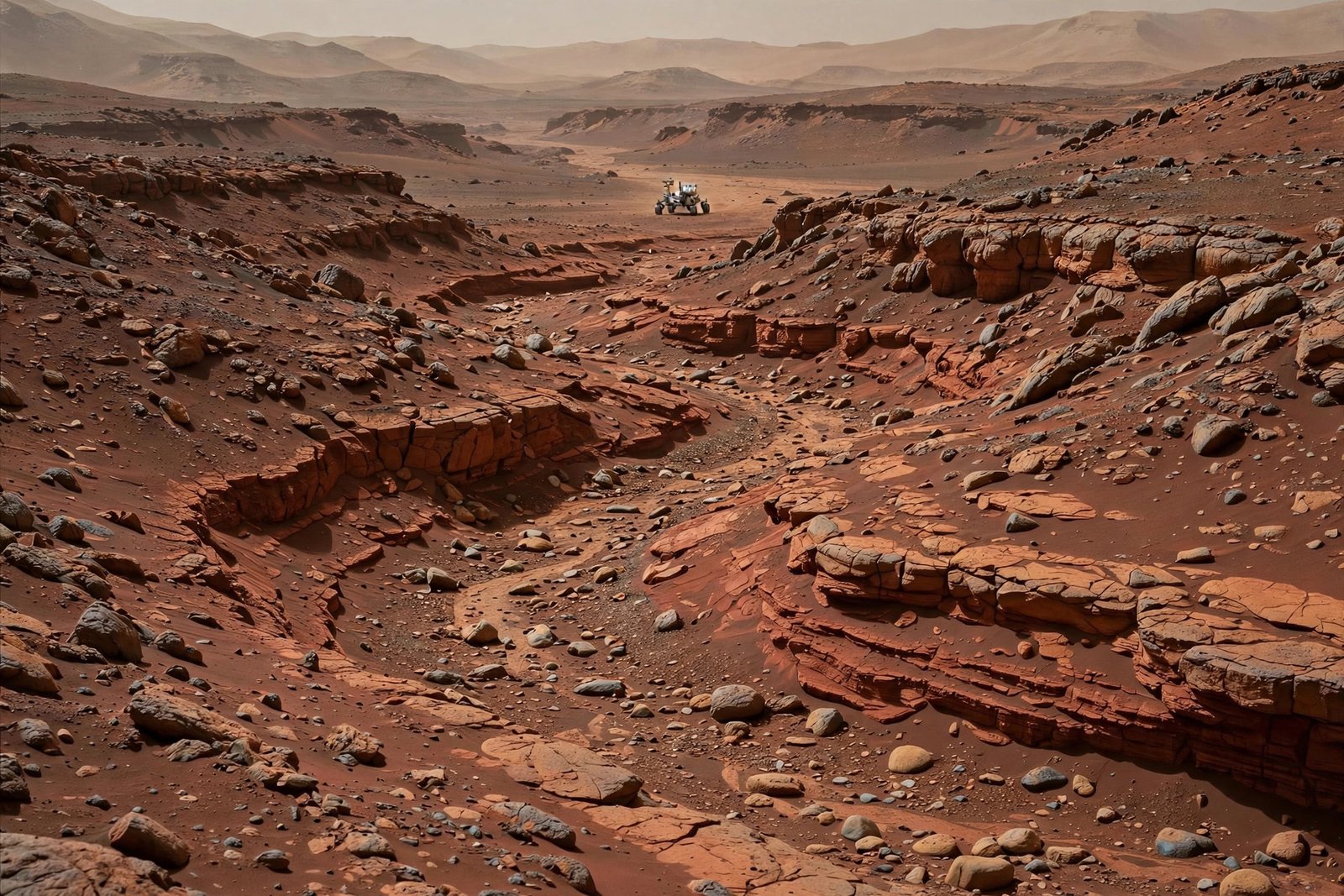
Mars is a frozen desert today — colder than Antarctica, with air too thin to breathe and a surface bombarded by radiation. Yet spacecraft keep finding evidence that water was once everywhere on the Red Planet, and that some of it may still be there, hidden underground or locked in ice. Is there really water on Mars? The answer is yes — and the implications, for the search for life and for future human explorers, are enormous.
From ancient riverbeds photographed by rovers to radar hints of buried lakes, the evidence has accumulated over half a century. Here is what we know, what remains contested, and why a question about a distant planet matters so much — including to Britain’s own space scientists.
The evidence for ancient water: a planet shaped by rivers
The case for a wet ancient Mars is written across its surface. Orbiters have mapped vast networks of branching valleys that look exactly like river systems, enormous outflow channels carved by catastrophic floods, and delta deposits where rivers met standing water. NASA’s Curiosity rover, trundling across Gale Crater since 2012, has photographed rounded pebbles — smoothed by tumbling in flowing water — and mudstones that could only have settled in a calm lake.
Perhaps most striking is Jezero Crater, where NASA’s Perseverance rover is now collecting samples: an unmistakable ancient river delta, with sedimentary layers recording a lake that persisted for long stretches. Mineral clues corroborate the story — clays that form in water, salts left by evaporation, and haematite “blueberries” that precipitate in wet conditions. Around 3.5 to 4 billion years ago, Mars had rivers, lakes and possibly a northern ocean. Then something went wrong: the planet lost its magnetic field, the solar wind stripped away much of the atmosphere, and the water either escaped to space or froze into the ground. The NASA Mars exploration programme publishes the raw images and findings as they arrive.
Where did the water go?
Much of it is still there, as ice. The polar caps are water ice (with seasonal carbon-dioxide frost), and radar and neutron spectrometers have found vast buried ice deposits at mid-latitudes — in some places, enough to cover the planet tens of metres deep if melted. Reading these remote images is a triumph of imaging science; see how AI photo editors analyse images for how machines interpret pictures closer to home.
Water on Mars today: ice, brines and buried lakes
Liquid water on the surface today is essentially impossible: the atmospheric pressure is so low that exposed water would boil and freeze simultaneously. But the subsurface is another matter. In 2018, the European Space Agency’s Mars Express orbiter reported radar reflections beneath the south polar ice consistent with a 20km-wide lake of liquid water — kept liquid, perhaps, by dissolved salts. Follow-up analyses have both supported and challenged the claim; some researchers argue the reflections could come from clays or salty ice rather than a lake. The debate continues, and it matters: a buried lake would be the most habitable known environment on Mars.
Other hints abound. Dark streaks called recurring slope lineae creep down crater walls in warm seasons — possibly briny seeps, though dry avalanches of sand are the rival explanation. The Phoenix lander dug up water ice just centimetres below the surface in 2008. And methane spikes detected in the atmosphere, varying with the seasons, keep alive the tantalising possibility of subsurface chemistry — geological or, just possibly, biological. ESA’s space science missions, with major UK involvement, continue to probe these questions.
Why it matters: life, resources and Britain’s role
Water is the hinge of everything. Wherever there is liquid water on Earth, life finds a way — in boiling vents, in Antarctic ice, in rocks kilometres underground. If Mars had long-lived lakes, life could have started there; if brines persist underground today, it might still survive. Perseverance is caching samples for a future return to Earth — the most ambitious planetary science mission ever attempted — precisely to test whether Martian water ever hosted biology.
Water is also the key to human exploration. Future astronauts could split Martian ice into drinking water, oxygen to breathe and hydrogen-oxygen rocket fuel — “living off the land” rather than hauling everything from Earth. That is why space agencies prospect for ice before they plan landings. Britain is deeply embedded in this effort: Airbus in Stevenage built the ExoMars rover (and its successor concepts), UK scientists lead instruments on multiple missions, and the UK Space Agency funds Mars research across British universities. Autonomous navigation for future rovers builds on the same sensing principles used on Earth — see how self-driving cars use sensors to read the world.
The missions hunting for answers
The search for Martian water — and the life it might have hosted — is now a multi-agency campaign. NASA’s Perseverance is sealing rock samples in titanium tubes for a future Mars Sample Return mission, which would bring them to Earth laboratories in the 2030s; the engineering is fiendishly complex and the budget battles are real, but the scientific payoff would be historic. China’s Tianwen programme has its own sample-return ambitions, and ESA’s long-delayed Rosalind Franklin rover — built in Stevenage — is designed to drill two metres beneath the surface, below the radiation-blasted topsoil where organic molecules might survive.
Closer to home, the water story reshapes how we think about Earth. Mars shows what happens when a watery planet loses its magnetic shield and atmosphere — a cautionary tale written in dried riverbeds. And the techniques developed to find water on Mars, from ground-penetrating radar to miniature spectrometers, are being turned back on our own planet: mapping aquifers in drought-stricken regions and monitoring polar ice. The Red Planet’s lost oceans may yet help protect Earth’s remaining ones.
Conclusion
Yes, there is water on Mars — frozen at the poles, buried in the soil, etched into ancient riverbeds, and quite possibly pooled as briny liquid deep underground. The planet transformed from a watery world into a desert, and understanding that transformation is both a cautionary tale and a scientific treasure. Whether that water ever cradled life is the question a generation of missions, including British-built hardware, is now trying to answer. The Red Planet may be dry, but the story is anything but — and the coming decade of sample-return missions may finally deliver an answer.
Frequently Asked Questions
Is there liquid water on Mars right now?
Not on the surface — pressure is too low. But radar data hints at buried briny lakes beneath the south polar ice, and seasonal dark streaks may be salty seeps. Both remain debated.
Did Mars once have oceans?
Evidence strongly suggests large bodies of water: river valleys, deltas, lakebed minerals and possibly a northern ocean around 3.5–4 billion years ago.
Why does water on Mars matter for finding life?
All known life needs liquid water. Finding past or present water identifies where life could have arisen — and where future missions should look for its traces.
What is Britain’s role in Mars exploration?
The UK builds Mars rover hardware (Airbus Stevenage), leads science instruments, and funds research through the UK Space Agency — a major contribution for a mid-sized space nation.