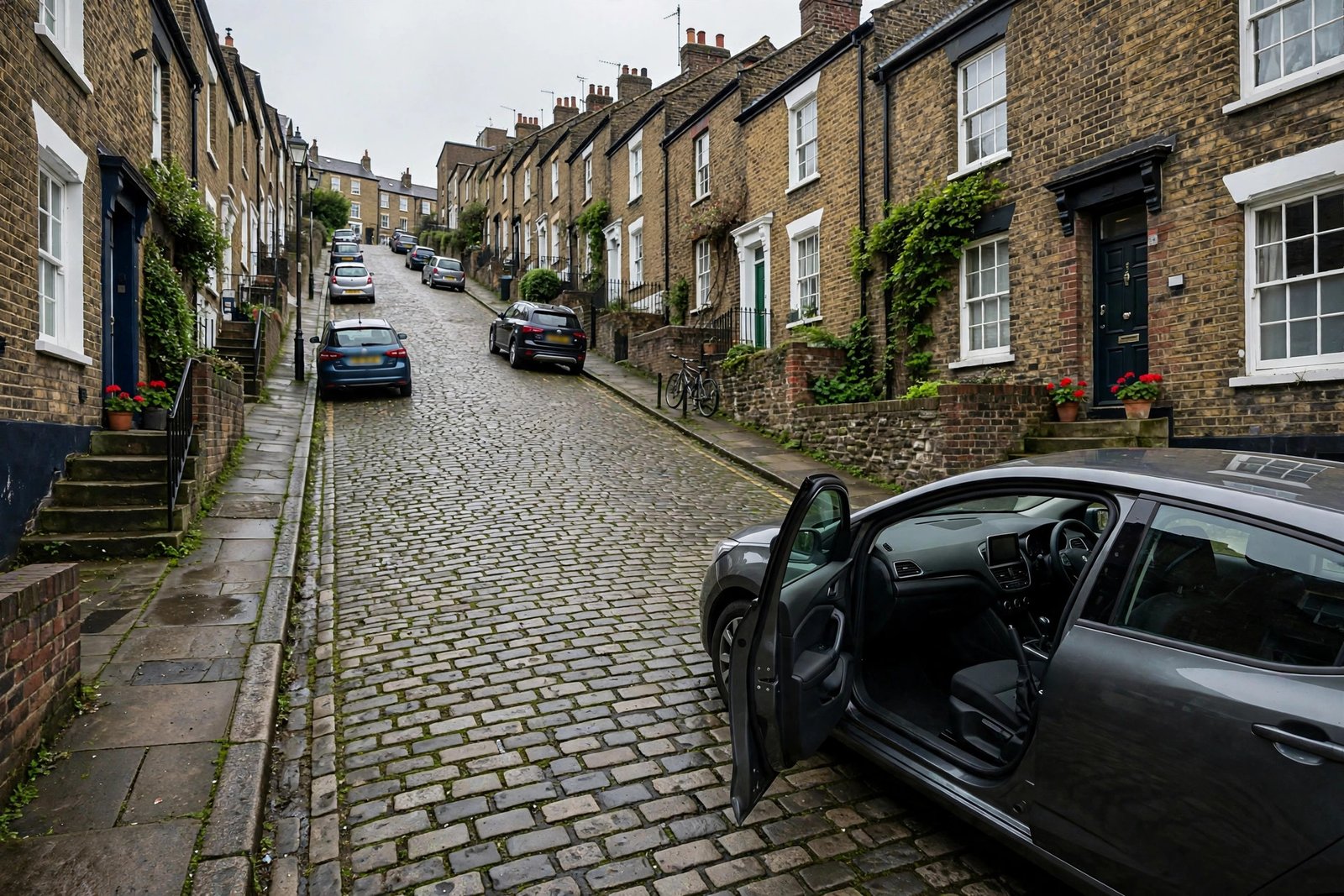
Anyone who’s lived on a steep street in Sheffield, Bristol, Bath or Edinburgh knows the ritual — and the worry. You park on a gradient every day, and somewhere in the back of your mind is the question: am I wrecking my gearbox? The short answer is that modern cars handle hills far better than old ones, but sloppy hill-parking habits genuinely do accelerate wear on transmissions, parking pawls and clutches. Here’s how to park on a hill without damaging your transmission: the correct technique for automatics and manuals, why it matters, and the mistakes that cost real money.
Why hills stress your transmission
When you park on a slope and simply shift to Park (automatic) or leave it in gear (manual) without the handbrake properly engaged, the car’s entire weight rests on a tiny component: the parking pawl in automatics (a small metal pin that locks the transmission) or the engine compression and clutch in manuals. The parking pawl is designed as a backup, not a primary holding device — it’s a pin roughly the size of your little finger holding back 1.5 tonnes on a gradient. Do this daily for years and the pawl wears, stretches its engagement, and can eventually fail or jam — a transmission-out repair costing £1,000+. In manuals, leaving the car in gear on a hill loads the clutch and drivetrain unnecessarily, and if the handbrake is weak, the car can creep. The fix in both cases is the same: the parking brake does the holding; the transmission is the backup — not the other way round.
The correct technique: automatics
Follow this exact sequence every time you park on a hill: 1. Stop with the foot brake, keeping the car stationary. 2. While still holding the foot brake, engage the parking brake (handbrake or electronic button) firmly. 3. Shift into Neutral. 4. Release the foot brake slowly and let the car settle — you’ll feel it rock slightly as its weight transfers onto the parking brake. 5. Then shift into Park. This sequence ensures the parking brake, not the pawl, bears the load — when you return, the gear lever slides out of Park effortlessly instead of clunking free under tension. That clunk you feel when yanking out of Park on a hill? That’s the sound of the pawl releasing under load — every clunk is wear. Do the sequence and it disappears. For electronic parking brakes, the same logic applies: engage it before selecting Park. And on steep hills, turn your front wheels toward the kerb (facing downhill) or away from the kerb (facing uphill) — if everything fails, the car rolls into the kerb, not into traffic. It’s in the Highway Code for a reason; GOV.UK’s Highway Code covers the official parking guidance.
The correct technique: manuals
Manual drivers have it slightly more complex. 1. Stop with the foot brake. 2. Engage the handbrake firmly while holding the foot brake. 3. Shift into Neutral, release the foot brake, let the car settle onto the handbrake. 4. Then select a gear as backup: first gear if facing uphill, reverse if facing downhill — the gear opposes the direction of potential roll, so engine compression resists movement. 5. Turn the wheels toward the kerb as above. The gear is the backup, not the primary hold — a strong handbrake does the real work. Never rely on gear alone with a weak handbrake: handbrake cables stretch and need periodic adjustment (a £30–£60 job), and a handbrake that holds on the flat may not hold on a 1-in-4. If your handbrake needs more than 5–6 clicks or the car creeps, get it adjusted — it’s a maintenance item, not a character trait. A reliable local garage sorts this in under an hour.
DSG, CVT and dual-clutch: the modern complications
Modern transmissions add wrinkles. Dual-clutch (DSG) gearboxes (VW Group, Ford Powershift) are essentially automated manuals — their clutches wear if you “hold” the car on a hill using throttle instead of the brake (the classic creep-forward-at-junction habit). Always hold with the brake, not the throttle. CVTs (many Nissans, Toyotas, Hondas) have their own parking-pawl arrangements — the same brake-first sequence applies. Electronic handbrakes with auto-hold: convenient, but verify the auto-hold actually engaged (dashboard light) rather than assuming — and still follow the sequence. Start-stop systems on hills: disable start-stop when parking on steep gradients; you want the engine running and responsive during the manoeuvre, not cutting out mid-sequence. None of this is difficult — it’s just deliberate where flat parking is casual.
The mistakes that cost money
Slamming into Park while rolling: even slight movement when engaging Park hammers the pawl — always fully stopped first. Riding the clutch on hill starts: holding a manual on a hill with clutch slip (instead of the handbrake) burns clutch material — a £500–£900 replacement eventually. Use the handbrake for hill starts, every time. Ignoring the handbrake’s decline: cables stretch gradually; the hill that held last year creeps this year. Test monthly on your steepest regular spot. Parking in gear without the handbrake “just for a minute”: minutes become the habit, and the habit becomes the repair bill. Forgetting wheels-to-kerb: free insurance against total brake failure — thirty seconds that could save a runaway car. And budget for the maintenance these habits protect: our guide to building an emergency fund exists precisely because cars surprise even careful owners.
What if you already have the clunk?
If your automatic already clunks badly out of Park on hills, or the lever is hard to move, the pawl may already be worn — but adopting the correct sequence now stops further damage, and many gearboxes continue fine for years once the load is removed. If Park ever fails to hold the car (it rolls with the brake off), that’s urgent: use the handbrake religiously and get the transmission inspected — a failed pawl can mean the car isn’t secure in Park at all. The RAC’s car maintenance advice covers transmission warning signs worth knowing.
The bottom line
Parking on a hill without damaging your transmission: foot brake to stop, parking brake engaged firmly, shift to Neutral, let the car settle onto the brake, then Park (automatics) or a backup gear — first facing uphill, reverse facing downhill (manuals) — and turn the wheels toward the kerb. Thirty seconds of sequence, every time, protects a £1,000+ repair. The parking brake holds; the transmission backs up. Get that hierarchy right and hills become just another parking spot.
Frequently Asked Questions
Does parking on a hill damage your transmission?
It can, if you let the car’s weight rest on the transmission (the parking pawl in automatics) instead of the parking brake. Using the correct sequence — brake first, then Park — eliminates the wear.
Should I park in gear or neutral on a hill?
Manuals: handbrake firmly engaged first, then first gear (facing uphill) or reverse (facing downhill) as a backup. Automatics: parking brake first, then Park. The brake does the holding; the gear is the backup.
Why does my car clunk when I shift out of Park on a hill?
The parking pawl is releasing under the car’s weight — a sign the pawl (not the parking brake) was holding the car. Adopt the brake-first parking sequence and the clunk should disappear.
Which way should I turn my wheels when parking on a hill?
Turn front wheels toward the kerb when facing downhill, away from the kerb when facing uphill. If the brakes fail, the car rolls into the kerb rather than into traffic.
Is it bad to hold a car on a hill with the clutch?
Yes — holding a manual on a hill with clutch slip burns the clutch (£500–£900 to replace). Always use the handbrake for hill starts and hill holding, not the clutch.