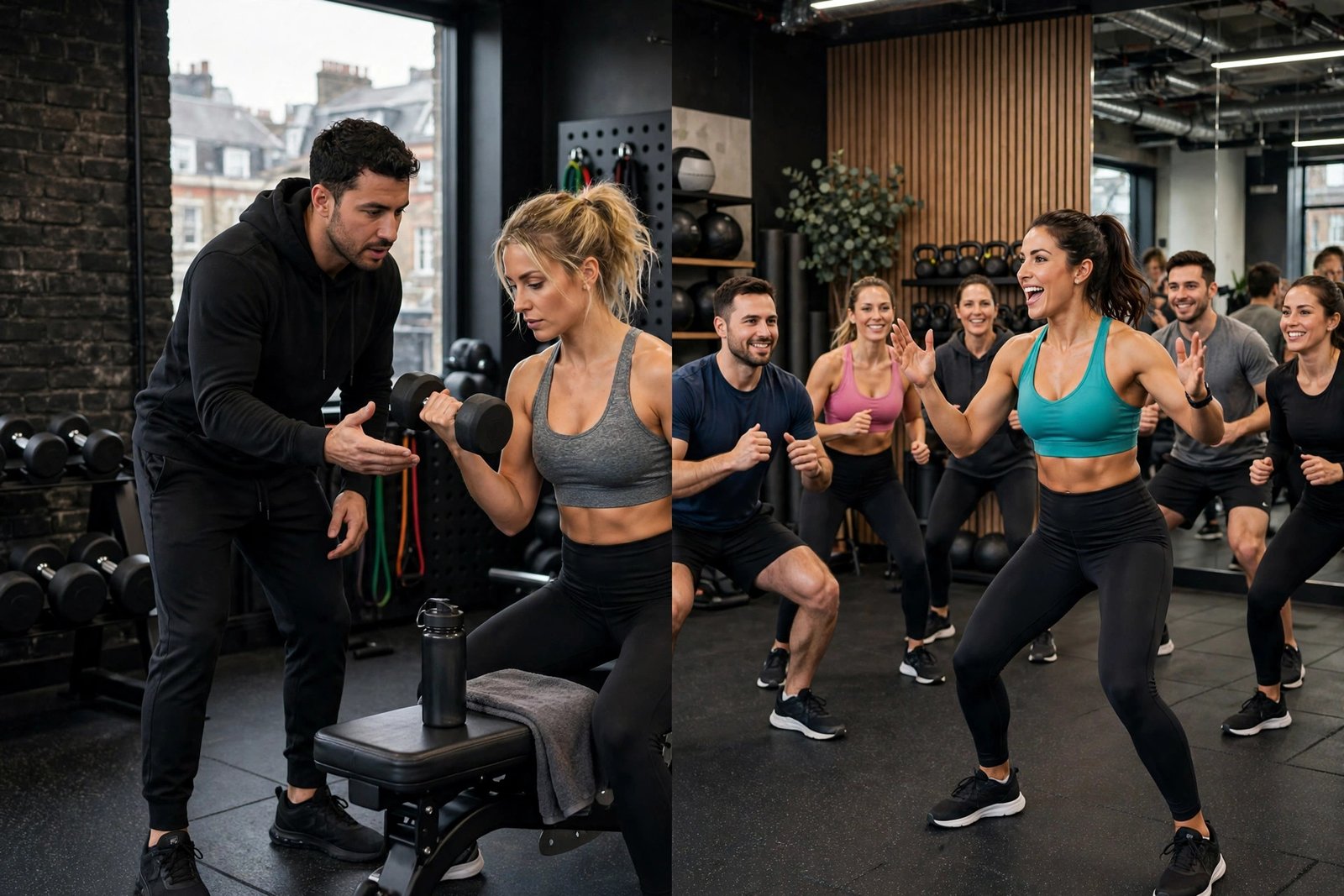
You’re ready to get serious about fitness, and the leisure centre or gym offers two paths: hire a personal trainer for one-to-one coaching, or throw yourself into group classes. Both work — but they work for different people, different goals and different budgets. In Britain, PT sessions typically cost £30–£60 an hour while classes are often included in membership, so the financial stakes of choosing wrong are real. This guide compares personal trainers and group classes honestly across cost, results, motivation and suitability, so you can pick the right one for you.
Cost: the maths that decides for most people
Let’s start with the unavoidable numbers. In most British cities, a qualified personal trainer charges £30–£60 per hour-long session (£40–£80 in London), with discounts for block bookings of 10–20 sessions. Two sessions a week — the minimum for meaningful PT-driven progress — costs £240–£480 a month on top of your gym membership. That’s a serious financial commitment, roughly equivalent to a car payment.
Group classes, by contrast, are usually included in gym and leisure-centre memberships (£15–£60 a month all-in), making them 5–10x cheaper per session. Boutique studios (F45, Barry’s, reformer Pilates) charge £15–£30 per class — pricier, but still far below PT rates. The cost conclusion is stark: if budget matters (and for most people it does), classes win overwhelmingly. PT is a premium service with premium pricing; the question is whether the premium buys results you can’t get otherwise. Anyone weighing the investment should also consider the free alternative — self-directed training using quality programming, which costs nothing beyond membership. Our beginner’s running guide shows how far structured self-guided training can take you.
Results: where personal training genuinely excels
PT earns its price in specific situations. One: complete beginners who need to learn safe technique — a good trainer builds your movement foundation in 8–12 sessions, preventing the injuries and bad habits that derail self-taught lifters. Two: people with medical conditions, injuries or disabilities, where generic class programming is inappropriate and individualised adaptation is essential. Three: specific, demanding goals — a powerlifting total, a dramatic body recomposition, return to sport after injury — where programming precision matters.
Four: accountability for people who know they won’t train alone. This is PT’s secret superpower and its most honest selling point — you’re paying partly for an appointment you can’t skip. Research consistently shows that supervised training produces better adherence and results than unsupervised training, and for some personalities the financial commitment is the mechanism that finally makes exercise stick. But be honest with yourself: if you’ve bought gym memberships, home equipment and fitness apps that all gathered dust, the problem may not be the format — though a trainer’s accountability might be exactly the circuit-breaker you need.
Where group classes win
Classes dominate on three fronts: variety, energy and sustainability. Variety: a typical leisure centre timetable offers 30–50 weekly classes across strength, cardio, mind-body and dance — you’d need several trainers to replicate that range. Trying new formats keeps training novel, and novelty sustains motivation far longer than the perfect programme done joylessly. Energy: there’s genuine science behind group exercise adherence — the social facilitation effect means people work harder and enjoy it more in groups, and class regulars form communities that pull you in on days motivation fails.
Sustainability: classes are a fitness solution you can maintain for years at a membership price, whereas PT at £400 a month is a temporary intervention for most budgets. The fittest 60-year-olds in Britain aren’t the ones who did six months of PT at 40 — they’re the ones who found a format they loved and never stopped. Classes also teach self-sufficiency indirectly: regulars absorb enormous exercise knowledge by osmosis. And for pure enjoyment, a great instructor with music pumping beats a silent one-to-one session for most personalities. Even simple formats work — walking groups deliver the same social-adherence benefits for free.
The quality lottery: choosing well in either format
Both options suffer from wild quality variance, and choosing badly wastes money either way. For PTs, check qualifications: look for Level 3 Personal Trainer certification minimum (the UK standard), ideally with additional credentials relevant to your goals (strength & conditioning, pre/post-natal, GP referral). Ask about experience with clients like you — a trainer who mainly coaches athletes may not suit a nervous beginner. Insist on an initial consultation and a trial session; good trainers assess, ask about injuries and goals, and explain their approach. Red flags: no assessment, immediate supplement sales, “no pain no gain” machismo, or programming that looks identical for every client.
For classes, the instructor matters more than the brand. A great BodyPump instructor transforms the class; a poor one makes it miserable and potentially unsafe. Try several instructors for the same class format. Check class sizes — beyond 25–30 people, individual correction becomes impossible. And beware the boutique-studio upsell treadmill: the £25 class is the product, and the “transformation challenges” and branded merchandise are the margin. The ukactive trade body sets standards for the UK fitness industry, and CIMSPA is the professional body for sport and physical activity workers — membership of either signals professionalism.
The hybrid answer most people should choose
Here’s the option the industry doesn’t advertise because it splits the revenue: do both, strategically. Buy a small block of PT sessions (8–12) to learn safe technique and build a personalised programme, then transition to classes and self-directed training for the long term, with occasional PT “check-ins” (monthly or quarterly) to fix form drift and update programming. You get PT’s technical foundation and accountability kick-start at a fraction of the ongoing cost, plus the sustainability and variety of classes.
This hybrid also solves the motivation puzzle: the PT block builds competence (which breeds confidence), classes provide community and variety, and self-directed sessions build autonomy. Over a year, you might spend £400–£600 on PT total rather than £5,000 — and end up fitter, because you built a system you can maintain indefinitely. Whichever path you choose, the NHS activity guidelines are the target: 150 minutes of moderate activity weekly plus strength work twice a week, however you get there.
The bottom line
Choose a personal trainer if you’re a complete beginner needing technique foundations, have medical or injury considerations, want specific demanding goals, or need the accountability of paid appointments — and can afford £250+ monthly. Choose group classes if you want variety, community and a sustainable long-term habit at membership prices. And seriously consider the hybrid: a short PT block to learn properly, then classes and self-directed training for life. The best choice isn’t PT or classes — it’s the one you’ll still be doing in two years.
Frequently Asked Questions
How much does a personal trainer cost in the UK?
Typically £30–£60 per session outside London (£40–£80 in London), with discounts for block bookings. Two sessions weekly costs roughly £240–£480 a month plus gym membership.
Are group fitness classes effective?
Yes — for general fitness, fat loss and adherence they’re excellent, with the social element boosting consistency. They lack the individualisation of PT for specific goals, injuries or technique correction.
How many PT sessions does a beginner need?
Usually 8–12 sessions to learn safe technique across the fundamental movements and establish a programme you can follow independently. After that, periodic check-ins suffice for most people.
Can I get fit with just classes and no gym floor work?
Absolutely, if the class mix covers strength and cardio. Combine strength-oriented classes (BodyPump, circuits) with cardio (spin, dance) and you’ll meet the NHS guidelines comfortably.
What qualifications should a UK personal trainer have?
Level 3 Personal Trainer certification minimum, plus relevant specialist credentials for your needs. CIMSPA membership indicates professional registration — ask, and don’t be shy about it.