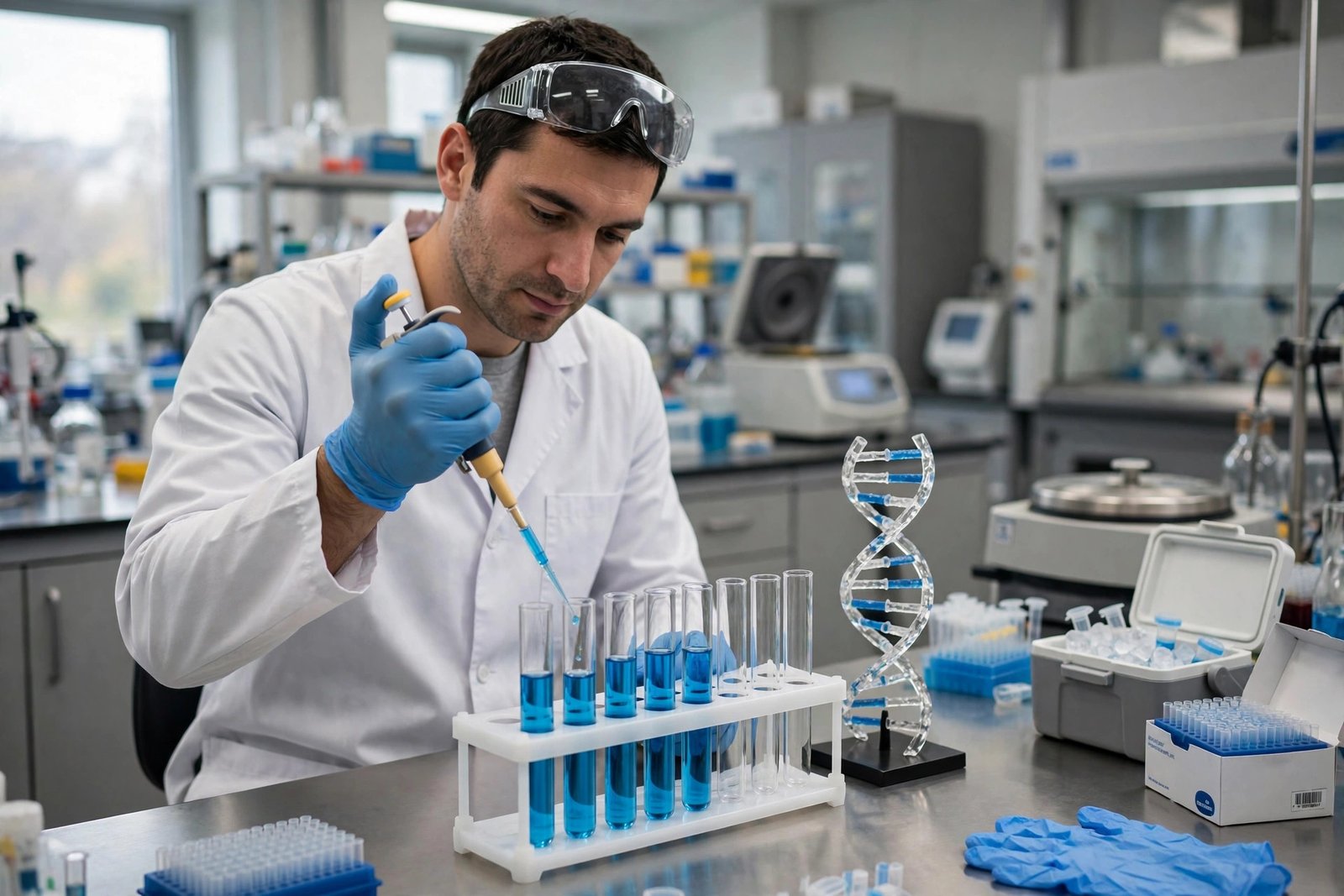
In November 2023, Britain became the first country in the world to approve a CRISPR-based medicine. The drug, Casgevy, offers a potential one-time cure for sickle cell disease and beta thalassaemia — inherited blood disorders that blight hundreds of thousands of lives. For a technology discovered barely a decade earlier, it was a breathtakingly fast journey from laboratory curiosity to licensed therapy.
So what exactly is CRISPR, how does it work, and how could it change medicine in Britain? The short version: it is a pair of molecular scissors that can edit DNA with unprecedented precision — and it is rewriting the rules of what medicine can fix.
What CRISPR is and how it works
CRISPR began as a bacterial immune system. Bacteria attacked by viruses snip out fragments of viral DNA and store them as “mugshots” (the CRISPR array); when the virus returns, the bacterium makes RNA guides from those mugshots that lead a protein called Cas9 to the invader’s DNA and cut it. In 2012, Emmanuelle Charpentier and Jennifer Doudna showed this system could be reprogrammed: give Cas9 a synthetic guide RNA matching any DNA sequence, and it will cut precisely there. They won the 2020 Nobel Prize in Chemistry for the discovery.
Cutting is only half the trick. Once DNA is cut, the cell’s own repair machinery kicks in — and scientists can hijack it. Provide a corrected DNA template and the cell may paste it in, fixing a mutation. Or let the cell repair the cut sloppily, disabling a harmful gene. Newer variants — base editors and prime editors — can rewrite individual DNA letters without cutting at all, like editing text with a pencil rather than scissors. The precision, speed and cheapness transformed genetics: experiments that took years and fortunes now take weeks. For context on how AI is accelerating medical science alongside gene editing, see whether AI can safely help diagnose medical symptoms.
Why it beats older gene therapy
Earlier gene therapies added a working gene at a random location — effective, but with a small risk of disrupting something important. CRISPR edits the genome in place, at a chosen address. That precision is what makes regulators comfortable and cures conceivable.
Casgevy: Britain’s world-first approval
The MHRA’s November 2023 approval of Casgevy (exagamglogene autotemcel) made global headlines. The treatment works like this: stem cells are harvested from the patient’s blood, edited with CRISPR in the laboratory to reactivate foetal haemoglobin (which compensates for the faulty adult haemoglobin), then infused back after chemotherapy clears the bone marrow. In trials, the great majority of sickle cell patients became free of painful crises, and thalassaemia patients no longer needed transfusions.
The caveats are real: the treatment costs millions per patient, requires gruelling chemotherapy, and long-term data are still accumulating — off-target edits remain a theoretical concern being closely monitored. NICE is evaluating cost-effectiveness for NHS use, and the therapy will initially reach only small numbers. But as a proof of principle it is historic: the first medicine that rewrites a patient’s DNA to cure a disease. The MHRA’s announcements detail the approval and its conditions.
What is next in the pipeline
Dozens of CRISPR trials are under way worldwide: for hereditary blindness (injected directly into the eye), for high cholesterol (a single infusion that permanently dials down a liver gene), for certain cancers (editing patients’ immune cells to hunt tumours), and for HIV. British research centres — the Francis Crick Institute, the Wellcome Sanger Institute, Great Ormond Street — are prominent in this work. Within a decade, CRISPR therapies could address dozens of single-gene disorders. The NHS is already preparing: its genomic medicine service is building the infrastructure to deliver these complex treatments equitably. Related medical AI is advancing in parallel — see how AI is being used across the NHS.
The ethical frontiers
Editing the blood stem cells of one patient — somatic editing — affects only that individual. Editing embryos or reproductive cells — germline editing — would pass changes to all future generations. The scientific consensus, hardened after the 2018 scandal in which a Chinese researcher created the world’s first gene-edited babies, is that heritable editing is not acceptable: the risks are unknowable and the consent issues profound. Britain’s Human Fertilisation and Embryology Authority maintains some of the world’s strictest oversight, and germline editing remains effectively prohibited.
Softer ethical questions are already pressing. Who gets million-pound cures — and who does not? Will gene editing widen health inequalities between rich and poor nations? Could it slide from therapy into enhancement — editing embryos for height or intelligence, should that ever become safe? None of these are hypothetical for long; the technology is advancing faster than the ethics. Britain’s regulatory approach — permissive for research, strict on application, with public dialogue built in — is widely regarded as a model, but it will be tested.
Safety: what could go wrong
The chief technical worry is off-target edits: Cas9 occasionally cuts DNA resembling, but not identical to, its target. Modern guide design and high-fidelity Cas9 variants have driven the rate very low, and regulators require extensive off-target screening before trials. Immune reactions to the editing machinery and the long-term effects of permanent DNA changes are monitored for years after treatment. So far, the safety record in trials has been encouraging — but “so far” in a ten-year-old field deserves emphasis.
CRISPR beyond medicine: food, industry and the environment
Medicine grabs the headlines, but CRISPR’s quietest revolution may be in agriculture. Gene-edited crops — wheat resistant to mildew, tomatoes enriched with GABA, pigs resistant to devastating viruses — are advancing through field trials, including in Britain, where the Precision Breeding Act 2023 created a regulatory path distinct from older GMO rules. Because gene editing can make changes indistinguishable from natural mutations, regulators increasingly treat it differently from transgenic modification. The environmental applications are equally striking: editing coral for heat tolerance, engineering mosquitoes that cannot transmit malaria (gene drives that spread the edit through wild populations), and even editing trees for faster carbon capture. Each application carries its own risk debate — particularly gene drives, which are designed to be uncontainable — but the breadth of the technology is now clear: CRISPR is not a medical tool but a general-purpose technology for rewriting biology.
Conclusion
CRISPR has travelled from bacterial immune system to Nobel Prize to NHS-evaluated cure in barely a decade — one of the fastest translations in medical history. For Britain, which approved the first therapy and hosts world-leading genome research, it promises a future where some inherited diseases are edited out of existence rather than managed for a lifetime. The science is dazzling; the task now is to make it safe, fair and wisely governed. The scissors are in our hands. What we cut — and what we refuse to — will define medicine for a generation.
Frequently Asked Questions
What does CRISPR stand for?
Clustered Regularly Interspaced Short Palindromic Repeats — the bacterial DNA sequences where the system was discovered. In practice it refers to the whole gene-editing toolkit built around the Cas9 protein.
Is CRISPR treatment available on the NHS?
Casgevy was approved by the MHRA in 2023; NICE is assessing it for routine NHS funding. Initially it will be available to limited numbers of eligible patients with sickle cell disease or beta thalassaemia.
Can CRISPR edit human embryos in the UK?
Research on embryos up to 14 days is permitted under licence, but implanting an edited embryo is prohibited. Heritable genome editing is effectively banned in Britain.
What diseases could CRISPR treat next?
Trials are under way for hereditary blindness, high cholesterol, certain cancers, HIV and many single-gene disorders. Polygenic conditions like heart disease are a longer-term prospect.