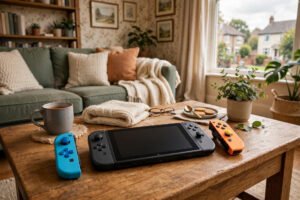
“Just five more minutes” — the universal anthem of children gaming in London flats, heard from Croydon to Camden. Managing screen time for kids who love gaming is one of the defining parenting challenges of the decade, and London adds its own texture: small living spaces, long parental commutes, and a city of extraordinary free alternatives competing for attention. The goal is not to ban gaming — it is to keep it in its place.
This guide offers a realistic, non-preachy framework: what the evidence actually says, the tools that work, London-specific alternatives that genuinely compete with the screen, and how to handle the conflicts without turning your home into a battlefield.
What the evidence actually says
First, exhale: the research does not support panic. The Royal College of Paediatrics and Child Health (RCPCH) — the UK’s authoritative voice — deliberately avoids setting a specific screen-time limit, concluding that the evidence of harm from screen time per se is weak and that content, context and displacement matter more than hours. Gaming in moderation is associated with cognitive benefits (problem-solving, spatial reasoning, reaction time) and social connection; problems arise when it displaces sleep, exercise, schoolwork or face-to-face time.
The honest risk list: sleep disruption (screens before bed delay sleep onset — the best-evidenced harm), reduced physical activity, exposure to inappropriate content or contacts online (see Childnet’s family advice), in-game spending pressure, and conflict when limits are enforced inconsistently. None of these requires prohibition — they require management. The displacement test is the useful one: not “how many hours?” but “what is gaming replacing?” A child who games for two hours after football practice, homework and dinner is in a different universe from one gaming through the night instead of sleeping. Broader household habits matter too; see reducing screen time realistically for the whole family.
Age matters
Under-5s need the tightest boundaries (the NHS and WHO advise minimal sedentary screen time for toddlers); primary-age children need structure and supervision; teenagers need negotiation and trust, with safety nets. One policy for all ages fails for all ages.
The practical toolkit: what actually works
Use the built-in controls — all of them
Every platform has them, and they are free: console play-time limits with automatic enforcement, phone/tablet app limits and downtime schedules, router-level bedtime cutoffs for Wi-Fi. Set them up once (see how to set up parental controls on a child’s tablet), and the technology becomes the enforcer instead of you — and charities such as Internet Matters publish setup guides for every device. — removing half the conflict at a stroke. Children accept “the Xbox turns off at nine” far more readily than a nightly negotiation.
Protect sleep ruthlessly
The single highest-value rule: no screens in bedrooms overnight. Charge devices in the living room, set a digital sunset 60–90 minutes before bed, and hold the line — sleep-deprived children are harder to parent in every dimension, and the evidence on screens and sleep is the strongest in the field.
Make the limits predictable
Consistent, known rules beat ad-hoc policing. Agree the framework together (especially with teens — imposed rules invite evasion, negotiated rules invite buy-in): when gaming happens, for how long, and what comes first (homework, fresh air, chores). Write it down. Review it termly. And model it — children whose parents are permanently on phones rightly detect hypocrisy.
Engage with the gaming, don’t just limit it
Ask what they are playing, watch a match, learn the characters. Parents who understand the games can distinguish a creative Minecraft build from a predatory loot-box grind, have real conversations about online behaviour, and — crucially — become allies rather than wardens. The goal is a child who self-regulates with your guidance, not one who games secretly the moment you look away.
London: the city as the alternative
Here London parents hold a trump card: the city offers more free and cheap alternatives to screens than anywhere else in Britain. The pitch: world-class free museums (Natural History, Science, British Museum — all free, all with gaming-adjacent exhibits from space tech to video game history), 170+ miles of cycle routes, free outdoor gyms in the parks, city farms, skate parks, and libraries running free clubs and events. Many London boroughs offer free or subsidised swimming and holiday activities for children — check your council’s website.
The trick is friction: make the alternative easier than the screen. Keep bikes accessible, not buried; know the bus route to the park; have the museum trip loosely planned before the weekend. Boredom is the screen’s greatest ally, and London’s answer to boredom is unmatched — if you do the small logistical work to unlock it. Structured activities (football clubs, Scouts, martial arts, music) provide the regular, committed alternative that casual outings cannot; most London boroughs list subsidised options.
The space problem
London’s small homes make “go outside” harder and bedroom gaming more tempting. Mitigations: gaming in shared spaces (non-negotiable for younger children), active video games (Ring Fit, Just Dance, VR) as a bridge, and treating the city’s parks as the garden you do not have — even 30 minutes in the local green space resets the dynamic.
Handling the conflicts
There will be conflicts — the research is clear that limit-setting around screens is now a top-three source of family arguments. What works: stay calm and boring (big reactions reward the drama), enforce predictably (inconsistency teaches that persistence pays), avoid punitive total bans (they breed secrecy), and pick your battles (a teenager’s two-hour weekend session is not the hill to die on; the 1am weekday session is). When gaming genuinely seems compulsive — inability to stop, withdrawal symptoms, major life interference — talk to your GP; gaming disorder is a recognised condition and help exists, though true cases are rare.
When gaming becomes the social life
A nuance modern parents must grasp: for many children, especially teenagers, gaming is not the opposite of socialising — it is socialising. The squad’s Discord call is the modern equivalent of hanging around the park; the shared Minecraft world is the treehouse. Blanket condemnation of “screen time” misses that an hour of cooperative play with school friends serves genuine social needs, particularly for children who find in-person socialising difficult. The parenting task is therefore subtler than it looks: protect sleep, ensure physical activity and schoolwork happen, teach online safety — but recognise the social value rather than dismissing it. Ask who they played with, not just how long. The child gaming with friends for two hours is developing relationships; the distinction matters.
Conclusion
Managing screen time for gaming-loving kids in London is not about winning a war against the console — it is about architecture: predictable rules enforced by technology, sleep protected absolutely, and a city of extraordinary alternatives made frictionless. Engage with their gaming, hold the important lines, and let London do what it does best: offer something more interesting than the screen, most days, for free.
Frequently Asked Questions
How much gaming is too much for kids?
The RCPCH sets no hour limit — what matters is displacement. If gaming displaces sleep, exercise, schoolwork or family time, it is too much; if it fits around a balanced life, the hours matter less.
Should children have consoles in their bedrooms?
Paediatric guidance says no for younger children — shared spaces enable supervision, and overnight device bans protect sleep. Charge devices outside bedrooms.
What free alternatives to gaming does London offer?
Free world-class museums, parks, city farms, skate parks, libraries with clubs, free outdoor gyms, and many boroughs’ free or subsidised swimming and holiday activities for children.
How do I enforce limits without constant arguments?
Use built-in tech controls as the enforcer, keep rules consistent and predictable, negotiate (don’t impose) with teens, model good habits yourself, and stay calm — inconsistency teaches persistence.