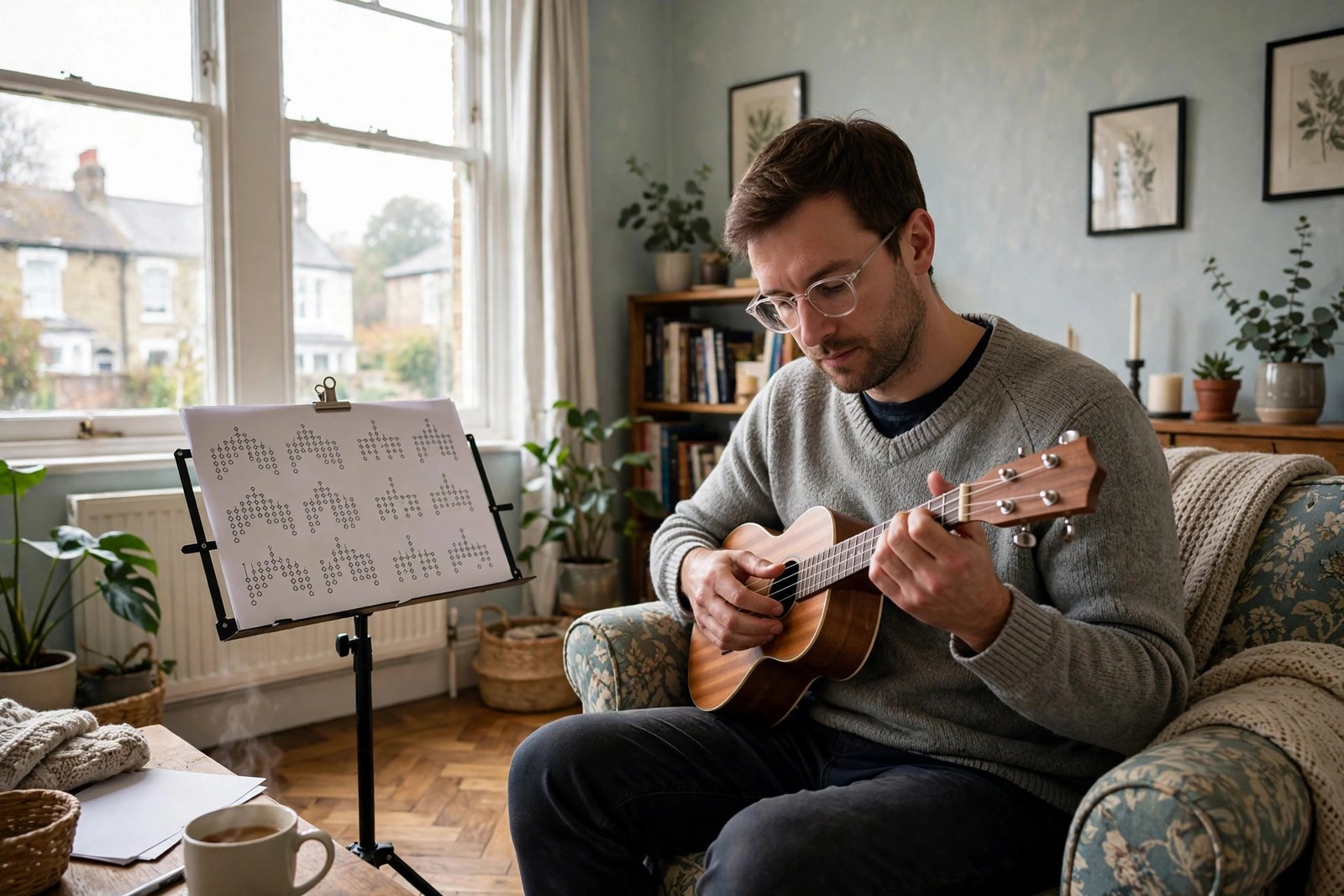
You are thirty-four, you have never played a note, and you have decided — finally — to learn an instrument. The internet will tell you that any instrument is learnable with enough practice, which is technically true and practically useless. Some instruments reward a beginner within weeks; others demand a year of sounding terrible before they give anything back. If you are asking what is the easiest instrument to learn as a UK adult, you want the honest ranking: which instruments get you making actual music fastest, which ones punish beginners, and how to choose for your life rather than your fantasy. Here it is, from someone with no incentive to sell you a piano.
What “easiest” actually means for an adult beginner
Easiest is not one thing. It is four things multiplied together: how quickly you can produce a pleasant sound (a ukulele wins; a violin loses catastrophically), how much music theory you need before playing real songs (guitar chords beat piano sight-reading), how much your body fights you (small hands, arthritis, dodgy backs all matter more at forty than at fourteen), and how the instrument fits your actual life — a drum kit in a terraced house is a neighbour dispute with sticks. Adults also learn differently from children: you have less free time, more self-consciousness, but far better discipline and pattern recognition. The easiest instrument for you is the one that gives you a recognisable song within a month and fits through your front door.
One more adult-specific truth: motivation beats ease. The “easiest” instrument you never practise is harder than the “difficult” one you play daily. So treat this ranking as a shortlist, then choose the instrument whose sound you actually love — because you will be listening to yourself learning it for a long time. If you are framing this as a broader life upgrade, our guide to learning a new hobby cheaply in the UK covers keeping the costs down while you experiment.
The genuinely easy tier: ukulele, keyboard, cajón
Ukulele is the undisputed champion of fast results. Four soft nylon strings, a tiny fretboard, and chord shapes that a complete beginner can learn in an afternoon — C, G, Am and F will carry you through hundreds of pop songs within your first week. Ukuleles cost £30 to £60 for a playable starter, they are nearly silent to neighbours, and the UK has a thriving ukulele group scene (search for your local “uke jam”) that welcomes beginners with open arms.
Keyboard (not piano — keyboard) comes second. A £100 starter keyboard with light-up keys or a learning app removes the two hardest parts of piano: reading notation and developing touch. You can play recognisable melodies within days, chords within weeks, and the volume knob solves every neighbour problem ever invented. Cajón — the box drum you sit on — deserves its mention: no tuning, no theory, intuitive within an hour, and acoustic jam sessions always need a percussionist. All three share the magic property: week-one music, not month-six music.
The ukulele caveat
The ukulele’s ease is real, but so is its reputation problem: some adults feel silly playing one. Get over it, or pick the keyboard. An instrument you are embarrassed to practise is an instrument you will not practise.
The medium tier: guitar, bass, drums (electronic)
Acoustic guitar is the most popular adult choice for good reason — portable, social, and the backbone of most songs you love — but be honest about the first month: steel strings hurt. Fingertips need two to three weeks to develop calluses, barre chords take months, and progress feels glacial before it suddenly clicks. Start on a nylon-string classical guitar or a low-action steel string to reduce the pain, and the guitar becomes very learnable. Bass guitar is secretly easier than six-string guitar: fewer strings, simpler early parts, and every band on earth needs a bassist, which means instant social playing opportunities.
Electronic drums solve the instrument’s only real problem — volume. A mesh-head e-kit played with headphones is barely audible outside the room, and basic rock beats are achievable within weeks. The coordination challenge is real (four limbs doing different things), but it is a coordination challenge, not a pain or theory challenge, and adults with any sense of rhythm progress fast. Cost is the barrier: a playable e-kit starts around £300, versus £30 for a ukulele. If rhythm is your thing and the budget stretches, it is enormously fun.
The hard tier: violin, trumpet, oboe and friends
Some instruments are objectively punishing for beginners, and honesty demands naming them. The violin produces a sound like a strangled cat for the first six to twelve months — there are no frets, so intonation is entirely in your hands and ears, and the bow is a separate skill from the fingering. The trumpet and other brass instruments require embouchure (lip muscle) development that takes months of daily practice before a clean note emerges. Woodwinds like the oboe and bassoon add reed wrangling to the difficulty. None of this means adults cannot learn them — adults do, every year — but they are two-year commitments before enjoyment, not two-week ones. If your heart is set on one, budget for weekly lessons from the start; self-teaching a fretless or embouchure instrument is how bad habits become permanent.
The piano sits between tiers: easy to start (press a key, get a perfect note), genuinely difficult to master (two hands, ten fingers, reading two staves). It is the best instrument for understanding music theory and the worst for your living room space and your wallet. A weighted-key digital piano (£300+) is the minimum viable adult setup. Choose piano if you want the deepest musical education; choose ukulele if you want the fastest fun. Both are valid; they are just different purchases.
How to choose: the 10-minute decision framework
Answer four questions. One: what music do you love? Match the instrument to the songs you actually listen to — a metal fan with a ukulele will quit by March. Two: where will you practise? Terraced house with thin walls points to keyboard with headphones, ukulele or e-drums; a detached house opens up acoustic guitar and even trumpet. Three: do you want to play with others? Social players should pick band instruments (guitar, bass, cajón, ukulele for jams); solitary players can pick anything. Four: what is your budget for the first year? Include lessons — even monthly lessons triple most adults’ progress rate.
Then do the cheapest possible experiment before committing: hire or borrow for a month. Many UK music shops offer instrument hire schemes, and the ABRSM lists teachers and resources for every instrument — the BBC’s adult learner guide is a reassuring read too. A month with a hired ukulele tells you more about your commitment than any article. And if the goal is partly social, remember that making friends as an adult in the UK gets dramatically easier when you join a beginner group or jam night — music is a social hobby wearing a solo hobby’s clothes.
The bottom line
For the fastest path from zero to real music, buy a ukulele or a starter keyboard: both produce recognisable songs within weeks, cost little, and annoy nobody. For the classic singer-songwriter dream, the guitar is worth its painful first month. For depth, the piano rewards patience like nothing else. Avoid violin, trumpet and oboe unless you are ready for a two-year apprenticeship in sounding bad. Whatever you choose, hire before you buy, get at least monthly lessons, and practise twenty focused minutes daily rather than two hours on Sunday. The easiest instrument is the one you will actually play — so pick the one you cannot wait to pick up.
Frequently Asked Questions
What is the easiest instrument to learn as an adult?
The ukulele — four soft strings, simple chord shapes, playable songs within days, and starter instruments from £30. The keyboard with learning apps is a close second.
Can adults really learn an instrument from scratch?
Yes. Adults learn differently from children — less free time but better discipline and pattern recognition. Twenty focused minutes a day produces steady, audible progress within weeks on beginner-friendly instruments.
Is guitar too hard for a complete adult beginner?
Not too hard, but honest: steel strings hurt for the first two to three weeks until calluses develop. Starting on a nylon-string or low-action guitar makes the first month dramatically easier.
Do I need lessons or can I self-teach?
You can self-teach ukulele, keyboard and guitar basics with apps and videos. But even monthly lessons triple most adults’ progress by catching bad habits early — budget for them if you can.
How much should I spend on my first instrument?
£30–£60 for a ukulele, ~£100 for a starter keyboard, £100–£150 for a beginner guitar, £300+ for an electronic drum kit or weighted digital piano. Hire for a month first if you are unsure.