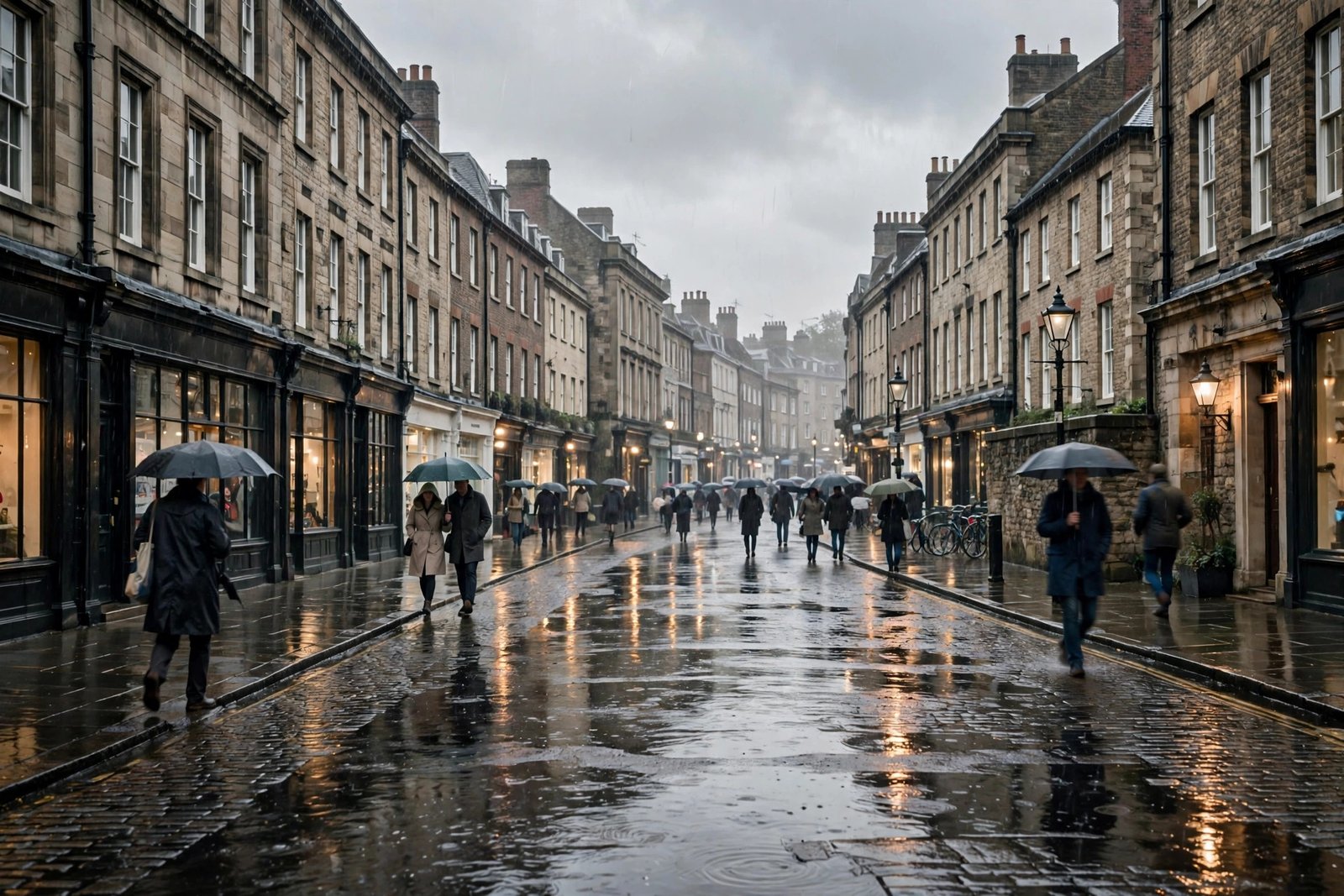
Britain’s reputation for rain is so entrenched that visitors pack waterproofs in July and locals treat a dry week as breaking news. But is the UK really as wet as its reputation suggests — and why does so much rain fall on these islands in the first place? The answer involves an ocean current, a restless jet stream, some very lumpy geography, and a quirk of atmospheric physics that puts Britain directly in the firing line of Atlantic weather.
Here is the simple version: warm, moist air streams off the Atlantic, hits Britain’s western hills, rises, cools, and dumps its moisture as rain. That one mechanism, repeated thousands of times a year, explains most of what falls from British skies. The details, though, are more interesting — and they explain why Manchester is famously damp while parts of Essex are drier than some Mediterranean spots.
Britain sits in the path of Atlantic weather systems
The single biggest reason for British rain is location. The UK lies between roughly 50 and 59 degrees north, squarely in the track of the mid-latitude westerlies — the prevailing winds that blow from west to east around the globe. These winds carry a conveyor belt of low-pressure systems, born over the Atlantic, that march towards Britain like an endless queue. Each low pressure system drags in warm, moisture-laden air, and as the system passes, that air is forced upward, cools, and condenses into cloud and rain.
The engine room is the temperature contrast between the warm subtropical Atlantic and the cold polar regions. Where those air masses meet, the jet stream — a fast river of air several miles up — snakes across the ocean, steering depressions straight at the British Isles. When the jet stream sits directly over Britain, as it often does in autumn and winter, the rain keeps coming in waves. The Met Office’s explainers on UK weather patterns track exactly how this steering current shapes each season.
The Gulf Stream’s warm-water bonus
The North Atlantic Drift, the extension of the Gulf Stream that washes Britain’s western shores, keeps surrounding seas unusually warm for this latitude — several degrees warmer than equivalent latitudes on Canada’s east coast. Warm water means more evaporation, which means the air arriving over Britain is loaded with moisture. It is the same current that gives Cornwall palm trees and keeps British winters mild, but it exacts its price in rainfall. Our separate guide to the best time to visit Cornwall shows the sunnier side of that bargain.
Hills squeeze the moisture out of the air
Rainfall in Britain is wildly uneven, and mountains are the reason. When moist Atlantic air meets high ground — the Cambrian Mountains of Wales, the Lake District fells, the Scottish Highlands — it is forced to rise. Rising air cools, and cool air cannot hold as much water vapour, so the moisture condenses and falls as rain. This is called orographic rainfall, and it is why the wettest places in Britain are all in the west and on high ground.
The numbers are striking. Seathwaite in Cumbria, tucked into the Borrowdale valley, averages around 3,500mm of rain a year — among the wettest inhabited places in the country. Parts of the Scottish Highlands exceed 4,000mm. Meanwhile, much of eastern England sits in a rain shadow: by the time the air has crossed the Pennines or the Welsh mountains, it has already shed most of its moisture. Cambridge averages barely 550mm a year — drier than parts of Spain. So when someone says “it always rains in Britain,” the honest reply is: it depends enormously on where in Britain you are standing.
The jet stream decides our seasons
If the westerlies are the delivery drivers, the jet stream is the satnav. This high-altitude current meanders in great waves, and its position determines what weather Britain gets. A jet stream parked to the north lets high pressure build over the UK — the settled, dry spells of a good summer. A jet stream draped across the south funnels depression after depression over the country, producing the grey, drizzly weeks of a bad one.
The jet stream also explains Britain’s notorious variability. Because the UK sits near the boundary between tropical and polar air, small shifts in the jet stream flip the country between air masses. It is entirely normal to experience four seasons in a day in Manchester or Glasgow — sunshine, showers, wind and a rainbow before lunch. Climate scientists are studying whether Arctic warming is making the jet stream wavier and slower, which could lock weather patterns in place for longer — longer droughts, but also longer deluges. Planning around the unpredictability is a national skill; see our tips on how to dress for unpredictable British weather.
Is Britain actually that rainy? The surprising truth
Here is the twist: by global standards, most of Britain is not especially wet. London’s annual rainfall of around 600mm is less than Rome’s, less than Sydney’s, and roughly half of New York’s. Even famously drizzly Manchester gets about 800mm — comparable to many continental cities. What Britain has is not exceptional volume but exceptional frequency: rain falls on around 150 days a year in the west and 110 in parts of the east, but often as light drizzle rather than dramatic downpours.
That frequency shapes the national character more than the totals. Gardeners plant for damp, architects design for driving rain, and the BBC Weather pages remain some of the most visited on the British internet. And when the rain does come in volume — the winter storms that batter the west coast, the summer cloudbursts that flood city streets — it reminds everyone that averages hide extremes. If you are stuck indoors with children during one of those downpours, our list of rainy-day ideas for kids across the UK may save the day.
Climate change is rewriting the rainfall map
Warmer air holds more moisture — roughly 7% more for every degree Celsius of warming — so a warming climate means heavier downpours when it rains. The Met Office’s UK climate projections show winters getting wetter, with more intense rainfall events, while summers trend drier overall but punctuated by fiercer cloudbursts. The winter floods that have repeatedly hit Yorkshire, Cumbria and the Somerset Levels are consistent with that picture.
For Britain, the future is less “more rain” than “rain arriving differently”: longer dry spells broken by more violent wet episodes. Water companies, farmers and flood planners are all redesigning around that new reality. The national conversation about rain, in other words, is shifting from a joke about the weather to a serious question about resilience.
Conclusion
Britain gets so much rain because it sits exactly where warm Atlantic air, the jet stream and western mountains conspire to wring moisture from the sky — a geographic lottery ticket that brings mild winters, green fields and a great deal of drizzle. The reputation outruns the reality in the drier east, but the frequency of wet days is real enough to define the culture. And as the climate warms, the British relationship with rain is evolving from resigned acceptance to active adaptation. The umbrellas, it seems, are staying.
Frequently Asked Questions
Which is the wettest place in the UK?
Seathwaite in Borrowdale, Cumbria, is usually cited as England’s wettest inhabited place, averaging around 3,500mm a year. Some exposed Highland sites in Scotland record even more.
Is London rainier than other European capitals?
No — London averages about 600mm a year, less than Rome, Paris or Berlin. Britain’s reputation comes from the frequency of damp, grey days rather than the volume of rain.
Why does it rain more in the west of Britain?
Moist Atlantic air hits western hills first and is forced upward, cooling and releasing rain. Eastern areas sit in the resulting rain shadow and are much drier.
Will climate change make the UK wetter?
Projections point to wetter winters with heavier downpours and drier summers overall, with more intense rainfall events year-round as warmer air holds more moisture.