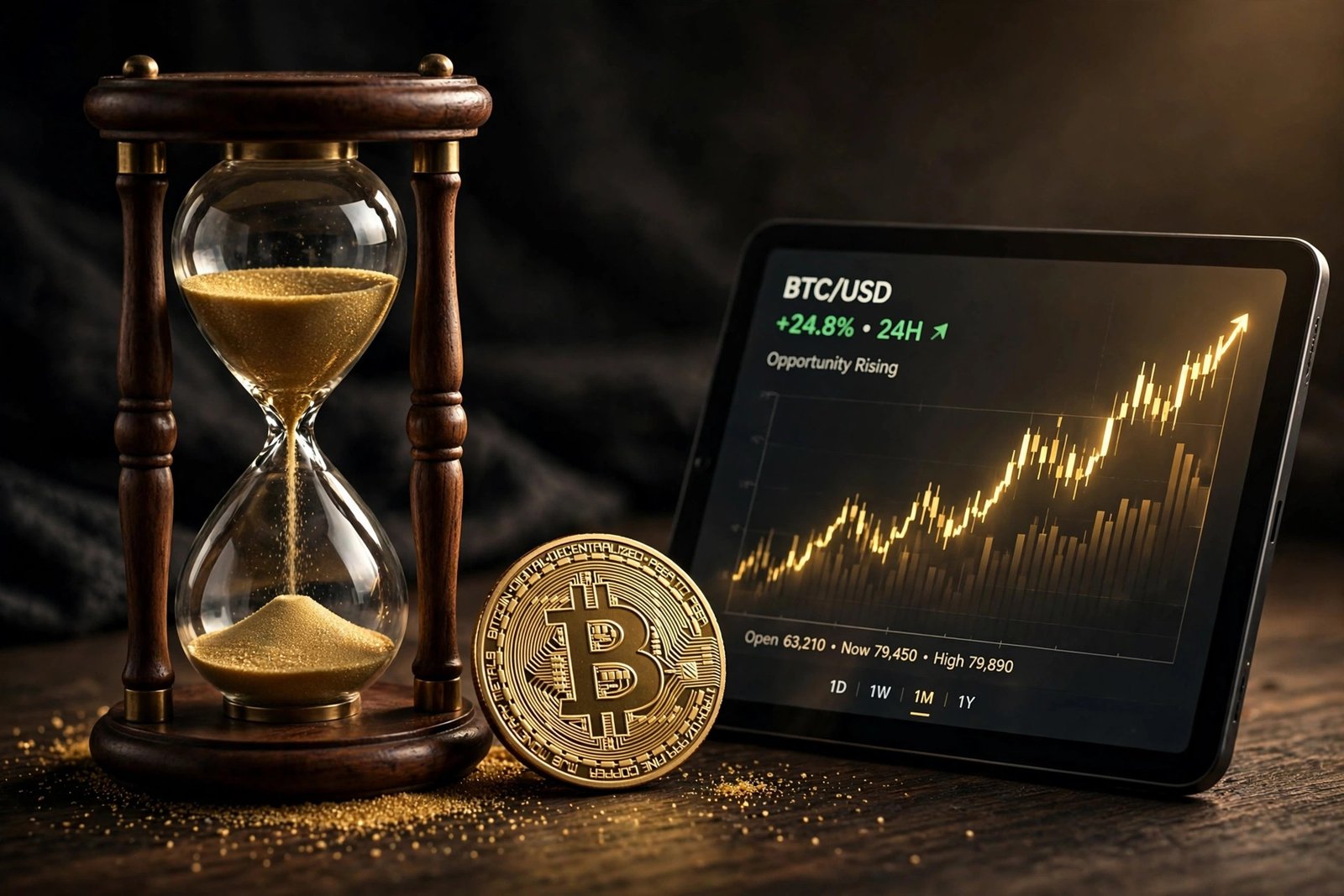
Bitcoin has been declared dead more than 400 times by the financial press — and yet here we are in 2026, with the price having weathered multiple 70%-plus crashes and returned to make new highs each cycle. If you’re in Britain wondering whether you’ve missed the boat, you’re asking the question at the most psychologically difficult moment: after the early adopters got rich and before anyone knows what comes next. The honest answer isn’t yes or no — it’s a framework for thinking about it clearly.
What “too late” would actually mean
Let’s define terms. If “too late” means “too late to turn £100 into £1 million,” then yes — that ship sailed around 2013, when Bitcoin traded for tens of pounds. The 100x returns belonged to people who bought when Bitcoin was an experiment discussed on cryptography mailing lists. But if “too late” means “too late to earn a reasonable return as part of a diversified portfolio,” that’s a very different question — and the answer depends on whether you believe Bitcoin still has adoption growth ahead of it.
Consider the adoption lens: global crypto ownership remains a single-digit percentage of adults, institutional involvement (ETFs, corporate treasuries, pension fund allocations) is still in its early innings, and regulatory clarity — including the UK’s FCA framework — is maturing rather than complete. Every previous “too late” moment (2017’s peak, 2021’s peak) was followed, eventually, by new highs. Past performance guarantees nothing, but the pattern suggests “late” is relative to your time horizon, not the calendar.
The case that it’s not too late
Bulls point to structural demand: Bitcoin’s supply is capped at 21 million coins, with issuance halving roughly every four years — the 2024 halving cut new supply again, and the next looms in 2028. Against fixed supply, even modest demand growth moves prices significantly. Add maturing infrastructure (spot Bitcoin ETFs approved in the US in 2024 opened the floodgates for institutional money), growing acceptance as a treasury asset, and the long-term narrative of digital scarcity in an inflationary world. For a British investor, the FCA’s regulated on-ramps and the 24-hour cooling-off protection make 2026 arguably the safest time to start — if not the cheapest.
The case for caution (stronger than the hype admits)
Now the other side, because balance matters. Bitcoin at 2026 prices needs enormously more capital inflow to double than it did at 2016 prices — the mathematics of large numbers cuts both ways. Regulatory risk is real: governments could restrict, tax or disincentivise crypto in ways that dent demand. Competition from central bank digital currencies and improved payment tech could erode the “digital gold” narrative. And volatility hasn’t gone away — 50% drawdowns remain entirely possible, which is devastating if your time horizon is short or your position is oversized. Anyone promising you the next 100x is selling something, usually themselves. The FCA’s crypto guidance is blunt: only invest money you could afford to lose entirely.
How a sensible Brit approaches Bitcoin in 2026
Forget timing the market — position yourself so timing doesn’t matter. That means: only invest genuine surplus, after your foundations are set. If you haven’t built an emergency fund of three to six months’ expenses, do that first; Bitcoin is not a savings account. Size the position so a 70% fall wouldn’t change your life — for most people, that’s a low single-digit percentage of savings. Use pound-cost averaging (small regular buys) rather than one dramatic lump sum; it removes the “did I buy at the top?” anxiety entirely. And if money is tight, our UK low-income budgeting guide will find you the surplus honestly rather than magically.
Also understand what you’re buying into tax-wise: Bitcoin gains above the £3,000 annual exempt amount face CGT at 10% or 20%, per HMRC’s guidance — factor that into your expectations of any return.
The 2026 landscape: what’s actually different now
It’s worth pausing on why 2026 specifically is a different moment from 2017 or 2021. Then, buying Bitcoin meant wiring money to lightly regulated offshore exchanges with minimal consumer protection. Now, a British buyer gets FCA-mandated risk warnings, a 24-hour cooling-off period, registered firms, and banks with sophisticated fraud monitoring watching the payment rails. The Wild West era is over — which cuts both ways. The protections reduce your chance of being scammed, but they also reflect a market that has matured: the inefficiencies and information gaps that created 100x opportunities have largely been arbitraged away by professional money. You’re buying into a more legitimate asset and, almost by definition, a less explosive one. Set your expectations for the market you have, not the market of legend.
There’s also a tax dimension that’s tighter than it used to be. The CGT annual exempt amount is £3,000 — a fraction of the £12,300 it was a few years ago — so even modest gains now fall into the taxable zone, and HMRC receives data directly from UK exchanges. Factor a 10–20% tax haircut into any return scenario you model. None of this makes Bitcoin a bad investment; it makes it a normal investment, subject to normal frictions. The investors who do well from here will be the patient, diversified, tax-aware ones — not the ones waiting for 2013 to happen again.
The bottom line
Is it too late to invest in Bitcoin in 2026? Too late for life-changing 100x returns on pocket money — almost certainly. Too late to participate in an asset class that may still have meaningful adoption growth ahead — probably not, if your horizon is years and your position is sensibly sized. The question that matters isn’t “is it too late?” but “can I afford to be wrong?” If the answer is yes — surplus money, small position, long horizon, proper records — then 2026 is as good a time as any to start learning. If the answer is no, no price and no year makes it the right time.
And one final thought for the genuinely undecided: you don’t have to decide everything today. Buying £25 of Bitcoin to learn how wallets, exchanges and volatility actually feel is not “investing in Bitcoin” in any meaningful financial sense — it’s inexpensive education. The investors who navigate crypto best tend to be the ones who learned the mechanics with tiny amounts before committing real money. Curiosity, funded with pocket change, is never too late.
Frequently Asked Questions
Has Bitcoin already peaked?
Nobody knows. Bitcoin has set new all-time highs after every major crash so far, but past cycles don’t guarantee future ones. Treat predictions in either direction with scepticism.
Is 2026 a good year to buy Bitcoin?
There’s no reliably “good” year — timing the market consistently is essentially impossible. Pound-cost averaging over time matters more than picking the perfect entry point.
Can Bitcoin still go up 10x from here?
Mathematically possible, but requiring vastly more capital than previous 10x moves. Base your planning on modest scenarios, not lottery outcomes.
Should beginners buy Bitcoin or Ethereum in 2026?
Bitcoin is the simpler, more established starting point — digital scarcity with the longest track record. Ethereum adds complexity (and opportunity) via smart contracts. Many beginners start with Bitcoin and learn from there.
What’s the biggest risk of buying Bitcoin now?
Volatility combined with oversizing: a 50% drawdown on a sensibly small position is a shrug; on money you needed, it’s a crisis. Position size is the risk control that matters most.