Every year, millions of Britons pay tax they don’t need to pay — on savings interest and investment gains that could have been completely tax-free inside an ISA. The Individual Savings Account is the single most powerful tool in UK personal finance: a government-backed wrapper that shields your money from Income Tax, Capital Gains Tax and dividend tax, year after year. Yet surveys consistently show huge numbers of people either don’t have one or don’t understand how they work. This guide fixes that — plainly, completely, and with the numbers that matter.
What an ISA actually is
Think of an ISA not as an account but as a wrapper — a tax-free forcefield you put around your savings or investments. Inside the wrapper, interest, dividends and capital gains are all tax-free, forever. Outside it, the same returns get taxed. The wrapper itself doesn’t earn anything; what earns is what you put inside it: cash in a Cash ISA, shares and funds in a Stocks & Shares ISA, and so on. The government’s official ISA guidance on GOV.UK sets out the rules, but the concept is simple: the state gives every UK adult a annual tax-free allowance, and the ISA is how you use it.
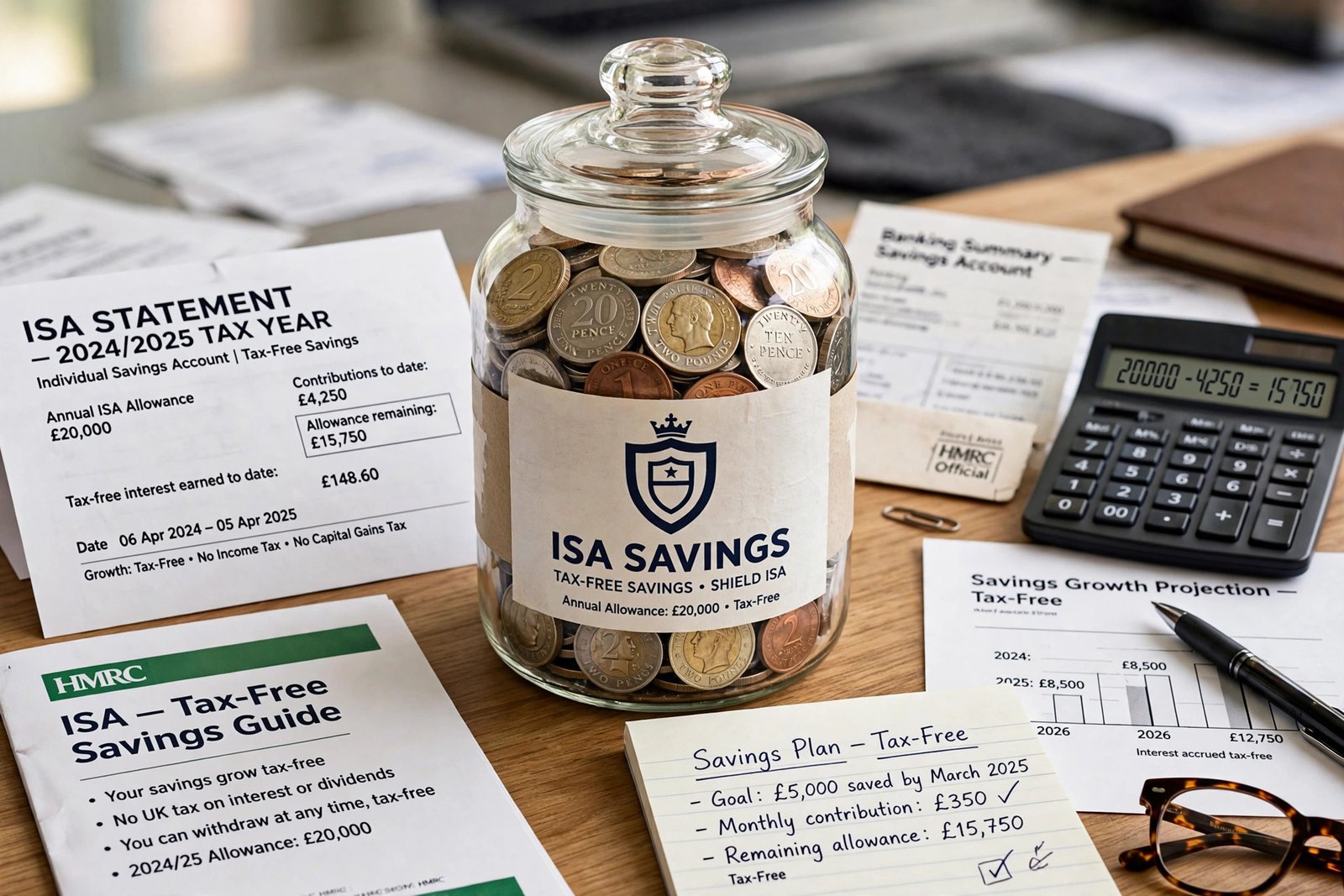
That allowance is £20,000 per tax year (6 April to 5 April) — the total you can put across all your ISAs combined, excluding Junior ISAs which are separate. Use it or lose it: unused allowance doesn’t roll over. You must be 18 or over and UK-resident to open one (16–17 year olds have more limited options).
The four main ISA types (and who each suits)
Cash ISA. A tax-free savings account. Your money earns interest, pays no tax on it, and (with easy-access versions) you can withdraw anytime. Best for: emergency funds and short-term savings goals. In a world of 4–5% savings rates, the tax saving is meaningful for higher earners and anyone exceeding their personal savings allowance.
Stocks & Shares ISA. A tax-free investment account holding shares, funds, bonds or investment trusts. Best for: long-term goals (5+ years) — retirement top-ups, future house deposits beyond LISA limits, general wealth building. This is where the ISA’s power compounds most dramatically: decades of tax-free growth.
Lifetime ISA (LISA). For first-time buyers and retirement: save up to £4,000 a year and the government adds a 25% bonus (£1,000 max). Withdraw for a first home (up to £450,000, per the Lifetime ISA rules on GOV.UK) or after 60 with no penalty; other withdrawals face a 25% charge that claws back the bonus plus a bit more. Best for: first-time buyers who’ll definitely buy.
Junior ISA. For children under 18: £9,000 annual allowance, tax-free growth, locked until 18. Best for: long-term saving for children — though remember the child gets full control at 18.
You can hold multiple types simultaneously as long as total subscriptions stay within £20,000 — and since rule changes, you can now subscribe to multiple ISAs of the same type in one year too.
Cash ISA vs Stocks & Shares ISA: the core decision
This is the choice that matters most. The trade-off is time horizon versus volatility. Money you’ll need within five years — house deposit, emergency buffer — belongs in cash: the value won’t fall, and with competitive rates the tax-free interest is genuinely worthwhile. Money you won’t touch for five-plus years historically grows far more in investments: UK and global stock markets have returned roughly 7–8% annually over long periods (before inflation and fees), versus 1–4% for cash. Over 20 years, that gap compounds into life-changing differences.
The fear that stops people — “what if the market crashes?” — is legitimate but manageable: invest monthly rather than in one lump (smoothing entry prices), diversify globally through a low-cost index fund, and simply don’t look. Investors who opened Stocks & Shares ISAs and ignored them for a decade have overwhelmingly done well; investors who panicked and sold in 2008 or 2020 locked in the losses the patient ones avoided. Before investing, though, make sure your safety net exists — build an emergency fund in easy-access cash first, so market dips never force you to sell investments at the worst moment.
Common ISA mistakes beginners make
Leaving the allowance unused. The £20,000 allowance resets every 6 April and doesn’t roll over. You don’t need to fill it — but even £50 a month into a Stocks & Shares ISA builds the habit that matters. Paying high fees. A 1% annual platform/fund fee versus 0.2% sounds trivial; over 30 years it can devour a quarter of your returns. Choose low-cost platforms and index funds. Keeping long-term money in cash. Inflation at 2–3% silently halves cash’s purchasing power every ~25 years; long-term cash holdings are a guaranteed slow loss. Raiding the ISA for non-emergencies. Every withdrawal resets the compounding clock — treat the Stocks & Shares ISA as untouchable. And ignoring the LISA if you’re a first-time buyer — the 25% government bonus is free money most buyers leave on the table; our guide to saving a house deposit shows how it fits the bigger picture.
How to open your first ISA (15 minutes)
One: decide cash versus stocks & shares (or both). Two: compare providers on fees, fund choice and app quality — banks, building societies and investment platforms all offer ISAs. Three: apply online with ID (driving licence/passport) and your National Insurance number; it takes minutes. Four: set up a monthly direct debit — automation beats willpower every time. Five: if investing, choose a global index fund as your default and leave it alone. That’s it. The hardest part was reading this guide.
The bottom line
ISAs are the closest thing UK personal finance has to free money: up to £20,000 a year shielded from all UK tax on returns, with options for cash savers, investors, first-time buyers and children. The mistakes are all avoidable — unused allowances, high fees, wrong time horizons — and the fix is always the same: open one, automate contributions, keep costs low, and let compounding work. Future-you, retiring years earlier or buying that first home with a fatter deposit, will be enormously grateful you spent fifteen minutes today.
Frequently Asked Questions
How much can I put in an ISA each year?
£20,000 per tax year across all your adult ISAs combined (excluding Junior ISAs, which have a separate £9,000 allowance). Unused allowance doesn’t carry over.
Can I have more than one ISA?
Yes — you can hold multiple types (Cash, Stocks & Shares, Lifetime) and, under current rules, multiple ISAs of the same type in one tax year, as long as total subscriptions stay within £20,000.
Is my money safe in an ISA?
Cash ISAs are covered by FSCS protection up to £85,000 per institution. Stocks & Shares ISAs carry investment risk, but the platform itself is FSCS-protected up to £85,000 if it fails.
Can I withdraw from an ISA anytime?
Cash and Stocks & Shares ISAs: yes (check for account-specific penalties). Lifetime ISAs: penalty-free only for a first home or after age 60 — other withdrawals face a 25% charge.
Should I choose a Cash ISA or Stocks & Shares ISA?
Cash for money needed within ~5 years or your emergency fund; Stocks & Shares for long-term goals (5+ years), where investment growth historically far outpaces cash.