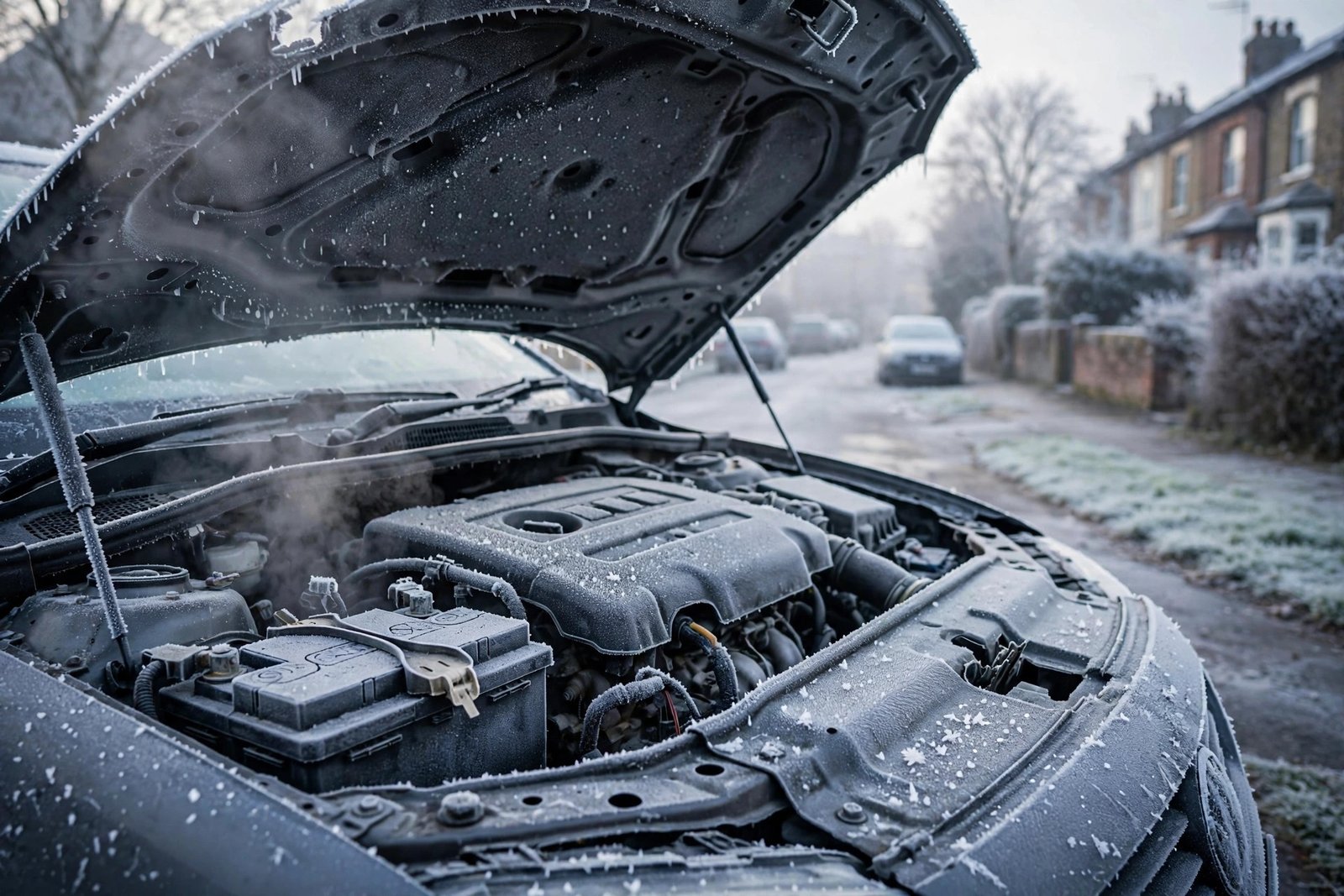
The coldest morning of the year, you are already late, and the starter motor gives that dreaded slow groan — or nothing at all. Car batteries hate British winters: freezing temperatures can rob a battery of a third of its cranking power just when the engine needs it most. The good news is that most winter battery failures are preventable with a little autumn preparation and a few cold-weather habits. Here is how to keep your battery alive through the frost.
Why cold kills batteries
It is chemistry. A car battery produces power through chemical reactions, and cold slows those reactions dramatically — at -18°C a battery delivers roughly half its rated power, and even at 0°C you lose 20–35%. Meanwhile the engine’s oil thickens in the cold, demanding more cranking effort. It is a double hit: less power available, more power needed.
Age makes it worse. Most batteries last 3–5 years, and a four-year-old battery that coped fine in October can give up in January. Short winter journeys compound the problem: starting the engine drains significant charge, and a five-minute trip to the shops never lets the alternator replace it. Do that twice daily for a month and the battery slowly starves. Add heated screens, blowers and lights all drawing power, and winter is simply the cruellest season for batteries — the same way phone batteries drain faster when worked hard in poor conditions.
The autumn check-up: prepare before the frost
October is battery month. Start with a visual inspection: corroded terminals (white or green crust) restrict current flow — clean them with a wire brush and a smear of petroleum jelly. Check the battery is clamped firmly; vibration kills batteries. If your battery has removable caps, check the electrolyte level and top up with distilled water (most modern batteries are sealed and maintenance-free).
Then test it properly. Many garages and battery retailers will do a free battery and charging-system test — a two-minute job with a proper tester that measures cold cranking amps against the battery’s rating. If it is marginal and over four years old, replace it pre-emptively in autumn: a £70–£150 battery fitted at your convenience beats a £200 emergency callout plus a missed day of work. Note that cars with stop-start systems need pricier AGM or EFB batteries (£150–£300) — fitting a cheap conventional battery will fail quickly and can upset the car’s electronics. Winter also brings condensation problems inside the car; a well-ventilated, regularly used car suffers less of both.
Daily habits that save your battery
Small habits make a big difference. Turn off lights, heated screens, blowers and heated seats before switching off the engine, so the next start is not fighting every electrical load at once. On freezing mornings, turn the ignition on for a few seconds before cranking to let the fuel pump prime and the glow plugs (diesel) warm. Once started, drive off gently rather than idling for ten minutes — modern engines warm faster under light load, and the alternator charges best above idle.
Most importantly, give the battery a proper run at least once a week: 20–30 minutes of driving recharges what daily short trips consume. If the car sits unused for weeks — common for second cars — connect a smart trickle charger/maintainer (CTEK and NOCO make the popular ones, £40–£80). These monitor the battery and top it up as needed without overcharging, and they can double a battery’s life. For cars parked on the street without power access, a solar trickle charger on the dashboard is a clever alternative. The AA lists battery failure as the top cause of winter callouts — almost all of them preventable.
When it dies anyway: jump starts and replacements
If the worst happens, jump-start correctly: connect red to the flat battery’s positive terminal, red to the donor’s positive, black to the donor’s negative, and black to an unpainted metal earth point on the flat car (not its negative terminal) — this avoids sparks near the battery. Start the donor car, wait a minute, then start yours. Remove leads in reverse order. Better still, carry a lithium jump-starter pack (£50–£100): pocket-sized, no donor car needed, and genuinely effective.
After a jump start, drive for at least 30 minutes to recharge — but know that a battery that has gone completely flat has suffered permanent damage and may never fully recover. If the car needed jumping once, get the battery and alternator tested within days; if twice, just replace it. When buying, match the specification (size, capacity, terminal layout) and register the battery with the car’s computer on modern vehicles — many BMWs, VWs and others need this coding step, which is why a garage fit (£20–£40 labour) often beats DIY. The RAC offers mobile battery fitting at your home or roadside, which on a freezing morning feels like money well spent.
Choosing the right replacement battery
When replacement time comes, buy the right battery — not just a cheap one. Three numbers matter: physical size and terminal layout (it must fit the tray and reach the cables), capacity in amp-hours (Ah), and cold cranking amps (CCA) — the latter being the most important for winter starting. Your handbook or the old battery’s label gives the specification; battery retailers’ reg-number lookup tools get it right in seconds.
Match the technology to the car. Standard cars take conventional flooded batteries (£60–£120). Stop-start cars need EFB or AGM types (£140–£300) — fitting a conventional battery will trigger warning lights and fail within months, a false economy that garages see constantly. Buy from a reputable retailer (Halfords, Euro Car Parts, or a motor factor) and check the manufacturing date — batteries self-discharge on the shelf, so fresher is better. Many offer free fitting, which is worth taking on modern cars that need battery registration coding. Keep the receipt: decent batteries carry 3–5 year warranties, and a warranty claim on a two-year-old battery is money back in your pocket.
Frequently Asked Questions
How long do car batteries last in the UK?
Typically 3–5 years, though heat, vibration and deep discharges shorten life. If yours is over four years old and cranking slowly on cold mornings, replace it before it strands you.
Will idling the car charge the battery?
Barely — the alternator produces little charge at idle. A 20–30 minute drive is far more effective. Idling for long periods also wastes fuel and, in some areas, can breach anti-idling rules.
Can I disconnect the battery if leaving the car for weeks?
You can, but modern cars may lose radio codes, window settings and learned engine parameters — and alarms/immobilisers may object. A smart trickle charger is the better solution.
Are expensive batteries worth it?
Buy the correct specification, not the most expensive. But do not fit a cheap conventional battery in a stop-start car that needs AGM/EFB — it will fail within months and the “saving” evaporates.
Conclusion
Winter battery survival is 90% preparation: test in autumn, replace when marginal, keep terminals clean, and give the car a proper weekly run or a trickle charger. Do that and the coldest morning becomes just another commute. Ignore it, and you will meet your breakdown provider at 7am in the frost — probably for the most preventable reason in motoring.