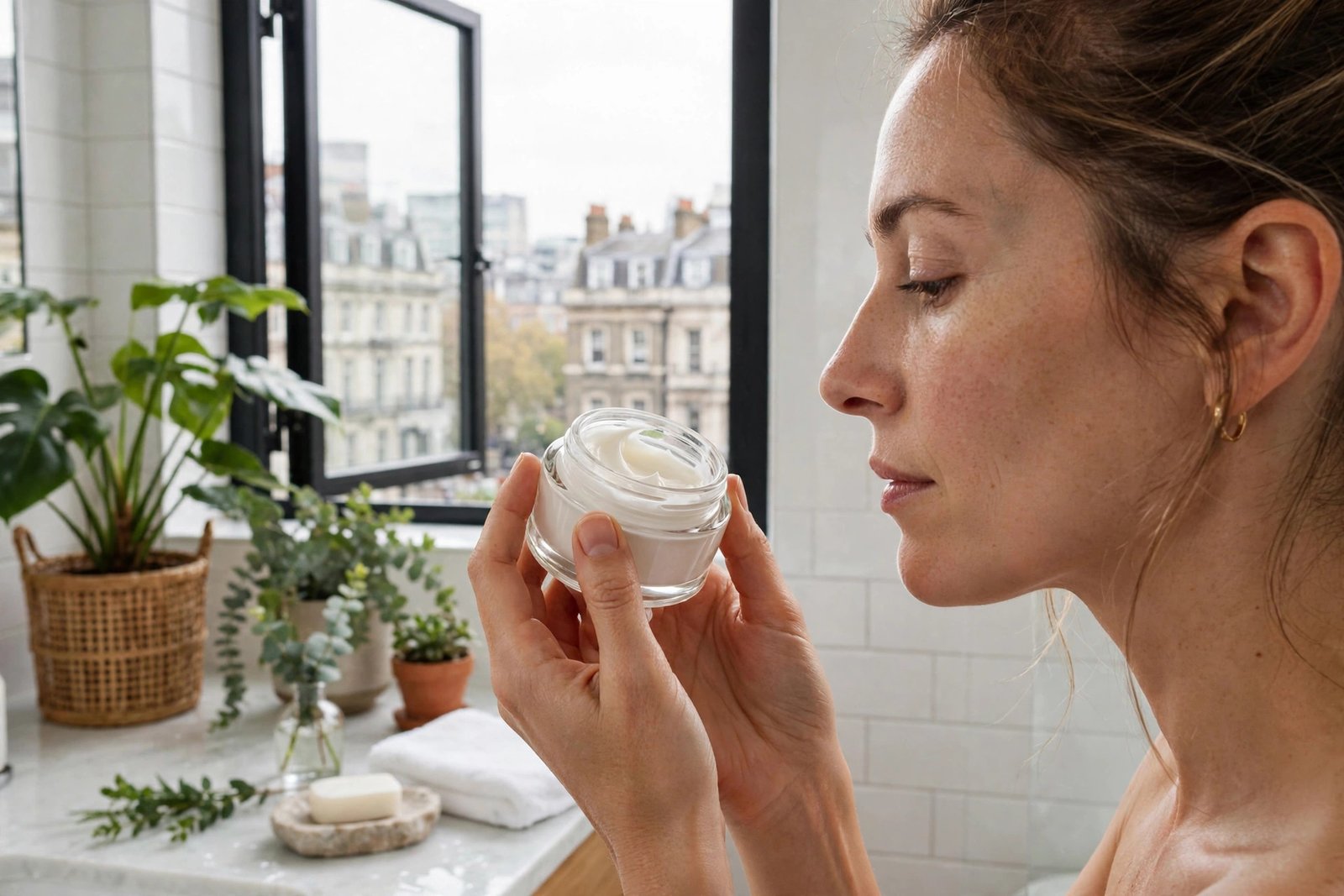
Oily across the T-zone by midday, tight and flaky on the cheeks by evening — combination skin is the skincare equivalent of needing two wardrobes for one body. Choosing a moisturiser for combination skin in London adds another layer of complexity: hard water, pollution, air-conditioned offices and unpredictable weather all pull your skin in different directions at once. The good news is that combination skin is the most common skin type in Britain, which means the industry has finally started formulating for it properly.
This guide explains how to read your combination skin’s conflicting signals, the ingredients that balance both zones, application techniques that treat each area appropriately, and how London’s specific conditions should shape your choice.
Understanding your combination pattern
Combination skin is not one thing — it is a map. Most people have an oily T-zone (forehead, nose, chin) with normal to dry cheeks, but variations abound: oily nose with dry everything else, seasonal combination that turns fully oily in summer and fully dry in winter, or dehydrated combination where the skin is simultaneously oily and lacking water. Spend a week observing: blot different zones midday, note where makeup breaks down first, and where tightness appears after cleansing.
The British Association of Dermatologists’ skincare guidance notes that over-treating one zone is the classic combination-skin error — nuking the T-zone with harsh products triggers rebound oil, while rich creams on oily areas cause congestion. Balance, not aggression, is the goal.
Ingredients that multitask well
Certain ingredients suit both zones simultaneously. Niacinamide (vitamin B3) regulates sebum in oily areas while strengthening the barrier in dry ones — arguably the single best combination-skin ingredient. Hyaluronic acid hydrates without oil, suiting the whole face. Lightweight ceramides support the barrier everywhere without heaviness. Gel-cream textures deliver water-based hydration that satisfies dry cheeks without overwhelming the T-zone.
What to avoid: heavy occlusives like coconut oil or thick butters across the whole face (fine as spot treatments on dry patches), harsh alcohol-based toners, and physical scrubs that irritate dry zones while overstimulating oily ones. Fragrance is worth avoiding too — it offers nothing and irritates the drier areas disproportionately.
The two-moisturiser method vs one smart product
You have two legitimate strategies. The multi-moisturising approach uses a light gel on the T-zone and a richer cream on the cheeks — maximum customisation, more faff. The single smart product approach uses one well-formulated gel-cream or balancing lotion everywhere — simpler, and modern formulations handle duality well. Most people land on a hybrid: one balancing moisturiser daily, with a richer cream as backup for cheeks in winter.
Application technique matters: apply to slightly damp skin, use less product on the T-zone, and press rather than rub. If your cheeks still feel tight after a single product, layer a hydrating serum underneath rather than switching to a heavier cream that will congest your nose. Affordable options abound — the UK’s best affordable high-street brands stock excellent niacinamide serums and gel moisturisers at sensible prices.
London-specific considerations
London’s environment shapes combination skin uniquely. Hard water — prevalent across the capital — leaves mineral residue that can irritate drier zones; if your cheeks feel tight after washing but your T-zone seems unaffected, hard water may be the culprit, and a gentle, thorough cleanse matters more. Pollution and particulate matter settle on skin during commutes, making the evening cleanse non-negotiable, particularly for congestion-prone T-zones.
Air-conditioned offices dehydrate exposed skin all year, so keep a facial mist or light hydrating serum at your desk for midday cheek rescue. And London’s stop-start weather means your skin rarely acclimatises — a flexible routine with adjustable layers beats a rigid one. For a restorative reset from city stress, our guide to planning a spa day at home offers gentle, barrier-friendly treatments.
Seasonal adjustments
Combination skin is rarely static across the year. Summer usually means a lighter touch everywhere — gel textures, blotting papers for the T-zone, possibly skipping moisturiser on the oiliest areas in favour of SPF alone. Winter reverses it: richer cheek hydration, facial oils as targeted treatments, and humidifier use at home to combat central heating.
Transition gradually between seasons rather than overhauling overnight, and introduce one change at a time so you can identify what works. The NHS guidance on dry skin offers useful background on managing the dry zones through winter.
Makeup and SPF layering for combination skin
Combination skin complicates makeup as well as skincare. Primer choice matters: a mattifying primer on the T-zone and a hydrating one on the cheeks prevents the midday split where foundation slides off the nose but clings to dry patches. Apply foundation thinly and set only the T-zone with powder, leaving cheeks luminous. Blotting papers pressed (not rubbed) on the nose and forehead at midday rescue shine without disturbing the rest of the face.
SPF layering needs the same zonal thinking: apply your full two-finger amount everywhere, but choose textures strategically — a mattifying SPF for the T-zone prevents the greasy breakdown that ruins makeup, while dry cheeks tolerate richer formulas. On high-pollution London days, consider an antioxidant serum under SPF for extra environmental defence; pollution particles contribute to congestion in oily zones, making the evening double cleanse particularly important for combination skin.
The evening routine for combination skin
Evenings are when combination skin gets its targeted treatment. Double cleanse to remove the day’s SPF and pollution — crucial for congestion-prone T-zones — then apply any active (salicylic acid for the T-zone two to three nights weekly, or a retinoid for anti-ageing) before moisturising. Consider “multi-masking” weekly: a clay mask on the T-zone to draw out congestion, a hydrating mask on the cheeks simultaneously. Finish with your balancing moisturiser, adding a drop of facial oil pressed into dry areas only. The evening routine can be richer than the morning one — nothing needs to sit under makeup, so let the products work undisturbed overnight.
Conclusion
Choosing a moisturiser for combination skin in London is less about finding a miracle product and more about understanding your skin’s map: niacinamide and hyaluronic acid as workhorses, gel-cream textures as the default, targeted richer care for dry zones, and seasonal flexibility for the capital’s changeable conditions. Treat each zone according to its needs, respect the hard water and pollution realities, and remember that combination skin is normal skin — the most common type, not a problem to fix. Balance it, and it behaves beautifully.
Frequently Asked Questions
Can I use two different moisturisers on my face?
Absolutely — multi-moisturising (light gel on the T-zone, richer cream on cheeks) is a legitimate, effective strategy. It takes slightly longer but gives each zone exactly what it needs.
Does combination skin need exfoliation?
Gentle chemical exfoliation (such as salicylic acid) once or twice weekly helps keep the T-zone clear, but go easy on drier areas. Over-exfoliating dry zones worsens the imbalance.
Why is my T-zone oily but my skin feels tight?
That is dehydrated combination skin — lacking water, not oil. The tightness signals dehydration; the oiliness is often the skin overcompensating. Hydrating (not oil-stripping) products fix it.
Should combination skin use face oil?
As a targeted treatment on dry areas, yes — a few drops pressed into cheeks in the evening works well. Avoid heavy oils across the T-zone, which is already producing plenty.