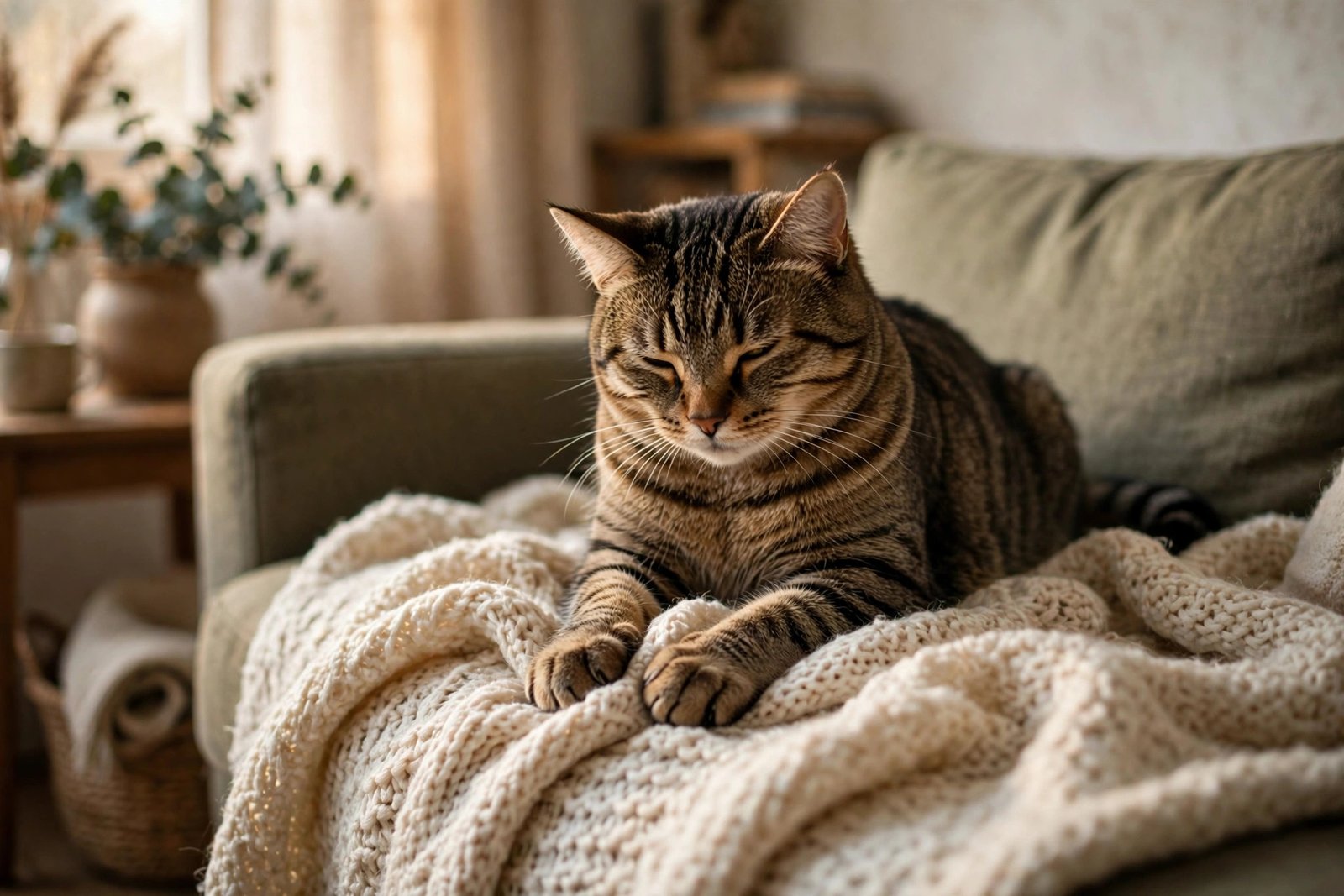
There they are, paws rhythmically pressing into your lap blanket, eyes half-closed, purring like a tiny engine — and if you are like most cat owners, you have wondered what on earth is going on. Kneading (or “making biscuits”, as the internet calls it) paired with loud purring is one of the most endearing feline behaviours, and also one of the most misunderstood. It is not random, it is not “weird”, and it is telling you something. Here is what your cat is actually communicating.
Kneading: a behaviour from the cradle
Kneading begins at birth. Newborn kittens knead their mother’s belly to stimulate milk flow while nursing, and the rhythmic paw-pressing becomes hardwired to feelings of warmth, safety and contentment. Adult cats knead when those same feelings resurface — on a soft blanket, on your lap, on the warm laundry pile. It is, essentially, a comfort behaviour: your cat is recreating the safest moment of their kittenhood.
There is more to it than nostalgia. Cats have scent glands in their paw pads, so kneading also marks territory — your blanket, your lap, you — as theirs and safe. Some behaviourists suggest kneading helps cats “test” a sleeping spot, a leftover instinct from wild ancestors patting down grass. And unneutered females may knead more when in season. Whatever the blend of reasons, the message is consistent: this cat feels secure. It is one of the clearest signs of a happy, bonded cat — and one more reason to keep their favourite textiles fresh, with our tips for keeping your house clean with pets.
Purring: more than just happiness
Purring is famously the sound of a contented cat — but it is also much more. Cats purr when happy, yes, but also when frightened, in pain, at the vet, and even while giving birth. Researchers believe purring serves as both communication and self-soothing: the low-frequency vibrations (25–150 Hz) may promote healing and bone density — a fascinating hypothesis for why cats recover from injuries remarkably well, and why they purr when hurt.
Context is everything. A cat kneading and purring on your lap at bedtime is broadcasting bliss. A cat purring while crouched, tense, with dilated pupils at the vet is self-soothing through stress — the feline equivalent of a person humming nervously. Learning to read the whole body, not just the soundtrack, is what separates experienced cat owners from beginners. Like humans managing their own stress responses — see our guide to managing anxiety without medication — cats have evolved their own calming mechanisms, and purring is chief among them. International Cat Care publishes excellent behaviour guides decoding these signals.
Why the combination? Kneading + purring decoded
When kneading and loud purring happen together, you are witnessing peak feline contentment — the two comfort behaviours amplifying each other. This combination almost always means: I am safe, I am happy, and I associate you with kittenhood security. It is, behaviourists agree, one of the highest compliments a cat can pay. Some cats drool slightly while doing it (a leftover nursing response); some go into a trance-like state. All normal.
Occasionally the combination appears in other contexts. A cat who suddenly starts kneading and purring excessively — especially an older cat, or one doing it on hard surfaces rather than soft ones — may be self-soothing through discomfort or anxiety rather than expressing joy. Changes in long-standing behaviour patterns deserve attention: increased kneading alongside appetite changes, hiding or litter tray issues warrants a vet check. But for the vast majority of cats, on the vast majority of evenings, biscuits plus purr equals happiness. Enjoy it — and maybe keep a dedicated “kneading blanket” to spare your good throw. Cats Protection notes that kneading is most common in cats separated from their mothers early, who retain the strongest kitten associations.
Should you ever discourage it?
The claws are the issue. Kneading with claws out on bare legs is painful, and many owners instinctively push the cat away — which punishes a behaviour rooted in love and security. Better solutions: keep claws trimmed (just the sharp tips, never declaw — illegal in the UK and cruel), place a thick blanket on your lap as a designated kneading pad, or gently redirect paws onto the blanket rather than your skin.
Never punish kneading itself. It is a core comfort behaviour, and suppressing it removes one of the cat’s primary self-soothing tools — like telling a person to stop sighing when relieved. If the kneading becomes compulsive (constant, on every surface, accompanied by wool-sucking or over-grooming), discuss it with your vet, as it can signal anxiety or, rarely, neurological issues. But the everyday evening biscuit session? That is your cat at their happiest. The appropriate response is a slow blink, a gentle stroke, and gratitude.
Kneading styles: what the variations mean
Not all kneading looks the same, and the variations carry their own messages. The classic alternating paw-press on a soft blanket is pure contentment. Kneading on hard surfaces — floors, tables, your laptop keyboard — often signals a cat working harder to self-soothe, and is worth noting if it is new behaviour. “Air kneading”, paws pumping at nothing while lying on their side, usually happens in deeply relaxed or half-asleep cats. Some cats knead only specific people or one treasured blanket, showing how strongly the behaviour ties to particular comfort associations.
Age matters too. Kittens knead instinctively; most cats continue lifelong, but a senior cat that suddenly stops kneading may be telling you about arthritis — pressing paws can hurt stiff joints. Conversely, a cat that has never kneaded and starts in old age may be seeking comfort for an underlying issue. As with every behaviour in this article, the trend is the message: know your cat’s normal, and treat changes as information. The biscuit-making ritual is a window into your cat’s emotional life — keep watching, and keep that dedicated blanket clean.
Frequently Asked Questions
Why does my cat knead me and not my partner?
Cats knead the people (and blankets) they associate most strongly with comfort and security. It is a compliment — you are the chosen safe space. Scent, warmth and who feeds them all play a role.
Is it normal for cats to drool while kneading?
Yes — slight drooling is a leftover nursing response and completely normal in contented kneaders. Excessive drooling outside kneading, however, can indicate dental issues and deserves a vet check.
Why does my cat purr when at the vet if purring means happy?
Because purring is also self-soothing. A stressed or painful cat purrs to calm itself — the feline equivalent of deep breathing. Read the body language (tense posture, dilated pupils) alongside the sound.
Can I stop my cat kneading with claws?
Redirect rather than punish: keep claws trimmed, provide a thick designated blanket, and gently move paws onto it. Never punish the behaviour itself — it is rooted in comfort and security.
Conclusion
Kneading plus loud purring is your cat’s love letter, written in the language of kittenhood: I feel safe, I am content, and you are home. Understand it, protect the claws-and-legs situation with a blanket, and never punish it. In the small hours, with a warm cat making biscuits on your lap and the house quiet, you are experiencing one of domestic life’s purest pleasures. Purr back (metaphorically) and enjoy it.