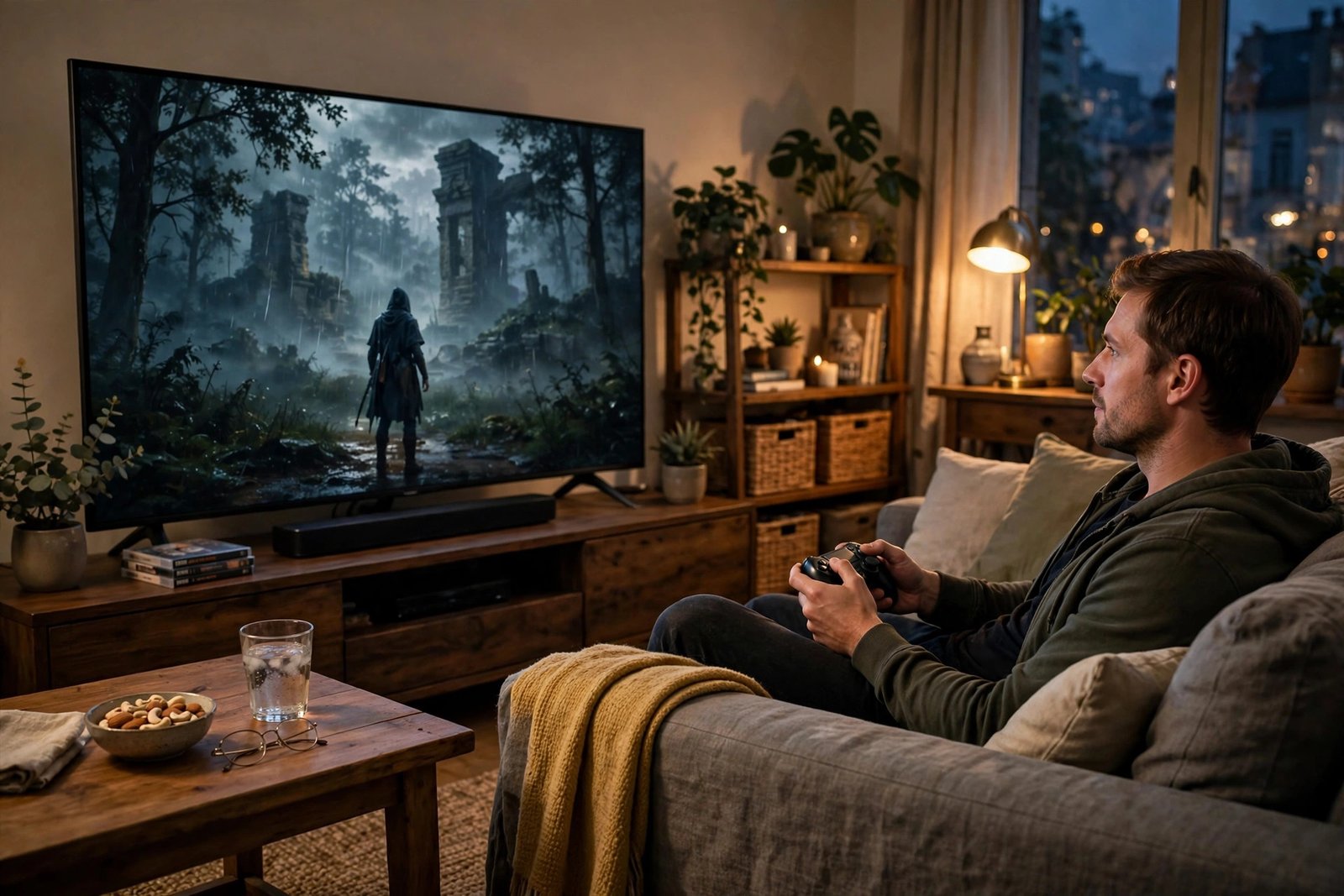
“I don’t play games” — followed, often, by “…but I loved that one.” Some video games transcend the hobby entirely: no reflexes required, no forty-hour commitment, just a great story you happen to play rather than watch. For the curious non-gamer — the reader, the film lover, the partner dragged to the sofa — these are the titles that convert sceptics.
What makes a game work for non-gamers is specific: intuitive controls, a compelling narrative that respects your time, minimal fail states, and an experience that could not exist in any other medium. Here are the best of them, and how to approach each.
What non-gamers actually want (and what puts them off)
The barriers are predictable: complex controls (dual-stick movement plus camera plus buttons is genuinely hard for newcomers), punishment for failure (dying repeatedly is humiliating, not fun), time demands (open-world epics assume a lifestyle), and cultural opacity (jargon, lore, assumed knowledge). The games below sidestep all four: most need only a couple of buttons, none punish experimentation harshly, several finish in an evening or two, and all explain themselves as they go.
The mindset shift that helps: think of these as interactive stories, not tests of skill. There is no shame in easy mode, in following a guide when stuck, or in treating the controller as a remote control with extra steps. The medium meets you halfway — these titles were designed for exactly this audience. Eurogamer’s reviews reliably identify the story games that deliver. Great narratives are a shared pleasure across media; see what to watch on Netflix UK right now for the passive equivalent.
The essential list
Firewatch
You are a fire lookout in the Wyoming wilderness, armed with a radio and a growing relationship with your supervisor — a first-person story about escape, connection and mystery that lasts about four hours. The controls are walking and talking; the writing is superb; the ending is debated to this day. The perfect first game for a reader.
What Remains of Edith Finch
A young woman explores her family’s strange house on an island off Washington State, each room unlocking a self-contained vignette about a relative’s life and death. Beautiful, melancholy, utterly unlike anything else — and completable in two hours. Frequently cited as the game that made non-gamers cry.
Life is Strange
A photography student discovers she can rewind time, and uses it to solve a mystery at her Oregon school. Episodic, choice-driven, emotionally devastating — essentially an interactive indie film about friendship and consequence. The rewind mechanic means mistakes are never punished, removing the fear of failure entirely.
Journey
A wordless pilgrimage across a desert towards a distant mountain, scored by a Grammy-nominated soundtrack, with anonymous fellow travellers who can help but never speak. Two hours long, profoundly moving, and proof that games can be art without a single line of dialogue. Play it in one sitting, lights low.
Detroit: Become Human
A branching sci-fi thriller about androids gaining consciousness, where every choice reshapes the story — with a flowchart after each chapter showing the paths you did not take, inviting replay. Glossy, cinematic and propulsive; ideal for the film fan who wants agency.
Unpacking
Tell a life story by unpacking boxes across eight moves, from childhood bedroom to first flat to family home. No dialogue, no fail states — just objects, rooms and the quiet devastation of narrative told through possessions. Zen, poignant and utterly accessible; many non-gamers’ surprise favourite.
How to play them: the practical setup
You do not need a gaming PC or the latest console. Most of these run on modest hardware: several are on Nintendo Switch (the most non-gamer-friendly console — intuitive, portable, no setup fuss), many are on PlayStation and Xbox via subscription catalogues (PlayStation Plus Extra and Game Pass include several list titles, making experimentation nearly free), and all are on PC via Steam, where frequent sales drop prices to £5–£15.
Start with the shortest (Journey, Edith Finch, Unpacking) to calibrate your taste before committing to longer ones. Play on the easiest difficulty without apology — these games’ stories do not depend on challenge. And consider co-playing: one person on controls, partner navigating and deciding — the “backseat driver” model is a beloved way couples and families share story games, turning a solo medium social. British television does character-driven storytelling brilliantly too; see the best British dramas to binge-watch.
If you want more
Graduate to: Outer Wilds (a time-loop space mystery, the connoisseur’s choice), Disco Elysium (a novel disguised as a detective RPG), Hades (for those who discover they enjoy a little action), and Pentiment (a medieval murder mystery for history lovers). Each respects the non-gamer’s priorities while offering more depth.
Why interactivity changes the story
Sceptics ask why anyone would “play” a story rather than watch it — and the answer is that agency transforms narrative emotionally. Choosing whether a character lives or dies, even in a fictional branching path, implicates you in a way watching never does: players report guilt, pride and grief over decisions that viewers merely observe. Environmental storytelling — piecing together what happened from the objects in a room, as in Gone Home or Edith Finch — makes discovery active rather than passive; the story lands harder because you found it. And the pacing is yours: linger in a beautiful scene, rush the boring bit, replay the choice that haunts you. Film gives you the director’s rhythm; games give you your own. It is a different art form, not a lesser one — and for the non-gamer willing to pick up the controller, it offers emotional experiences no other medium can provide.
Conclusion
The best story-driven games for non-gamers share a philosophy: the story is the point, the controls are an invitation, and your time is respected. Start with Firewatch or Edith Finch on whatever screen is nearest, give it two unhurried hours, and see. You may discover — as millions of sceptics have — that “I don’t play games” was only ever true until the right one came along.
Frequently Asked Questions
What is a good first video game for someone who never plays?
Firewatch, What Remains of Edith Finch, Journey or Unpacking — all short (2–5 hours), intuitive to control, with no meaningful fail states and outstanding stories.
Do I need an expensive console to play story games?
No — most run on Nintendo Switch, older consoles, modest PCs, or via subscription services (Game Pass, PlayStation Plus Extra) that make trying them nearly free.
Are story games actually games or just films?
They are games whose primary mechanic is choice, exploration or expression rather than reflex challenge — interactivity shapes the narrative in ways film cannot replicate.
Can you play story games with a partner?
Absolutely — “co-playing” (one on controls, one navigating/deciding) is a popular way to share story games, and some titles offer dedicated co-op story modes. Many couples report it becoming a cherished shared ritual, like a book club with a controller.
What if I get stuck and can’t progress?
There is no shame in it: drop the difficulty to its lowest setting, look up a walkthrough for the tricky section, or watch the remainder as a video. The story is the point — how you reach its ending is entirely up to you.