
Business A journal entry
How to Spot a Link Farm: A Practical SEO Check for UK Businesses
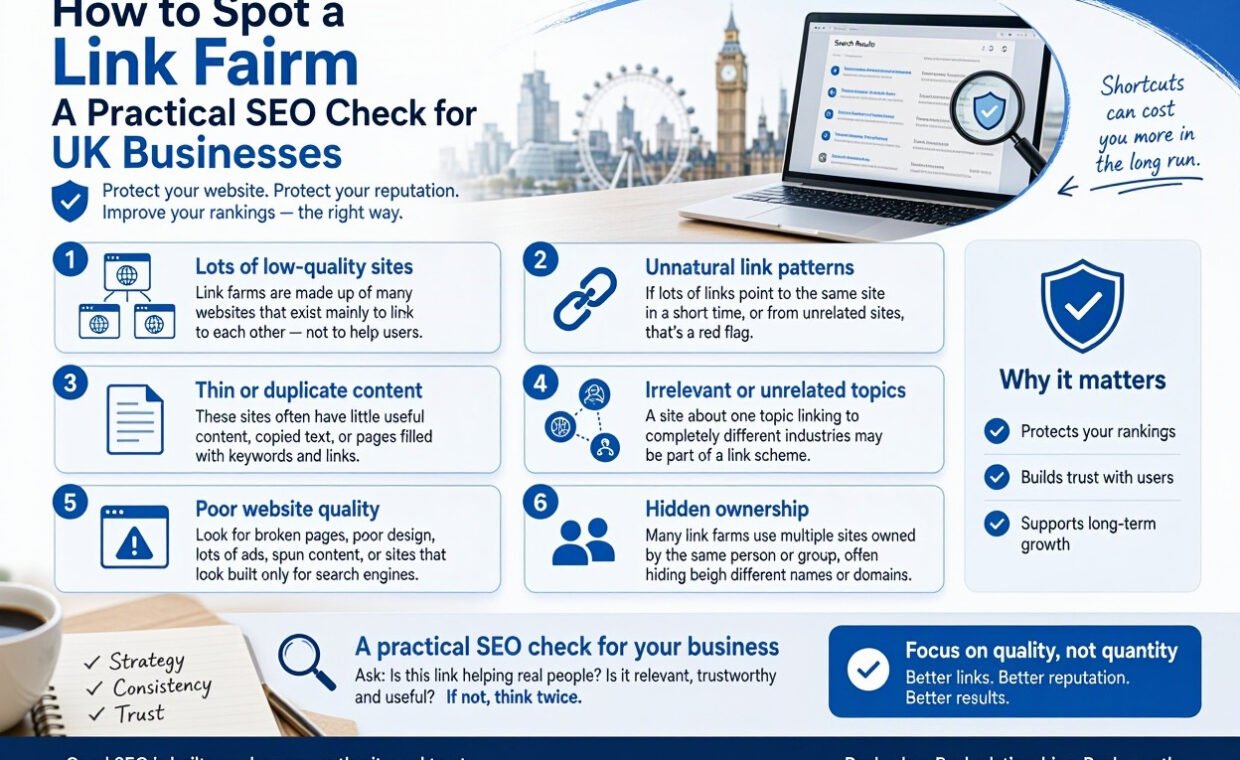
A sudden offer of hundreds of backlinks for a small fee can sound like an easy route up Google’s results. In reality, links from networks built mainly to manipulate rankings may do more harm than good. For a business owner, publisher or marketing manager, knowing how to spot a link farm helps protect both a website’s reputation and the time invested in SEO. The clues are usually visible in the sites’ content, ownership and linking patterns — if you know what to look for.
What is a link farm?
A link farm is a group of websites created or coordinated largely to link to one another, or to paying clients, in an attempt to influence search rankings. Some are obvious networks with copied pages and unrelated topics. Others look like ordinary blogs at first glance, but publish a steady stream of thin guest articles whose main purpose is to place links.
Not every website that accepts guest contributions is a link farm. Genuine publications have an audience, an editorial point of view and standards for what they publish. The issue is whether the site exists to inform readers or primarily to sell ranking signals. Search engines can ignore manipulative links or take action against sites that rely on them, so a large backlink count is not automatically an asset.
How to spot a link farm: the main warning signs
- Every topic appears on the same site. A blog covering dental implants, cryptocurrency, kitchen renovations and football betting may be a general-interest publication, but check whether those subjects are handled coherently. A sudden mix of unrelated commercial articles can indicate that posts are accepted for links rather than readers.
- The content feels interchangeable. Look for repetitive introductions, shallow advice, awkward phrasing and articles that make broad claims without useful detail. If several posts seem built from the same template, the site may be prioritising volume over editorial quality.
- Outbound links dominate the page. A page crowded with links to unrelated businesses, especially when the surrounding text barely mentions them, deserves scrutiny. Check whether links are relevant to the article and whether the publisher clearly distinguishes advertising or sponsored material.
- Publishing is unusually prolific. A large number of new posts each day is not proof on its own, but it becomes concerning when each piece promotes a different business and the articles lack a consistent voice. Check recent posts, not just the homepage or a polished media kit.
- The site gives little sign of a real publication. Look for an identifiable editor, a clear contact route, an established archive and evidence that readers engage with the work. A generic “write for us” page offering guaranteed do-follow links to any industry can be a warning, particularly when there are no meaningful submission standards.
For a more detailed checklist, this guide on how to identify link farms explores the patterns to examine before agreeing to a placement.
Check the link, not just the website
Even a legitimate site can publish a poor-quality or irrelevant link. Ask whether the linked page genuinely helps readers understand the article, and whether the surrounding sentence makes sense without the commercial relationship. A link to a UK bookkeeping service in a practical guide for small firms is easier to justify than a link to an unrelated app in an article about gardening.
Also consider the destination and the anchor text — the clickable words. Repeatedly using an exact commercial phrase can look unnatural, especially if the link appears in a paragraph that was written around it. Brand names, descriptive phrases and ordinary references are often more natural, but no anchor text can make an irrelevant placement valuable.
A sensible review before you pay
Before commissioning a guest article or buying a placement, spend a few minutes reviewing the publication:
- Read several recent articles in the same section, including pieces without obvious commercial links.
- Search the site for the subject you plan to write about and see whether it has a genuine editorial history in that area.
- Check whether the article would still be useful if the link were removed.
- Ask how the publisher handles paid contributions and whether links are marked appropriately.
- Be wary of guaranteed ranking improvements, large link packages or pressure to decide immediately.
Keep a record of placements and review your backlink profile periodically. If a link looks suspicious, do not assume that every unfamiliar domain requires urgent action. Assess the context first, and seek experienced SEO advice before making changes that could affect valuable links.
Guest articles that serve readers
Guest posting can still be a worthwhile way to share expertise and reach a relevant audience. The test is the article itself: does it answer a real question, suit the publication’s readers and meet the same standard as its other work? A useful guest posting opportunity should be judged on editorial fit and audience value, not simply on a promised link metric.
That principle applies across digital projects. A company planning an app, for example, should budget for development and promotion separately rather than treating backlinks as a shortcut to launch success. Osdire’s mobile app development cost breakdown focuses on US pricing, so UK businesses should use it as a comparison rather than a local quote — but it illustrates why digital investment needs proper planning.
Conclusion
To spot a link farm, look for a pattern rather than relying on one metric: unrelated subjects, thin articles, excessive outbound links, relentless publishing and little evidence of an actual readership. Then judge the proposed link on relevance and usefulness. Strong SEO is built on a site people would choose to read even without a ranking benefit. If a placement offers only a backlink, the safest decision is usually to keep looking.
§ Further Entries

How to Network as an Introvert Business Owner (UK Guide)
Networking tips for introverted UK business owners: low-pressure events, one-to-one strategies and online alternatives that actually work.

Business Rates Relief for Small Businesses in the UK, Explained
What business rates relief means for UK small businesses: Small Business Rate Relief thresholds, discounts and how to claim.

How to Close a Limited Company in the UK: Strike Off vs Liquidation
How to close a limited company in the UK: strike off, Members' Voluntary Liquidation, costs, timelines and tax — explained clearly.