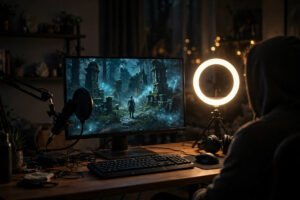
Ray tracing is the graphics buzzword of the generation — emblazoned on GPU boxes, toggled in settings menus, and debated endlessly in forums. It promises cinema-quality lighting in real time: reflections that actually reflect, shadows that behave like shadows, light that bounces the way it does in the real world. But it also halves your frame rate. So what is ray tracing, and does it actually matter for gameplay?
The short version: it is the most significant leap in real-time graphics in a decade, it is often gorgeous, and whether it matters depends entirely on what you play and what you value. Here is the full picture.
What ray tracing actually is
Traditional game graphics “fake” light. Rasterisation — the technique games have used for 30 years — draws 3D scenes by projecting triangles onto the screen, then applies clever approximations for lighting: pre-baked shadows, screen-space reflections (which can only reflect what is already on screen), and cube maps for glossy surfaces. These tricks are fast and, at their best, convincing — but they break in predictable ways: reflections vanish at screen edges, light does not bounce between surfaces, shadows look painted on.
Ray tracing does it properly: it simulates individual rays of light as they travel from the camera into the scene, bouncing off surfaces according to the laws of optics. This is how Pixar renders films — each frame taking hours on render farms. The miracle of the last few years is doing a version of it 60 times per second on a consumer GPU, via dedicated ray-tracing hardware cores (NVIDIA’s RT cores, AMD’s ray accelerators) and AI upscaling that reconstructs a clean image from fewer rays. The result: reflections that show the actual scene, global illumination where light genuinely bounces around rooms, and shadows with true softness. The visual difference is most dramatic in games built around it — Cyberpunk 2077’s neon streets, Alan Wake 2’s forests, Metro Exodus’s sunrises. It pairs naturally with display upgrades; see whether upgrading to a 4K TV is worth it.
The performance price
There is no free lunch: full ray tracing typically costs 30–50% of frame rate versus rasterised rendering. The industry’s answer is upscaling — DLSS, FSR and XeSS reconstruct high-resolution images from lower-resolution ray-traced renders, clawing back most of the loss. The practical upshot: on a mid-range GPU or console, you usually choose between ray-traced fidelity at 30fps and rasterised performance at 60fps. That choice defines the entire debate.
Does it matter? The honest breakdown by game type
For slow, atmospheric, visually-driven games — the answer is often yes, emphatically. In horror games, ray-traced shadows and reflections transform tension: a corridor lit only by bouncing light feels genuinely threatening in ways baked lighting cannot match. In open-world showcases and narrative adventures, global illumination adds a richness that screenshots struggle to convey but players feel immediately. Digital Foundry’s analyses at Eurogamer consistently show ray tracing as the single biggest visual differentiator in this class of game.
For competitive multiplayer — the answer is no. In shooters, battle royales and fighting games, players disable ray tracing deliberately: frame rate and visual clarity win matches, and the prettiest reflections are a distraction (and a performance cost) nobody competing wants. Most esports titles do not even offer it. For fast action games generally, 60fps+ with clean rasterisation beats 30fps with beautiful light every time.
For everything in between — the honest middle is that ray tracing is a “nice to have” that rarely changes gameplay. It makes great games prettier; it does not make average games great. No game is worth playing because of its reflections.
The hybrid future
The industry is converging on hybrid rendering: ray tracing for the effects where it matters most (reflections, shadows, ambient occlusion) with rasterisation elsewhere, plus ever-better upscaling. Each GPU generation makes the performance cost smaller. Within a few years, the fidelity-versus-performance choice will likely disappear — ray tracing will simply be how games render light, and the debate will seem quaint. The underlying rendering advances parallel those in creative tools; see how AI photo editors analyse images.
Should you pay extra for it? The buying advice
In 2026, ray tracing capability is table stakes, not a premium feature: every current console supports it, and any new GPU worth buying (roughly £250+) handles it competently. Tom’s Hardware benchmarks confirm the current price-performance picture. Do not buy a more expensive GPU solely for better ray tracing unless you specifically play the cinematic single-player games where it shines and own a display that shows it off. For a £300–£400 GPU buyer, rasterisation performance per pound remains the smarter metric — the card that runs everything at 60fps+ with ray tracing off beats the card that does pretty reflections at 35fps.
On consoles, use the choice the developers offer: try both modes for an hour each. Many players discover they prefer the responsiveness of performance mode once the novelty of fidelity mode fades — and many never look back. There is no wrong answer, only your answer.
Path tracing: the next frontier
Full ray tracing in games is still usually a hybrid — rays for selected effects, rasterisation for the rest. Path tracing goes further: simulating all light transport with rays, the way Pixar renders films. Cyberpunk 2077’s Overdrive mode and Alan Wake 2’s path-traced options offer a glimpse: astonishingly coherent lighting, at a performance cost that currently demands top-tier GPUs and aggressive upscaling. It remains a tech-demo luxury in 2026 — beautiful, barely playable on mid-range hardware, and a preview of where everything is heading. Each GPU generation halves the cost; within a few hardware cycles, path tracing will be what “ultra settings” means. Today’s debate about whether ray tracing matters will seem as quaint as arguing about texture filtering — the technology always wins eventually, it just needs time to become affordable.
Conclusion
Ray tracing is real-time graphics done properly — light simulated rather than faked — and in the right games it is transformative. But it is a visual luxury, not a gameplay revolution: it matters enormously for atmospheric single-player showcases, not at all for competitive play, and modestly for everything else. Treat it as the garnish, never the meal — and let your own eyes, trying both modes for an hour each, cast the deciding vote. Do not pay a premium for it, do not sacrifice frame rate you will feel for reflections you will stop noticing, and enjoy it where it shines. The light, as they say, is lovely — but the game is the thing.
Frequently Asked Questions
What is ray tracing in gaming?
A rendering technique that simulates individual rays of light bouncing through a scene, producing realistic reflections, shadows and global illumination — versus traditional rasterisation, which approximates these effects.
Does ray tracing affect FPS?
Yes — typically costing 30–50% of frame rate, though AI upscaling (DLSS/FSR) recovers much of the loss. Most games offer a choice between ray-traced fidelity and higher-frame-rate performance modes.
Is ray tracing worth it on PS5?
For cinematic single-player games, often yes — try fidelity mode. For competitive or fast-action games, performance mode’s 60fps matters more. Experiment per game.
Do I need an expensive GPU for ray tracing?
No — any current-generation GPU around £250+ handles it competently, and all current consoles support it. Do not pay a large premium solely for ray tracing performance.