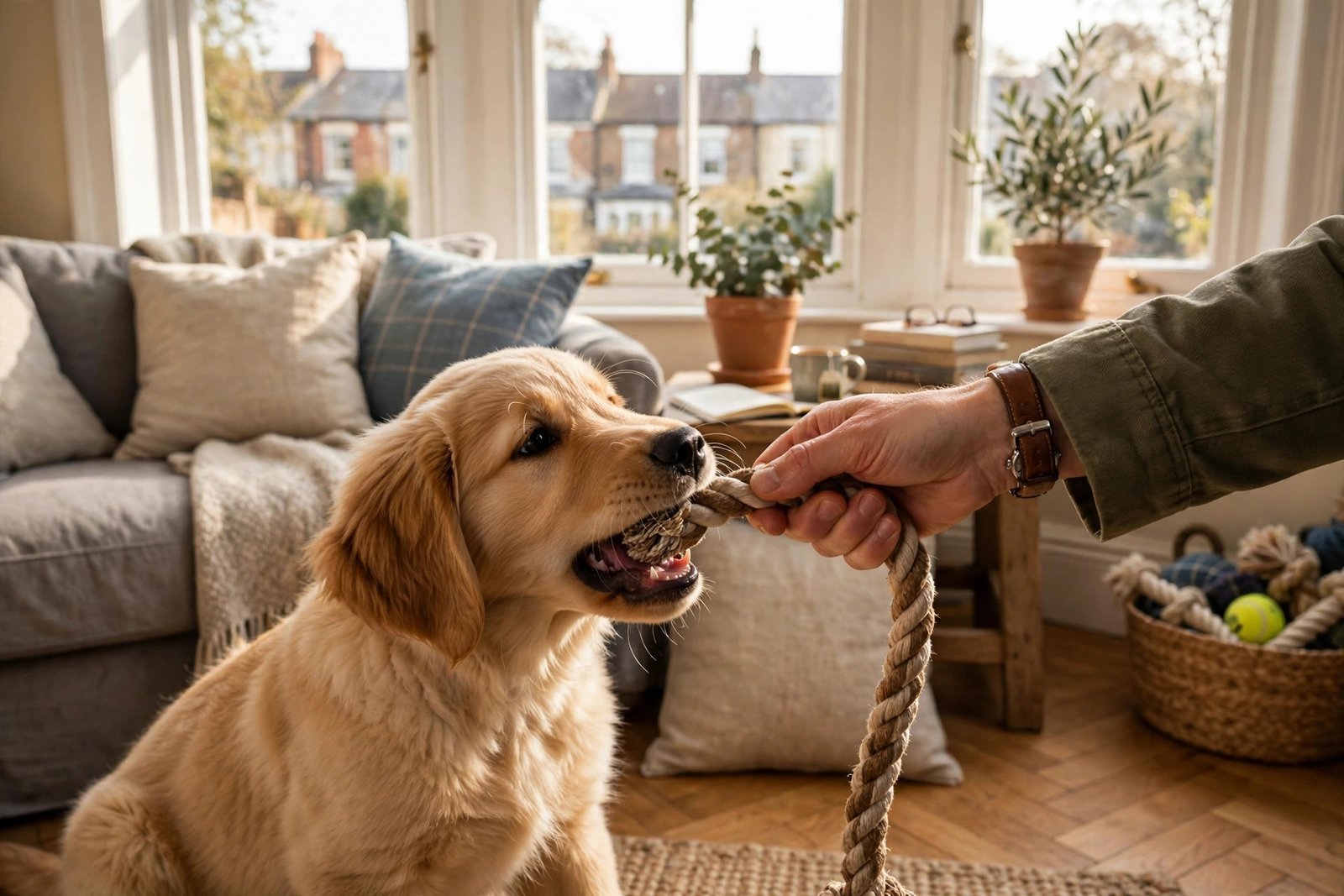
Your eight-week-old puppy is adorable — right up until those needle-sharp teeth sink into your ankle for the fourth time before breakfast. If you are wondering how to train a puppy to stop biting hands and feet, take comfort in the fact that virtually every puppy owner in Britain asks the same question. Mouthing is not aggression, spite, or a sign of a “bad” dog. It is how puppies explore the world, soothe teething gums, and learn the rules of social play. Your job is not to punish the biting out of them, but to teach them — patiently and consistently — that human skin is never a chew toy.
This guide explains why puppies bite in the first place, the redirection and bite-inhibition techniques UK behaviourists actually recommend, how to set up your home and routine to prevent the worst of it, and the mistakes that make biting worse. Follow it for a few weeks and those land-shark days will be behind you.
Why puppies bite hands, feet and everything else
Puppies investigate with their mouths the way toddlers use their hands. Between three and six months, teething adds genuine gum discomfort to the mix, and chewing relieves it. Play-biting also mimics how puppies interact with littermates: they nip, the sibling yelps, and they learn how hard is too hard. When your puppy bites your fingers, they are treating you like a littermate — which means you need to teach them the same lesson their siblings would, in a language they understand.
Two patterns intensify biting. The first is overtiredness: puppies need 18 to 20 hours of sleep a day, and a tired puppy becomes a bitey, zoomy menace remarkably like an overtired toddler. The second is under-stimulation: a bored puppy with nothing appropriate to chew will invent their own entertainment, usually involving your toes. Dogs Trust’s puppy training advice emphasises that most “problem” biting is really a management problem, not a temperament one.
Teach bite inhibition first, then zero tolerance
Bite inhibition — learning to control jaw pressure — is the foundation skill, and it must be taught before you demand no mouthing at all. When your puppy’s teeth touch your skin with uncomfortable pressure, give a calm, short yelp or say “ouch” in a neutral tone, then immediately withdraw your hand and turn away for a few seconds. You are simulating what a littermate would do: fun stops when teeth hurt.
Timing is everything. The withdrawal must happen within a second or two of the bite, or the puppy cannot connect the two events. After a brief pause, re-engage with a toy. If the puppy bites hard again, repeat once more; a third hard bite means a short time-out in a boring, safe space — not the crate, which should stay a happy place. The Kennel Club’s puppy training resources note that consistency across every family member matters enormously: if one person allows rough play with hands, the puppy learns that biting sometimes works, which is the hardest lesson to unlearn.
Redirect, redirect, redirect
Every time teeth meet skin, offer a legal alternative within arm’s reach. Keep chew toys, rope tugs and frozen carrots or damp frozen flannels (for teething gums) scattered around the rooms your puppy uses. When the puppy goes for your fingers, swap in the toy and praise the moment they take it. You are not just stopping a behaviour; you are building a new habit of reaching for toys instead of people.
For ankle-biters who chase moving feet, the game changes slightly: freeze. Moving feet trigger chase instinct, so stop walking, stand still like a tree, and wait for the puppy to lose interest before calmly redirecting to a toy. Squealing and hopping about looks like the best game ever to a puppy, so boring stillness is your secret weapon.
Set up your home and routine to prevent biting
Prevention beats correction. Enforce naps: put your puppy down for rest every one to two hours in a quiet pen or room, because most evening “witching hour” biting is exhaustion in disguise. Build in short training sessions and sniffy walks, which tire a puppy’s brain far more effectively than endless fetch. And puppy-proof your space properly — much like the approach in our guide to childproofing a home on a budget, the goal is to remove temptations (trailing cables, low shoes, accessible laundry) so the puppy rehearses good choices instead of bad ones.
Manage greetings too. Visitors who crouch down with wiggling fingers are irresistible targets, so arm guests with a toy and ask them to greet the puppy calmly. Children need supervision and a simple rule: if the puppy gets mouthy, they stand up, fold their arms and turn away. Keeping the whole household running the same playbook is what makes progress stick — and it keeps keeping your house clean with a puppy far easier when chews stay on toys rather than table legs.
What not to do
Never punish biting with physical corrections — no smacking, muzzle-grabbing, “alpha rolls” or scruff-shaking. These techniques frighten puppies, damage trust, and frequently make biting worse because a scared puppy bites harder and faster. Shouting is equally counterproductive; to a puppy, loud reactions look like exciting play.
Do not use bitter sprays on your own skin as a primary strategy either. They can work as a backup for persistent furniture-chewing, but they do not teach the puppy anything about appropriate behaviour, and some puppies simply power through the taste. Focus your energy on teaching and managing rather than deterring.
When biting might signal a bigger problem
Normal puppy biting is loose-bodied, wiggly and paired with play signals. Seek professional help if the biting is accompanied by stiff body language, growling over food or toys, snapping when handled, or bites that break skin deliberately rather than accidentally. True resource guarding and handling sensitivity need a qualified behaviourist — look for one accredited by the Animal Behaviour and Training Council — not tougher discipline.
Also note the timeline: most puppies improve dramatically between four and six months as teething ends and training accumulates. If biting is escalating rather than fading by six or seven months despite consistent work, that is your cue to get expert eyes on the situation rather than waiting it out.
Conclusion
Puppy biting is a phase, not a personality trait. The puppies that grow into gentle-mouthed adult dogs are not the ones that were punished hardest — they are the ones whose owners taught bite inhibition calmly, redirected relentlessly, managed tiredness and boredom, and kept every human in the house consistent. It will test your patience for a few weeks, and your ankles may bear the scars, but the method works: yelp and withdraw, redirect to toys, enforce naps, and never let hands become playthings. Do that, and one day you will realise the land-shark has quietly grown into a dog with the softest mouth in the park.
Frequently Asked Questions
At what age do puppies stop biting?
Most puppies bite less from around four months as teething eases, with significant improvement by six months. Consistent training usually resolves it by seven to eight months; persistent hard biting beyond that deserves professional assessment.
Should I yelp when my puppy bites me?
A short, calm yelp or “ouch” followed by withdrawing attention mimics littermate feedback and works well for most puppies. If your puppy gets more excited by the sound, switch to a silent withdrawal of attention instead.
Does biting mean my puppy is aggressive?
Almost never. True aggression in young puppies is rare; mouthing is normal exploration and play. Worry only if biting comes with stiff body language, growling over resources, or deliberate hard bites that break skin.
Can I use a spray to stop my puppy biting my hands?
Bitter sprays are a poor primary strategy for hand-biting and do not teach the puppy anything. Invest the effort in bite-inhibition training, redirection and enforced naps instead — they address the cause, not just the symptom.