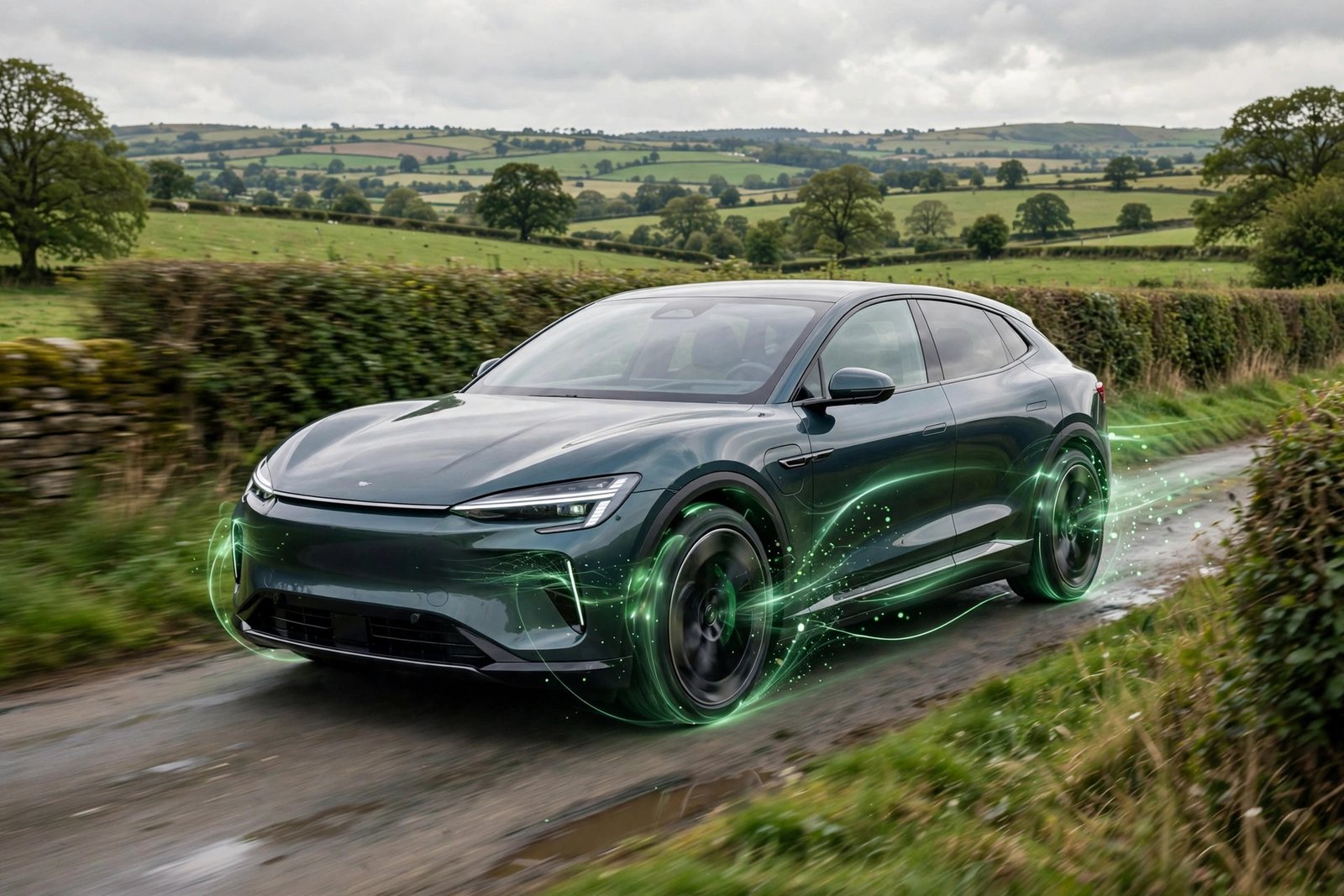
You lift your foot off the accelerator and the car slows itself — no brake pedal, no coasting, just a smooth, deliberate deceleration as if an invisible hand is gently holding you back. That is regenerative braking, the signature party trick of electric cars and hybrids, and for drivers new to EVs it is the single strangest sensation of the switch. What is actually happening, why does it feel so odd, and does it matter? Here is the full explanation from a British driver’s perspective.
What regenerative braking actually does
In a petrol or diesel car, braking turns your speed into heat — brake pads squeeze discs, kinetic energy becomes wasted warmth. An electric motor, though, can run in reverse: when you lift off the accelerator, the motor becomes a generator, converting the car’s motion back into electricity and feeding it into the battery. The resistance of that generation is what slows the car. Instead of throwing energy away as heat, you recapture it — typically recovering 10–25% of energy in urban driving, which directly extends your range.
Every EV and hybrid does this, from a Toyota Yaris Hybrid to a Tesla Model Y. The strength varies: most cars offer adjustable levels (often via steering-wheel paddles or a drive-mode selector), from a gentle retardation barely stronger than engine braking to full “one-pedal” modes. It works best in stop-start town driving — exactly the conditions of British commuting — and least on long motorway cruises, where there is little braking to regenerate from. It is one of several ways EVs rewrite the driving rulebook; for another, see how self-driving car technology actually works.
What it feels like: the first-drive experience
The first thing you notice is the absence of coasting. In a petrol car, lifting off produces a gentle glide; in an EV with strong regen, lifting off produces immediate, confident deceleration — more like engine braking in a low gear. New drivers almost always lift off too abruptly at first, producing jerky slowdowns that unnerve passengers. The trick is modulation: the accelerator becomes a single pedal controlling both speed and slowing, pressed for go, eased for slow.
Within a week, most drivers convert completely. One-pedal driving in traffic is genuinely relaxing — your right foot barely moves, creeping forward and easing back in a smooth rhythm. Nissan’s e-Pedal, Tesla’s standard regen, BMW’s adaptive recuperation and Hyundai/Kia’s paddle-adjustable levels all have slightly different calibrations, but the learning curve is the same: strange for a day, intuitive for a week, preferred thereafter. The oddest moment comes when you drive a petrol car again and lift off expecting deceleration that never arrives — EV drivers call it “regen withdrawal”. And because regen handles most slowing, the friction brakes stay cool and last dramatically longer — many EV drivers report brake pads lasting 100,000+ miles.
The practical implications for UK driving
Regen changes how you drive British roads. Downhill, it is brilliant: descending a Lake District pass, regen holds your speed while charging the battery, instead of cooking the brakes. In town, it turns traffic lights into charging opportunities. But there are quirks to learn. In icy conditions, strong regen can unsettle the car — the deceleration is applied through the driven wheels only, which on slippery surfaces can provoke a slide; most EVs let you reduce regen in winter, and you should. Similarly, regen does not illuminate the brake lights as aggressively as pedal braking in some implementations (regulations require lights above certain deceleration rates), so stay aware in fast traffic.
Efficiency-wise, the biggest wins come from anticipation: lifting off early for roundabouts and junctions maximises regeneration, while late, hard braking wastes energy as heat in the friction brakes. It rewards the smooth driving style that advanced driving courses have always taught — just with a battery to show for it. For the broader picture of cleaner motoring, read our guide to travelling more sustainably — the same principles apply on holiday as on the commute.
Regen vs coasting: which is better?
Enthusiasts debate this endlessly. Maximum regen recaptures the most energy when you must slow down; but if you do not need to slow down at all, coasting (zero regen) is more efficient, because every energy conversion loses a little. The most efficient drivers use low regen on open roads (coasting when lifting off) and high regen in town (recapturing stop-start energy). Many EVs automate this: BMW’s adaptive system uses navigation and sensors to choose, coasting on clear motorways and regenerating into junctions.
For most drivers, though, the difference is marginal — a few percent of range — and consistency beats optimisation. Pick the regen level that feels natural, drive smoothly, and let the car handle the rest. The real efficiency gains come from speed (motorway velocity murders EV range far more than regen settings) and heating (heat pumps and pre-conditioning while plugged in matter enormously in British winters). Official efficiency figures and charging guidance are published on gov.uk‘s electric vehicle pages, and the AA offers practical EV driving advice for members and non-members alike.
Hybrids vs full EVs: how regen differs
Not all regen is equal. Full EVs (Tesla, Nissan Leaf, Hyundai Kona Electric) have large batteries that can absorb strong regeneration, so one-pedal driving is fully realised — you may barely touch the brake pedal for days. Conventional hybrids (Toyota Yaris, Honda Jazz) have small batteries that fill quickly, so regen is milder and the friction brakes do more work; the sensation is closer to strong engine braking than true one-pedal driving.
Plug-in hybrids sit between the two, with regen strength varying by battery state — full battery, weak regen. The practical upshot: if you love the one-pedal style, you need a full EV to get the full experience. And whichever you drive, the maintenance dividend is real but graded: EV brake components last dramatically longer, hybrids moderately longer, than pure petrol or diesel equivalents. Test-drive both back to back if you are choosing between them — the difference is immediately obvious within the first mile.
Frequently Asked Questions
Does regenerative braking wear out the battery?
No — regen charging is gentle compared with rapid charging, and battery management systems control it carefully. If anything, regen extends brake life far more than it affects battery life.
Do the brake lights come on during regenerative braking?
Yes, when deceleration exceeds the regulatory threshold — the car activates them automatically. Gentle regen below the threshold may not trigger them, which is one reason to stay alert in traffic.
Can I turn regenerative braking off?
Most EVs let you reduce it to a minimum, though rarely to true zero — some level of regen is integral to how the car drives. Low/off settings mimic the coasting feel of a petrol car.
Does regen work when the battery is full?
Only weakly — a full battery cannot accept more charge, so the car reduces regen and relies more on friction brakes. This is why EVs feel different for the first few miles after a 100% charge.
Conclusion
Regenerative braking feels alien for about a day — then it feels like the way cars should always have worked. It recaptures energy, spares your brakes, and turns town driving into a smooth one-pedal glide. Learn its quirks (ease off in ice, anticipate for efficiency), and it becomes one of the quiet joys of electric driving on British roads.