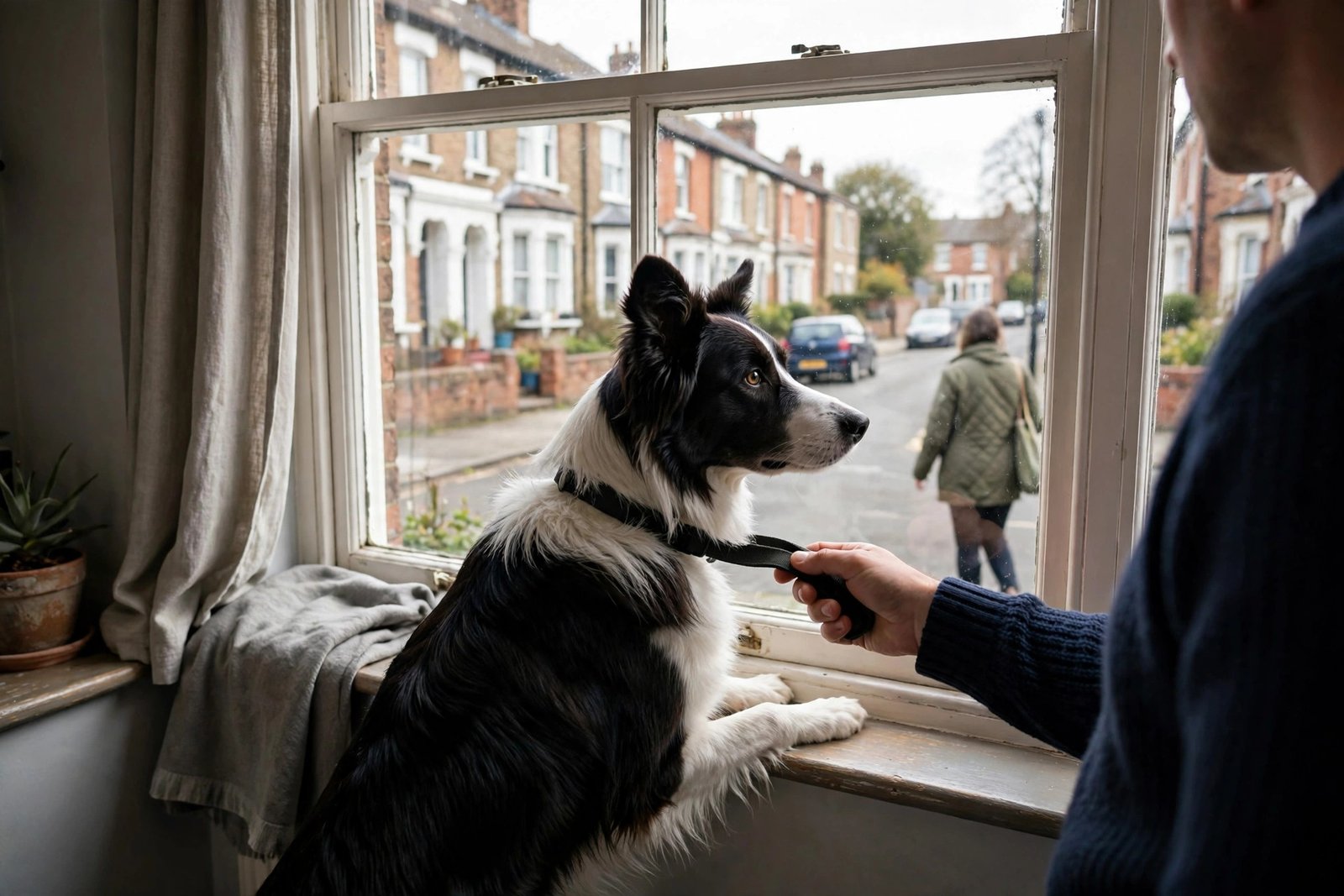
The postman approaches. Your dog erupts. The jogger passes — eruption. A neighbour dares to walk their own dog past your own house — full eruption, with bonus lunging at the window. If your dog barks at every stranger who comes near, walks become stressful, the house feels under siege, and you start dreading the doorbell. Here is the reassuring truth: barking at strangers is one of the most common behaviour complaints in the UK, and it is also one of the most fixable — provided you address the emotion behind the noise rather than just shouting “quiet” over it.
This guide explains why dogs bark at passers-by, the management changes that bring instant relief, a step-by-step desensitisation plan, and how to handle the neighbourly side of a barky dog. Expect progress in weeks, not days — but real, lasting progress.
Why your dog barks at strangers
Most stranger-barking falls into three buckets. Territorial barking is the classic: the dog perceives the home and garden as theirs to defend, and every passer-by is a potential intruder who — from the dog’s perspective — is successfully driven away each time they keep walking. That is powerfully self-rewarding: bark, stranger leaves, barking “worked.”
Fear-based barking looks similar but feels different to the dog: the stranger is scary, and barking is a distance-increasing strategy — “go away before I have to deal with you.” Alarm barking is the third type: the dog is simply announcing novelty, the canine equivalent of shouting “someone’s here!” Many dogs blend all three. Dogs Trust’s behaviour advice notes that punishment tends to worsen fear-based barking, because the dog now has two scary things: the stranger and your reaction.
First, rule out the simple amplifiers
Before any training, check the basics. An under-exercised, under-stimulated dog barks more — a tired dog is a quieter dog. Dogs left alone in the front room with a full view of the pavement all day will rehearse barking hundreds of times; every rehearsal strengthens the habit. Boredom, lack of mental enrichment, and even pain (a dog that hurts is a dog with a short fuse) all turn the volume up.
Aim for genuine fulfilment: two decent walks with sniffing time, a few minutes of training, and food puzzles or chews that occupy the brain. Many owners are stunned how much barking fades once the dog’s day has actual content in it.
Management: stop the rehearsals today
Training takes weeks; management works this afternoon. If your dog guards the front window, remove the trigger: frosted window film on the lower panes, closing curtains during peak pavement hours, or moving the dog’s bed away from the lookout post. A white-noise machine or radio near the front door masks the letterbox and footstep sounds that set dogs off.
In the garden, do not leave a territorial barker unsupervised — every unsupervised barking session is practice. Bring the dog in when you cannot supervise, or section off the part of the garden with the street view. Management is not giving up; it is preventing hundreds of extra rehearsals while your training takes effect.
The desensitisation and counter-conditioning plan
This is the core of the fix: changing how your dog feels about strangers, not just suppressing the noise. Start at a distance where your dog notices people but stays under threshold — calm enough to take treats. Every time a stranger appears at that distance, amazing food rains from the sky (chicken, cheese, whatever your dog adores). Stranger appears, good things happen; stranger disappears, good things stop. Over sessions, the dog’s emotional response shifts from “threat!” to “predictor of chicken.”
Gradually decrease distance over days and weeks, never pushing past the point where your dog can still think and eat. Keep sessions short — five to ten minutes — and end on a win. Inside the house, rehearse a “thank you, quiet” protocol: when the dog alerts, calmly acknowledge (“thank you”), then cue a incompatible behaviour such as going to a mat for a stuffed Kong. You are not rewarding barking; you are rewarding the decision to disengage. The RSPCA’s dog training guidance supports reward-based methods as the most effective and humane approach for fear and territorial behaviours.
The neighbourly side: barking and the law
A dog that barks at every passer-by can become a neighbourhood issue, and in the UK it can become a legal one. Under the Environmental Protection Act 1990, persistent dog barking can be deemed a statutory noise nuisance, and councils can serve abatement notices — ignoring one is a criminal offence. So alongside training, be a good neighbour: acknowledge the problem if someone mentions it, explain you are working on it, and share your plan. Most people are remarkably patient when they see genuine effort.
Our guide to dealing with noisy neighbours within the law covers the legal framework from the other side of the fence, which is worth understanding so you can stay ahead of any complaint. If your dog’s barking is worst when you are out, a pet camera will tell you the truth about what happens in your absence — many “quiet” dogs are daytime barkers.
Travelling and visitors with a reactive barker
Stranger-barking does not have to confine you to home. When visiting friends or booking breaks, preparation prevents embarrassment: bring the mat, the Kongs, and the window-film mindset. Choosing accommodation wisely helps enormously — pet-friendly holidays in the UK with detached cottages and enclosed gardens give a reactive dog space to decompress without an audience. Tell hosts honestly about your dog’s quirks; most pet-friendly hosts have seen it all.
When to call in a professional
Get help if barking is escalating despite consistent work, if it is paired with lunging, snapping or biting, or if fear is clearly the driver and your dog is generally anxious. Look for a behaviourist accredited by the Animal Behaviour and Training Council (ABTC) — anyone can call themselves a “dog behaviourist” in the UK, so accreditation matters. Avoid trainers promising instant fixes with aversive tools; suppressing barking through fear often converts a noisy dog into a silently biting one.
Conclusion
A dog that barks at every stranger is usually doing a job it believes matters: guarding, warning, or keeping scary things at bay. Your task is to retire them from that job with kindness — manage the environment so the habit stops rehearsing, fulfil the dog so life is not one long boring stakeout, and systematically rewire their feelings about passers-by with distance, patience and very good chicken. It is not a weekend fix, but owners who commit to the plan almost always get their peaceful house back. And the postman, bless him, will finally get to do his round in peace.
Frequently Asked Questions
Will a bark collar stop my dog barking at strangers?
It may suppress the noise temporarily, but collars do not address fear or territorial drive and can increase anxiety and aggression. Reward-based desensitisation is safer and produces lasting change.
Should I let my dog “guard” the house by barking?
A single alert bark is fine; sustained barking at every passer-by is stressful for the dog and risks neighbour complaints. Teach a “thank you, quiet” routine so one bark is enough.
How long does it take to stop territorial barking?
With consistent management and daily short training sessions, most owners see meaningful improvement in four to eight weeks. Long-established habits in older dogs can take a few months.
Can the council really take action over barking?
Yes. Persistent barking can be investigated as a statutory noise nuisance under the Environmental Protection Act 1990, and councils can issue abatement notices. Training proactively protects you legally as well as socially.