Two gardeners, same size plot, same British weather. One harvests enough vegetables to halve the shopping bill; the other grows a picturesque weed collection with occasional courgettes. The difference is rarely effort or soil — it is layout. A well-planned garden puts every plant where it thrives, every path where it is needed, and every square metre to work across the whole season. If you are asking how do I plan a garden layout for maximum yield in Britain, here is the design method: the principles that govern productive plots, the classic layouts that work in our climate, and the planning mistakes that cost harvests.
Principle one: map the sun and the microclimates
Before drawing a single bed, observe for a year — or at minimum, map sun through a full day in midsummer and midwinter. Note where the sun hits first and last, which walls cast afternoon shade, where frost lingers on spring mornings (cold air pools in hollows), and which corner catches the prevailing wind. South-facing walls are the warmest microclimate in any British garden — the thermal mass radiates heat at night — making them prime real estate for tender crops, trained fruit and heat-lovers. North-facing walls suit shade-tolerant salads and currants.
Zone by frequency of visit: the crops you harvest daily (salads, herbs, beans) go nearest the kitchen door; the crops you visit weekly (potatoes, squash, sweetcorn) go furthest. This sounds obvious and is violated constantly — the salad bed at the bottom of the garden gets neglected while the potatoes by the door get admired. Water access shapes layout too: thirsty crops (courgettes, beans, salads) near the tap or butt; drought-tolerant herbs and perennials further out. Draw the map on paper — sun, shade, wind, frost pockets, water — before placing a single bed. Our raised bed guide covers the structures you will be placing on that map.
Principle two: rotate, succeed and companion-plant
Crop rotation is the yield multiplier beginners skip. Growing the same family in the same soil year after year builds up pests and diseases (clubroot in brassicas, eelworm in potatoes) and depletes specific nutrients. The classic four-year rotation: legumes (peas, beans — they fix nitrogen), followed by brassicas (cabbage, kale, broccoli — hungry feeders that love the nitrogen), followed by roots (carrots, beetroot, onions — light feeders), followed by potatoes (which break up the soil and get the fresh manure). Divide the plot into four sections and rotate the groups around them yearly. On paper it takes ten minutes; in soil it prevents most recurring crop failures.
Succession planting doubles yield from the same ground: as each crop finishes, another goes in — spring radishes followed by summer beans followed by autumn salads in the same bed. Keep a simple sowing calendar and never let a bed sit empty in the growing season. Intercropping fills the gaps: slow carrots between fast radishes, lettuce under sweetcorn, basil among tomatoes. Companion planting has folk-wisdom status with patchy evidence — but the well-supported pairings (marigolds deterring whitefly, nasturtiums as aphid trap crops, alliums among carrots confusing carrot fly) earn their place. The Garden Organic rotation and companion-planting guides are the UK authority.
The vertical dimension
British gardens are small; the sky is free. Grow up: runner beans, climbing French beans, cucumbers, squashes and even small pumpkins on sturdy trellises, arches and obelisks. A 2-metre trellis on the north side of a bed produces kilos from a footprint of centimetres, without shading its neighbours. Vertical growing is the single highest-yield-per-square-metre technique available to the small-plot gardener — and it looks magnificent.
Classic layouts for British plots
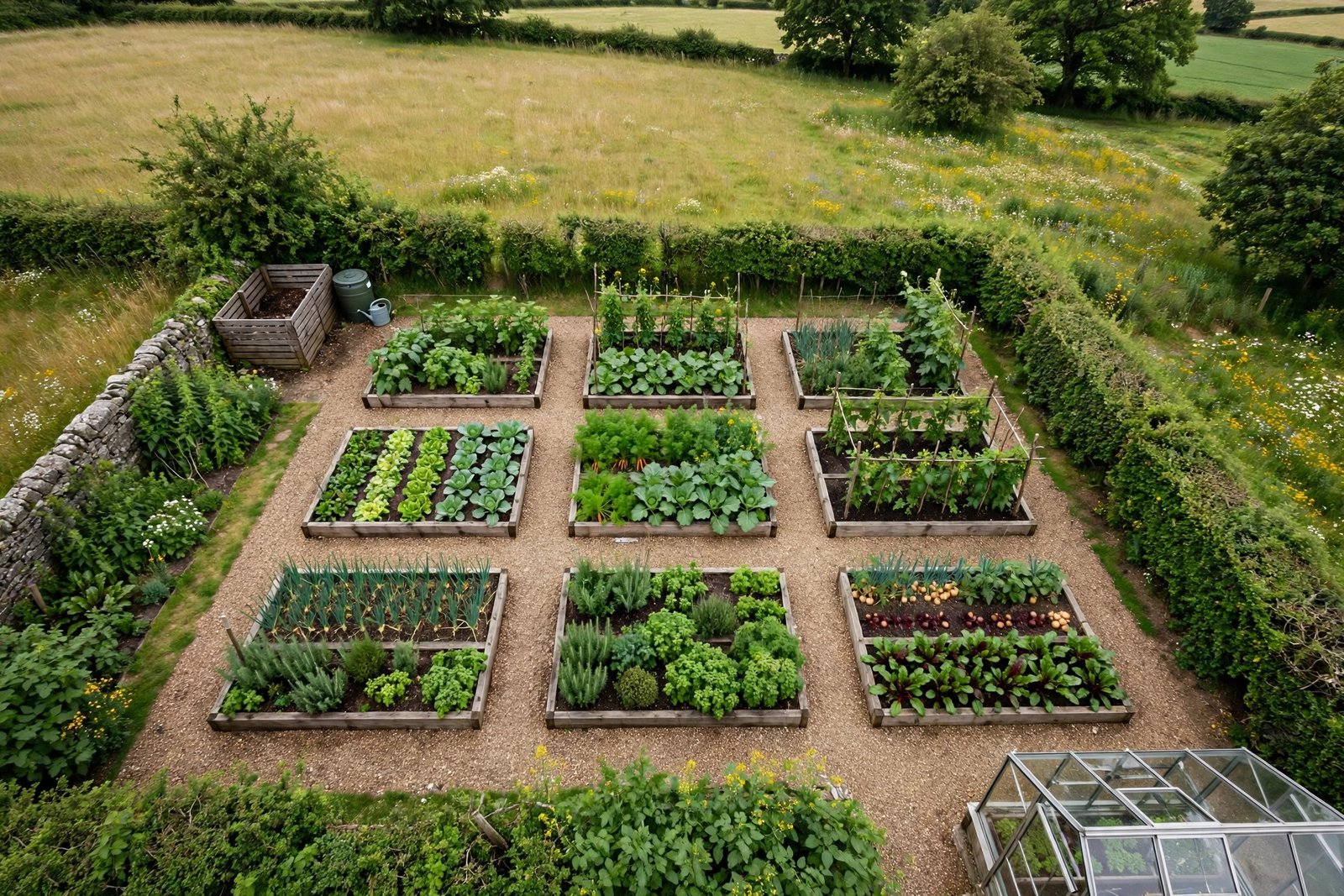
The kitchen garden (potager): geometric beds near the house, mixing vegetables, herbs and flowers — productive and beautiful, the traditional cottage-garden descendant. Paths between every bed (no stepping on soil), beds no wider than 1.2m (reachable from both sides). The allotment grid: long straight rows on bigger plots — less pretty, maximally practical for bulk crops (potatoes, onions, brassicas), with rotation blocks clearly marked. The raised-bed system: 3–6 uniform beds (1.2×2.4m is the standard), each a rotation unit — the easiest layout to plan, build and manage, ideal for beginners and small gardens.
Key infrastructure: a compost area (3 bays ideal: filling, rotting, ready) sited conveniently but discreetly; water (butts on every downpipe, tap or butt within hose reach of every bed); tool storage (a shed or store near the working area, not the house); and paths wide enough for a wheelbarrow (60cm minimum). The unglamorous infrastructure determines whether the beautiful layout actually gets worked. For choosing what fills the beds, our small garden plant guide matches crops to spaces. The RHS allotment and kitchen-garden resources cover larger-scale planning.
Planning mistakes that cost harvests
Too big, too fast: the classic — a huge plot dug in March enthusiasm, weedy by July. Start with what you can maintain in 2–3 hours a week and expand. Ignoring the sun map: the shed in the sunniest spot, the vegetables in the shade — audit before building anything permanent. No rotation plan: planting wherever there is space each spring guarantees disease build-up within three years. Paths too narrow: 30cm paths become impassable jungles by August; 60cm minimum, 90cm for wheelbarrow routes. Forgetting the gardener: no seating, no shelter, no beauty — the productive garden you never visit is a failed garden. Include a bench with a view of your work; you have earned it.
Plan on paper, revise yearly. Sketch the layout each winter: what grew where, what thrived, what failed, what the family actually ate. The second-year plan, informed by the first year’s evidence, is always dramatically better. Keep old plans — the five-year sequence shows your rotation working and your skills compounding. The garden is never finished; the plan is how you steer it.
The bottom line
Maximum yield comes from: mapping sun, frost and water before placing anything; zoning daily crops near the kitchen; rotating in four-year blocks; successions and intercropping so no bed idles; growing vertically; and building the unglamorous infrastructure (compost, water, paths, storage) that makes the plan workable. Draw it on paper this winter, build it in spring, revise it every year. The productive garden is not the biggest or the most expensive — it is the best planned.
Frequently Asked Questions
How do I plan a vegetable garden layout?
Map sun, shade, wind and frost pockets first; zone daily-harvest crops near the kitchen; use a four-year crop rotation; plan successions so beds never idle; and include compost, water and path infrastructure.
What is crop rotation?
Growing plant families in a four-year cycle (legumes → brassicas → roots → potatoes) so pests and diseases do not build up and nutrients are used efficiently. Essential for sustained yields.
How wide should vegetable beds be?
Maximum 1.2m — reachable from both sides without stepping on the soil. Paths between beds should be 60cm minimum (90cm for wheelbarrow access).
What is succession planting?
Planting a new crop as each one finishes — e.g. radishes in spring, beans in summer, salads in autumn in the same bed. It can double or triple yield from the same ground.
Should I put tall plants on the north or south side?
North side (in Britain) — so they do not shade shorter crops. In the southern hemisphere it would be reversed; the principle is that tall plants go on the poleward side.