
Music A journal entry
Is 30 Too Late to Learn Piano? The Honest Answer
Thinking of learning piano at 30? It's not too late. Learn realistic timelines, the best setup for UK adults, and how grown-ups should practise differently.
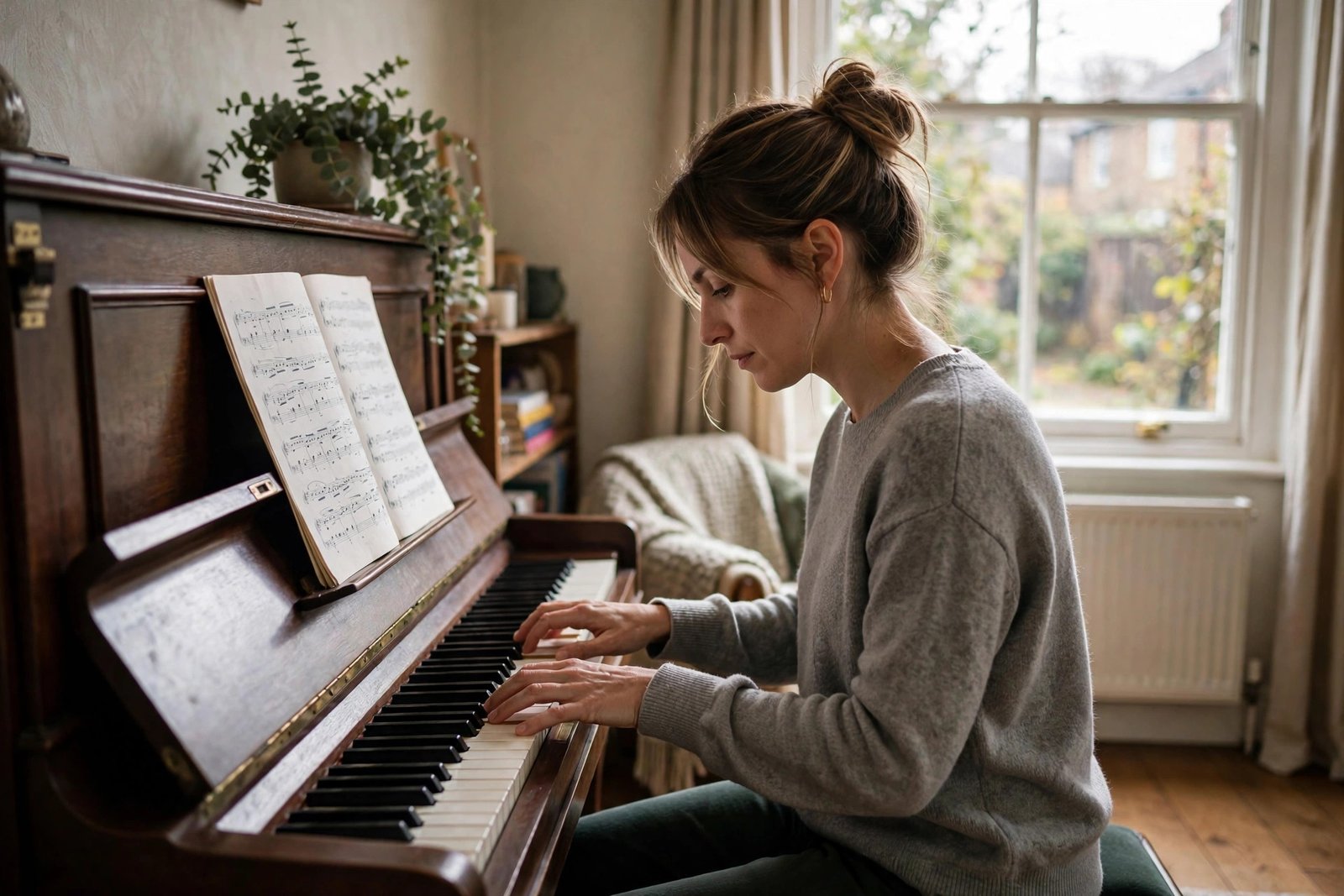
Thirty candles on the cake, zero piano lessons behind you, and a quiet voice asking whether the ship has sailed. It has not — not even close. The idea that music is a children’s game is one of the most persistent myths in British culture, and it stops thousands of adults from discovering one of life’s great pleasures. Adult piano learners are not just common; music teachers increasingly say they are among their favourite students. Here is the honest truth about starting piano at 30 in the UK: the advantages, the real challenges, and how to do it well.
The science is on your side
Yes, children’s brains are more plastic — but adult brains learn music perfectly well, and adults bring compensating advantages: better discipline, clearer goals, the ability to understand theory conceptually rather than by rote, and the focus to practise deliberately. Research on adult music learning consistently shows that regular practice matters far more than starting age. A 30-year-old practising 30 focused minutes daily will outpace a distracted child within a year.
There is also the wellbeing angle. Learning piano in adulthood is associated with stress reduction, improved concentration, and genuine joy — it is one of the few hobbies that is simultaneously creative, intellectual, and physical. The ABRSM, which examines over 600,000 candidates yearly, reports growing numbers of adult entrants across its grades — you would be joining a large and growing club, not an oddity.
What “good” looks like: realistic timelines
Set honest expectations and you will stay motivated; set fantasy ones and you will quit by March. With consistent practice (20–40 minutes, 4–5 days a week):
- 3 months: reading basic notation, playing simple pieces with both hands, understanding major scales.
- 6–12 months: Grade 1–2 standard pieces, comfortable with key signatures, playing recognisable songs for friends.
- 1–2 years: Grade 3–4 level, beginning to play expressively rather than just correctly.
- 3–5 years: Grade 5+ and genuinely musical playing — the point where piano becomes a lifelong companion rather than a project.
You will not be playing Chopin etudes in a year, and anyone promising so is selling something. But playing beautiful, satisfying music — the actual goal — arrives much sooner than people expect.
Getting set up in the UK without overspending
You need an instrument with weighted keys — unweighted keyboards teach bad habits. Options:
- Digital piano (£300–£600): the sensible adult choice. Weighted keys, headphone socket (crucial for terrace-house neighbours and sleeping children), no tuning costs. Yamaha P-series and Roland FP-series dominate this bracket.
- Second-hand acoustic (£200–£500 + moving costs): wonderful sound, but factor in £80–£120 yearly tuning and the logistics of moving 200kg of piano.
- Keyboard to start (£100–£200): acceptable for the first few months if it has touch-sensitive, weighted keys — upgrade once you are committed.
For lessons, adult education colleges, community music schools, and graduate teachers across the UK typically charge £20–£35 an hour outside London. Many adults thrive with fortnightly lessons plus structured self-study between. Piano is also a brilliant example of learning a new hobby cheaply in the UK — the startup costs are modest compared with most adult pursuits.
How adults should practise (differently from children)
Adult learners fail not from lack of talent but from practising like children — or not practising at all. What works:
- Short, daily sessions beat weekend marathons. Twenty focused minutes daily rewires neural pathways; three hours on Sunday mostly tires your hands.
- Slow practice. Play new passages at half speed until they are automatic, then gradually increase tempo. Adults resist this because it feels unmusical — it is the fastest route to accuracy.
- Sectional practice. Work on the four hard bars, not the whole piece. Loop problem spots until they are easy.
- Use your analytical brain. Analyse chord progressions, spot patterns, understand why the music works — this is where adults have a genuine edge over children.
- Record yourself monthly. Progress is invisible day-to-day; recordings prove it is happening.
The Independent Society of Musicians offers resources for adult learners and guidance on finding teachers experienced with adult beginners specifically — worth seeking out, since teaching adults well is a distinct skill.
The real challenges (and how to beat them)
Time is the genuine constraint: work, relationships, and life compete with practice. The solution is scheduling — a fixed 25-minute slot (before work, after the kids’ bedtime) protected like any appointment. Finger dexterity develops slower at 30 than at 8, but it develops; patience with the physical learning curve is the main psychological hurdle. Performance anxiety affects adults more — counter it by playing for trusted friends early and often, normalising the vulnerability.
Perhaps the biggest trap is comparison: watching eight-year-olds on YouTube play Rachmaninoff and concluding you are “too old.” Those children practise four hours daily under professional supervision. Compare yourself only to your past self — the recordings prove the trajectory.
What adult learners get wrong (and right)
Adult beginners share predictable pitfalls. Wrong: practising only pieces, never technique — scales and exercises feel boring, but they are the compound interest of piano progress. Wrong: playing everything too fast — speed is a byproduct of accuracy, never the other way round. Wrong: comparing your month six to someone else’s year six. Wrong: quitting at the first plateau (they arrive around months 4–8 and break with consistent slow practice, not with force).
Right: learning to read music from day one (adults who delay reading regret it for years). Right: recording yourself monthly — the progress is real even when daily practice feels static. Right: playing for others early and often, normalising performance before the stakes feel high. Right: choosing pieces you love, not just pieces at your “level” — motivation is the fuel, and a beloved melody practised joyfully teaches more than a dutiful etude practised resentfully. Teachers consistently report that their most successful adult students are not the most talented but the most consistent — the ones who protect their 25 minutes like a meeting with someone important.
Conclusion
Is it too late to learn piano at 30 in the UK? Emphatically not. Adults bring discipline, analytical thinking, and genuine motivation — advantages that outweigh youthful neuroplasticity for everyone except aspiring concert soloists. With a weighted-key digital piano, a good teacher (or structured self-study), and 25 focused minutes a day, you will be playing real music within months and genuinely musical pieces within a couple of years. The best time to start was at eight; the second-best time is this week. And once you can play, finding live gigs near you takes on a whole new dimension — you will hear music with a player’s ears.
Frequently Asked Questions
How long does it take an adult to learn piano?
With 20–40 minutes of daily practice, most adults play satisfying pieces within 6–12 months and reach intermediate level (Grade 3–5) in 2–4 years.
Do I need a real piano or is a keyboard enough?
A digital piano with weighted keys (£300–£600) is ideal for adults. Unweighted keyboards teach poor technique; a proper acoustic is lovely but brings tuning costs and neighbour considerations.
Should I take graded exams as an adult?
Optional but useful — grades provide structure, goals, and measurable progress. Many adults take them; many happily do not. Grade 5 theory is worth doing regardless, as it unlocks musical understanding.
Is 30 too old for fingers to learn piano technique?
No. Dexterity develops at any age with practice; it simply takes consistent repetition. Adults sometimes progress faster than children in reading and theory, balancing slower physical adaptation.
How much do adult piano lessons cost in the UK?
Typically £25–£45/hour outside London (£40–£70 in London), with graduate teachers and group classes available for less. Fortnightly 30-minute lessons are a cost-effective rhythm for beginners.
§ Further Entries
Is Joining a Choir Good for Beginners? (Manchester)
Beginner singer in Manchester? Discover why choirs are ideal for newcomers, what your first term is really like, and how to find the right choir for you.
How to Sing High Notes Without Straining Your Voice
Straining for high notes? Learn why it happens and the vocal coach method to fix it: breath support, throat release, mixed voice, and a 15-minute daily routine.
How to Tune Your Guitar by Ear (No Tuner Needed)
No tuner? No problem. Learn the fifth-fret and harmonic methods to tune your guitar by ear anywhere — plus the ear-training drills that make it stick.